Resources

Phoenix Security
Blog - AppSec & Cloudsec

Discover all the Phoenix Security Latest News and Blog

Search

TOP BLOG

CVE-2026-98432 is a pre-authentication use-after-free in the Linux kernel's IPv4 TCP handshake, present since kernel 4.4 and shown to reach remote root on MPTCP listeners. In 15 days Red Hat moved its score from 5.9 to 9.8 with no code change. Here is why the scores split and how to patch.

CVE-2026-98432 is a pre-authentication use-after-free in the Linux kernel's IPv4 TCP handshake, present since kernel 4.4 and shown to reach remote root on MPTCP listeners. In 15 days Red Hat moved its score from 5.9 to 9.8 with no code change. Here is why the scores split and how to patch.

Sarah Mitchell
Tired of scrambling every time a new zero-day hits the headlines? Discover a threat-centric approach to vulnerability management that tackles root causes head-on. Dive into real-world examples—like the notorious Log4j (CVE-2021-44228)—and learn how ASPM application security, cybersecurity best practices, and frameworks (CVE → CWE → CAPEC → MITRE ATT&CK) can streamline remediation. Whether it’s ransomware or unauthorized access attempts on QNAP devices, see how focusing on broad threat categories and root cause analysis can supercharge your defense strategy and minimize patch fatigue.
Francesco Cipollone
ClearBank broke a 250-year banking tradition by becoming the UK’s first new clearing bank in centuries—a bold move that extends to their approach to cybersecurity. In partnership with Phoenix Security, ClearBank has pioneered advanced Application Security Posture Management (ASPM) techniques that go beyond merely identifying vulnerabilities. By focusing on root causes, defense in depth, and real-world context—like which services are mission-critical or shielded by a WAF—their teams prioritize what truly matters. Neil Reed, Principal AppSec Engineer, underscores the importance of targeted remediation, using Phoenix’s exception engine to intelligently downgrade or reclassify findings that pose minimal risk. This risk-based strategy is a game-changer in scaling security without overburdening engineering teams. By running structured remediation campaigns and cutting container noise by up to 91%, ClearBank’s DevSecOps workflow has evolved to be both agile and robust. Their forward-thinking stance shows how the right blend of technology, context, and collaboration can fortify an organization, keeping pace with shifting regulations and emerging threats.
Neil Reed
EPSS V4 arrives March 17 with new insights on real-world exploit likelihood. Preliminary data shows moderate score shifts, though outliers exist, including a puzzling jump for CVE-2007-4559. Binned distributions reveal minimal changes near the lower end, often tied to unverified exploits, while bug bounty activity and threat feeds help validate higher-risk flaws. Ransomware campaigns frequently target vulnerabilities with high EPSS scores, reminding security teams that a single metric rarely provides the full picture. ASPM, application security reviews, and ongoing remediation efforts round out a more comprehensive approach. This holistic method considers bug bounty reports, active scanning, and real-time intel, ensuring that unknown zero-day threats are not overlooked.
Francesco Cipollone
Executives often pose one question: “Who owns this risk, and how extensive is it?” Phoenix Security addresses that challenge with Blast Radius Analysis and Business Unit Impact Analysis. These features bring clarity to ASPM initiatives, highlight shared vulnerabilities like Log4j, and offer a path to deeper root cause discoveries. Experience streamlined accountability, minimized patch cycles, and a stronger cybersecurity posture—all in one platform.- Mapping of vulnerabilities to Installed Software – Find Assets/Vulns by Scanner – Detailed findings Location information Risk-based Posture Management – Risk and Risk Magnitude for Assets – Filter assets and vulnerabilities by source scanner Integrations – BurpSuite XML Import – Assessment Import API Other Improvements – Improved multi-selection in filters – New CVSS Score column in Vulnerabilities
Alfonso Eusebio
Are never-ending critical alerts leaving you scrambling? Explore how reachability analysis identifies vulnerabilities that truly matter, saving your teams from needless patch frenzies. This session, hosted by the OWASP NYC Chapter, uncovers the latest insights in ASPM, remediation techniques, and application security best practices. Attendees learn how to streamline vulnerability management through practical examples, advanced risk scoring, and live demonstrations of container-based architectures. Expect lively discussions, real-world success stories, and expert tips on targeting only the exploitable weaknesses—rather than chasing every single alert in your backlog.
Francesco Cipollone
The cybersecurity landscape is evolving rapidly, demanding a threat-centric, risk-based approach to vulnerability management. With the U.S. favoring voluntary guidelines and Europe enforcing stricter regulations, organizations must navigate compliance while focusing on real exploitability over CVE volume. This blog delves into ASPM, cloud security, and regulatory intelligence, exploring how businesses can move beyond the traditional patch-and-pray model to address root cause vulnerabilities before they become critical risks.
Francesco Cipollone
Enhance your vulnerability management with Application Security Posture Management (ASPM) and reachability analysis. Discover how ASPM helps prioritize exploitable vulnerabilities, reduce security noise, and improve risk management. Learn about advanced techniques like code and container reachability, contextual deduplication, and Phoenix Security’s cutting-edge solutions for smarter, more effective application security.
Francesco Cipollone
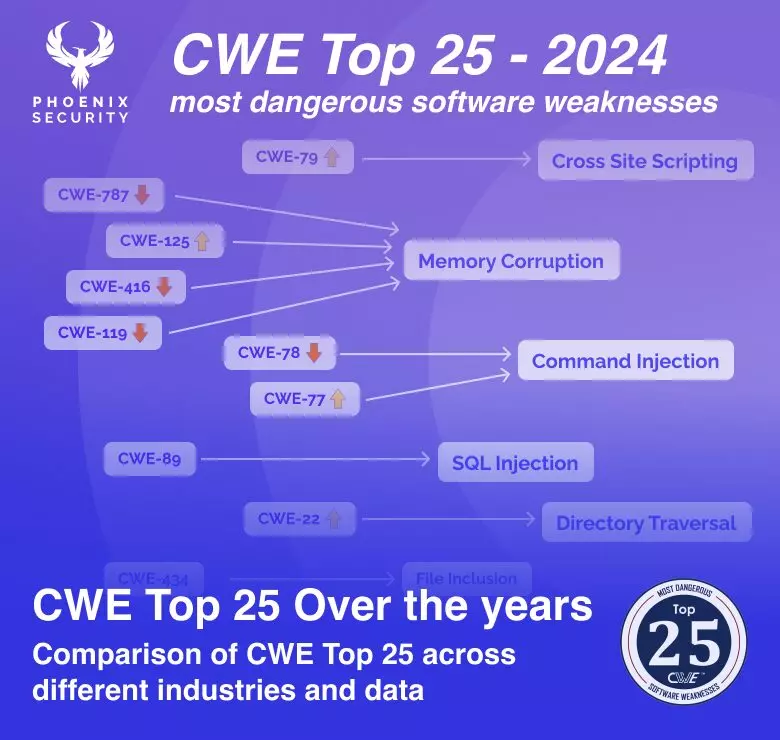
The 2024 CWE Top 25 is out, and it’s no casual stroll through the vulnerability garden—especially when ransomware operators are busy planting path traversal exploits, while bug bounty hunters dig up endless injection flaws. In this blog, we examine the biggest risers, the most surprising dips, and the divergence between real-world exploit data and official CWE rankings. We’ll also reveal how AI-driven ASPM (Application Security Posture Management) and Phoenix Security’s contextual risk-based approach unite to help you focus on your most pressing threats. After all, not all flaws are created equal—some are simply more mischievous than others.
Francesco Cipollone

Resources

Listen to the latest Phoenix Security  podcast

Listen to the latest Phoenix Security podcast

Guides

Get Started with Phoenix Security

News

Read the latest Phoenix Security news

Blog

Read the latest Blogs

Events

Discover our events

Talks

Explore the talks

Whitepapers

Discover Whitepapers

News

Read the latest News

Videos

Discover video resources

Welcome to Peace of Mind

Trusted by more than 1000 users and 380 organizations

Dashboard
Derek

Derek Fisher

Head of product security at a global fintech

Derek Fisher – Head of product security at a global fintech. Speaker, instructor, and author in application security.

Derek is an award winning author of a children’s book series in cybersecurity as well as the author of “The Application Security Handbook.” He is a university instructor at Temple University where he teaches software development security to undergraduate and graduate students. He is a speaker on topics in the cybersecurity space and has led teams, large and small, at organizations in the healthcare and financial industries. He has built and matured information security teams as well as implemented organizational information security strategies to reduce the organizations risk.

Derek got his start in the hardware engineering space where he learned about designing circuits and building assemblies for commercial and military applications. He later pursued a computer science degree in order to advance a career in software development. This is where Derek was introduced to cybersecurity and soon caught the bug. He found a mentor to help him grow in cybersecurity and then pursued a graduate degree in the subject.

Since then Derek has worked in the product security space as an architect and leader. He has led teams to deliver more secure software in organizations from multiple industries. His focus has been to raise the security awareness of the engineering organization while maintaining a practice of secure code development, delivery, and operations.

In his role, Jeevan handles a range of tasks, from architecting security solutions to collaborating with Engineering Leadership to address security vulnerabilities at scale and embed security into the fabric of the organization.

Jeevan Singh

Jeevan Singh

Founder of Manicode Security

Jeevan Singh is the Director of Security Engineering at Rippling, with a background spanning various Engineering and Security leadership roles over the course of his career. He’s dedicated to the integration of security practices into software development, working to create a security-aware culture within organizations and imparting security best practices to the team.
In his role, Jeevan handles a range of tasks, from architecting security solutions to collaborating with Engineering Leadership to address security vulnerabilities at scale and embed security into the fabric of the organization.

James

James Berthoty

Founder of Latio Tech

James Berthoty has over ten years of experience across product and security domains. He founded Latio Tech to help companies find the right security tools for their needs without vendor bias.

christophe

Christophe Parisel

Senior Cloud Security Architect

Senior Cloud Security Architect

Chris

Chris Romeo

Co-Founder
Security Journey

Chris Romeo is a leading voice and thinker in application security, threat modeling, and security champions and the CEO of Devici and General Partner at Kerr Ventures. Chris hosts the award-winning “Application Security Podcast,” “The Security Table,” and “The Threat Modeling Podcast” and is a highly rated industry speaker and trainer, featured at the RSA Conference, the AppSec Village @ DefCon, OWASP Global AppSec, ISC2 Security Congress, InfoSec World and All Day DevOps. Chris founded Security Journey, a security education company, leading to an exit in 2022. Chris was the Chief Security Advocate at Cisco, spreading security knowledge through education and champion programs. Chris has twenty-six years of security experience, holding positions across the gamut, including application security, security engineering, incident response, and various Executive roles. Chris holds the CISSP and CSSLP certifications.

jim

Jim Manico

Founder of Manicode Security

Jim Manico is the founder of Manicode Security, where he trains software developers on secure coding and security engineering. Jim is also the founder of Brakeman Security, Inc. and an investor/advisor for Signal Sciences. He is the author of Iron-Clad Java: Building Secure Web Applications (McGraw-Hill), a frequent speaker on secure software practices, and a member of the JavaOne Rockstar speaker community. Jim is also a volunteer for and former board member of the OWASP foundation.

Join our Mailing list!

Get all the latest news, exclusive deals, and feature updates.

The IKIGAI concept
Protected By
Shield Security PRO