

Join our Mailing list!
Get all the latest news, exclusive deals, and feature updates.
Phoenix Research · Intelligent Crawlers · Threat-Centric Scoring
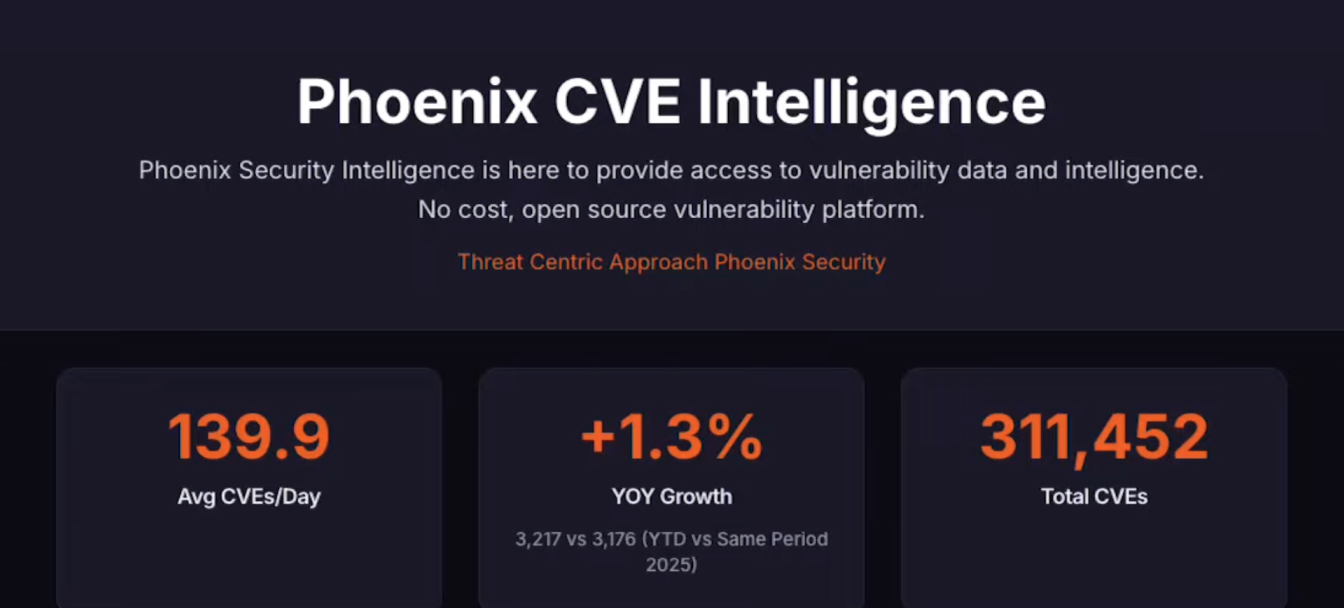
311,452 CVEs. One question that matters: which ones are actually coming for you? Phoenix tracks exploitation velocity, blast radius, and attacker behaviour — so your team works the right list, not the longest one.
In 2018 you had a year to respond after a CVE dropped. Today the median is under a week — and 67.2% of exploited vulnerabilities get weaponized before a patch even exists. By the time CISA adds something to KEV, attackers have usually been running it for days.
Disclosure to exploitation, on average.
Zero-days: 16.1% of all exploited CVEs.
Median time to exploitation now.
Zero-days: 67.2% of all exploited CVEs.
CVSS 9.8. Niche library. No external exposure. No exploit code anywhere. But it's "critical" — so the team drops everything to patch it. This is how backlogs pile up and engineers burn out. The score is high. The risk is not.
VPN gateway. Low EPSS score at disclosure. Nobody panics. Six weeks later it's in every ransomware playbook. High blast radius, no public exploit yet — exactly the gap attackers count on. Most tools miss this entirely.
Phoenix scores every CVE on a 0–100 composite: exploitation evidence (CISA/VulnCheck KEV, mass-scan telemetry, ransomware links) weighted at 30%, blast radius in your specific environment at 12%, plus likelihood and speed pressure. A CVSS 10.0 with no attacker interest scores ~16. A VPN vulnerability with confirmed exploitation and high blast radius goes straight to Tier 1 — patch in 24–48 hours.
For the 37% of high-blast-radius CVEs that don't have exploitation evidence yet, Phoenix builds a watchlist with predicted exploitation timing. You get ahead of the attack, not behind it.
Each area has its own scoring model. Product CVEs behave differently from open-source dependencies. Zero-days need different signal than known exploits. Phoenix handles all four without treating them the same.
CVEs in your product inventory, scored against active exploitation data. EOL flags surface before the software becomes a permanently unpatched entry point.
Open-source vulnerabilities spread through dependency trees, not single products. Phoenix uses OpenSSF Criticality Score and tracks packages that keep getting compromised.
67.2% of exploited CVEs get used before a patch drops. The Exploit Acceleration Index measures how fast exploitation is spreading across internet telemetry — and escalates automatically.
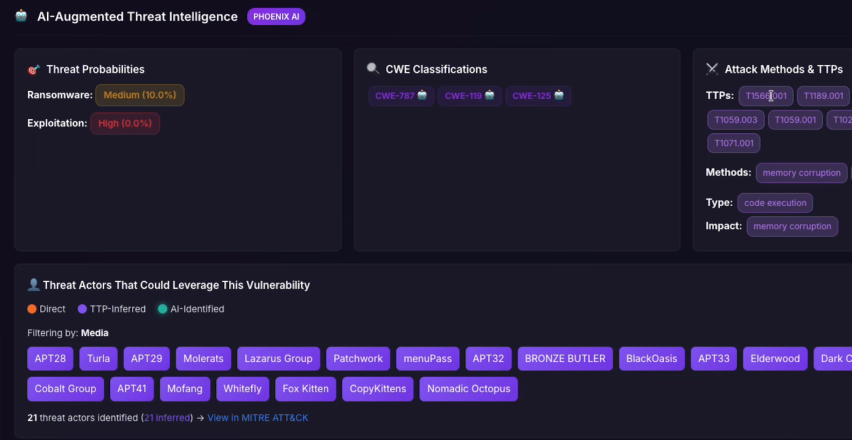
Volerion AI re-scores every CVE beyond static CVSS. VulnCheck KEV and Shadowserver telemetry feed the evidence layer. The result updates continuously — not once per scan cycle.
Open access for security practitioners before you commit to Phoenix. Explore the data, run your CVEs, see how the scoring works.
The full breakdown of how Phoenix applies LLMs to vulnerability scoring — moving past EPSS and scaling to CVE volumes that human analysts can't cover.
Download WhitepaperCVSS tells you how bad a vulnerability could be in the worst-case scenario. It says nothing about whether anyone is actually exploiting it, whether your infrastructure is in the blast radius, or how fast the situation is moving.
This paper walks through what Phoenix measures instead — and why the difference matters when your team has to decide what to fix this week.
Phoenix Blue is open for pre-registration. Security practitioners, researchers, and engineering leaders get first access — no sales call required.
Access granted on a rolling basis.
Leave your details. We'll send credentials when your spot is ready.
We'll send credentials when your spot is ready.
Derek Fisher – Head of product security at a global fintech. Speaker, instructor, and author in application security.
Derek is an award winning author of a children’s book series in cybersecurity as well as the author of “The Application Security Handbook.” He is a university instructor at Temple University where he teaches software development security to undergraduate and graduate students. He is a speaker on topics in the cybersecurity space and has led teams, large and small, at organizations in the healthcare and financial industries. He has built and matured information security teams as well as implemented organizational information security strategies to reduce the organizations risk.
Derek got his start in the hardware engineering space where he learned about designing circuits and building assemblies for commercial and military applications. He later pursued a computer science degree in order to advance a career in software development. This is where Derek was introduced to cybersecurity and soon caught the bug. He found a mentor to help him grow in cybersecurity and then pursued a graduate degree in the subject.
Since then Derek has worked in the product security space as an architect and leader. He has led teams to deliver more secure software in organizations from multiple industries. His focus has been to raise the security awareness of the engineering organization while maintaining a practice of secure code development, delivery, and operations.
In his role, Jeevan handles a range of tasks, from architecting security solutions to collaborating with Engineering Leadership to address security vulnerabilities at scale and embed security into the fabric of the organization.
Jeevan Singh is the Director of Security Engineering at Rippling, with a background spanning various Engineering and Security leadership roles over the course of his career. He’s dedicated to the integration of security practices into software development, working to create a security-aware culture within organizations and imparting security best practices to the team.
In his role, Jeevan handles a range of tasks, from architecting security solutions to collaborating with Engineering Leadership to address security vulnerabilities at scale and embed security into the fabric of the organization.
James Berthoty has over ten years of experience across product and security domains. He founded Latio Tech to help companies find the right security tools for their needs without vendor bias.
Chris Romeo is a leading voice and thinker in application security, threat modeling, and security champions and the CEO of Devici and General Partner at Kerr Ventures. Chris hosts the award-winning “Application Security Podcast,” “The Security Table,” and “The Threat Modeling Podcast” and is a highly rated industry speaker and trainer, featured at the RSA Conference, the AppSec Village @ DefCon, OWASP Global AppSec, ISC2 Security Congress, InfoSec World and All Day DevOps. Chris founded Security Journey, a security education company, leading to an exit in 2022. Chris was the Chief Security Advocate at Cisco, spreading security knowledge through education and champion programs. Chris has twenty-six years of security experience, holding positions across the gamut, including application security, security engineering, incident response, and various Executive roles. Chris holds the CISSP and CSSLP certifications.
Jim Manico is the founder of Manicode Security, where he trains software developers on secure coding and security engineering. Jim is also the founder of Brakeman Security, Inc. and an investor/advisor for Signal Sciences. He is the author of Iron-Clad Java: Building Secure Web Applications (McGraw-Hill), a frequent speaker on secure software practices, and a member of the JavaOne Rockstar speaker community. Jim is also a volunteer for and former board member of the OWASP foundation.
Get all the latest news, exclusive deals, and feature updates.