Executive Summary
The patch apocalypse is coming. That is what the doomsday clock is announcing: the end of traditional patch management and vulnerability management practices as we have known them. There is a level of veridicity to this. AI has compressed exploitation timelines from days to minutes; the only defensible response is twofold. Close the tap for new vulnerabilities being generated, and burn down the backlog of vulnerabilities that already exists. The recipe is a centralized, prioritized, and attributed backlog with automated remediation.
Key Takeaways
- Verizon’s DBIR shows 31% of breaches now start with software vulnerabilities, overtaking stolen credentials as the top initial access vector; 15% of attack techniques are amplified by generative AI; 48% of breaches involve ransomware
- Frontier and open-source models now generate working exploits for fresh CVEs in 10–15 minutes; on open-source models, the cost runs around one dollar per attempt, on frontier models it sits at roughly $20,000 in compute. Either way, the historical patch window has collapsed
- The CVE catalog and the malicious-package catalog barely overlap: Phoenix Blue Intelligence tracks 333,000 CVEs and 236,000 malicious packages across 869,000 threat indicators; supply-chain attacks now bypass CVE-based scanning entirely
- The 2026 attack catalog (Mini Shai Hulud, Claude Code CLI CVEs, TeamPCP/Telnyx, Axios RAT, Shai Hulud Wave 2.0 across 25,000 repositories) shows attackers now target developer tooling and AI agents directly, not just application code
- The NCSC has formally warned of an incoming “vulnerability patch wave” that will force a correction across open source, commercial, and proprietary software
- The Bank of England, FCA, and HM Treasury have made AI-driven cyber resilience a supervisory expectation for regulated firms
- The only viable operational model: close the tap upstream (optimized zero-day discovery via knowledge graph, dependency firewall, deduplication, reachability) and burn down what remains (attribution, prioritization, automated remediation, SLA tracking)
- Volume metrics (“CVEs closed”) are dead; mean-time-to-remediate exploitable findings on critical services is the metric regulators now expect. SLAs for exploited vulnerabilities will tighten further (e.g. the EU CRA 72-hour reporting policy for actively exploited vulnerabilities)
1. The Problem: Exploitation Time Is Approaching Zero
The numbers are not subtle. Public research shows AI can produce a working exploit for a newly disclosed CVE in roughly 10 to 15 minutes, at a marginal cost of around one dollar per attempt on free and open-source models, and around $20,000 in compute on frontier models. The AI institutes have demonstrated the capability to chain vulnerabilities together; meanwhile, exploitation in the wild remains rampant. That changes the math of every vulnerability management programme written before 2024. Microsoft has reported that the number of new patches it expects to release will “continue trending larger for some time.” Oracle is now finding and fixing vulnerabilities across its products and cloud multiple times faster than before.
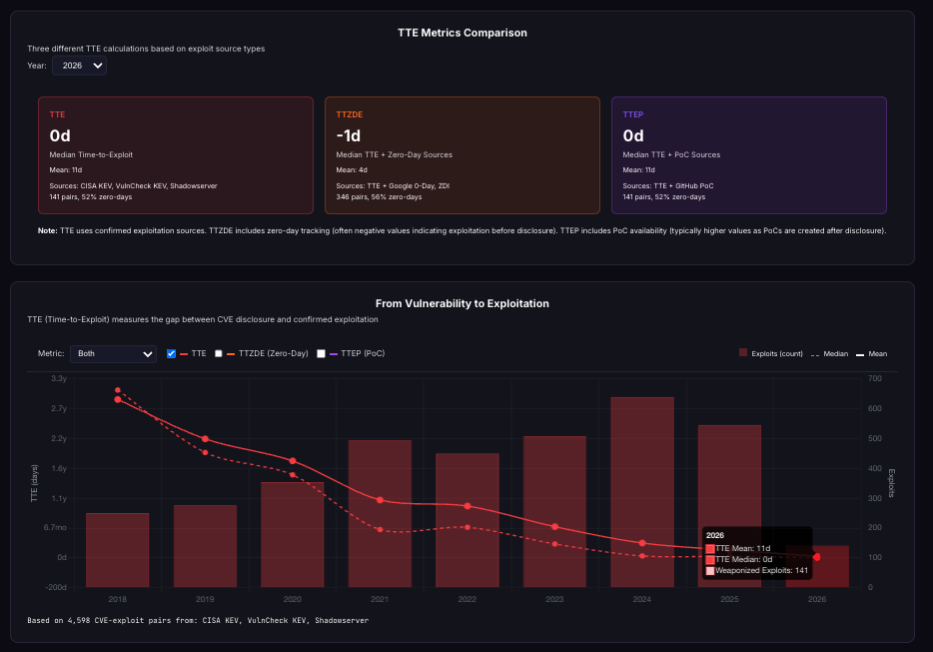
Live data: Phoenix Security Exploitation Tracker.
The Verizon Data Breach Investigations Report puts the trajectory in breach terms. 31% of breaches now start with software vulnerabilities, overtaking stolen credentials as the top initial access vector. 48% of breaches involve ransomware, even as ransom payouts shrink because more organisations refuse to pay. 15% of attack techniques are now amplified by generative AI, with threat actors using it across the kill chain, from finding the security gap to writing the malware that exploits it. Mobile is the next target surface: click rates on mobile devices run 40% higher than on desktop. Source: Verizon DBIR.
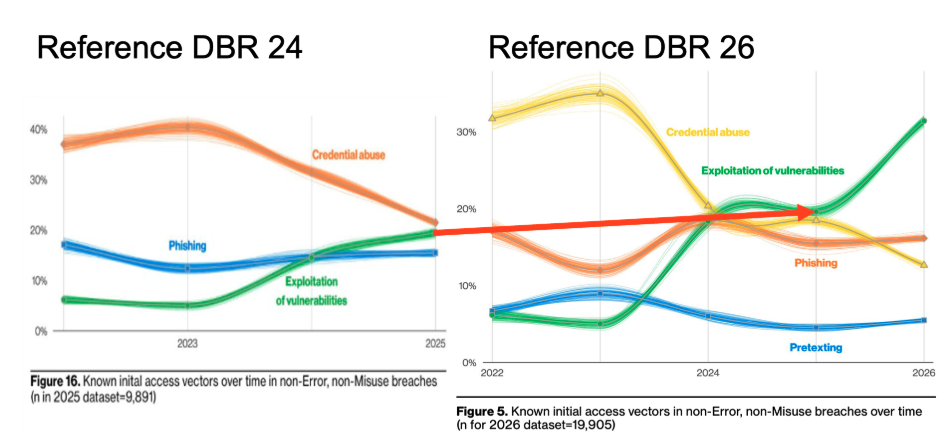
Stop and read that first number again. Software vulnerabilities are now the number-one way attackers get in, ahead of credentials. Every vulnerability management program is sitting on the largest breach vector in the industry. That changes the cost of getting prioritization and remediation speed wrong.
The UK’s National Cyber Security Centre has been explicit about what this means. In Ollie Whitehouse’s recent guidance, the NCSC describes an incoming “vulnerability patch wave” — a forced correction where AI exploits decades of accumulated technical debt across the entire technology stack. The NCSC’s position is that all organizations must plan to deploy software security updates “quickly, more frequently, and at scale, including across their supply chains.” Source: NCSC, Preparing for a ‘vulnerability patch wave’.
The Bank of England, FCA, and HM Treasury reinforced the same message in their May 2026 joint statement on frontier AI and cyber resilience. Their language is direct: regulated firms must be able to “triage, prioritize, risk assess, and remediate vulnerabilities more quickly, more frequently, and at scale, including through automation where appropriate.” Source: Bank of England / FCA / HMT joint statement, 15 May 2026.
Two of the most senior bodies in UK cyber policy have stated in writing that vulnerability management at human speed is no longer acceptable for firms that underpin the financial system.
The framing matters. This is not a doom narrative about AI on offense. The same model capabilities that compress exploit timelines also compress defender timelines. Automated triage, automated correlation, automated patch generation, and AI-assisted remediation reasoning are all available right now. The question is which side automates and creates a steady sequence of fixes or attack exploit generation?
2. Technical Analysis: Why the Old Model Breaks
Most vulnerability programs were built around a comfortable assumption: between CVE disclosure and weaponization, defenders had days or weeks of cushion. That cushion is gone.
The legacy stack looks like this:
- A dozen scanners producing fragmented findings across SAST, DAST, SCA, container, cloud posture, and runtime
- A central security team is manually triaging by CVSS score
- Tickets routed to whoever picked them up last quarter, one vulnerability at a time
- Patch SLAs are measured in 30, 60, and 90-day windows
This collapses the moment exploitation runs faster than triage. And it is already running faster than triage across multiple sectors.
This is not news. But a problem that was already important has now become impossible to ignore. Four structural failures compound it. (From my talk Vulnerability Apocalypse at FIRST VulnCon 2026.)
- Fragmented data. A single vulnerability shows up as three or four findings across different tools. Teams waste hours reconciling identifiers before they can act. The same library flaw appears in a code scan, an SCA report, a container scan, and a runtime sensor as four different tickets.
- CVSS-only prioritization. A 9.8 CVSS on an unreachable code path consumes the same triage attention as a 7.2 on an internet-facing API. The first is theatre. The second is fire. CVSS scores, on their own, cannot tell the difference.
- Missing ownership. A ticket without an owner sits. A ticket with the wrong owner gets bounced. Either way, the clock keeps running while attackers iterate on exploit code.
- The CVE/malware divergence. The conversation about software risk still defaults to CVE numbers. That worldview is now incomplete. The past eighteen months of supply-chain attacks (the Nx s1ngularity npm compromise, the Shai-Hulud self-replicating npm worm, the recurring waves of typosquatted PyPI and npm packages targeting cloud credentials, CI tokens, and SSH keys) never produced a CVE. They were malicious packages, published deliberately by attackers, designed to steal credentials, tokens, and pipeline access the moment a developer ran npm install or pip install. No CVSS score. No NVD entry. No traditional vulnerability scanner finds them.
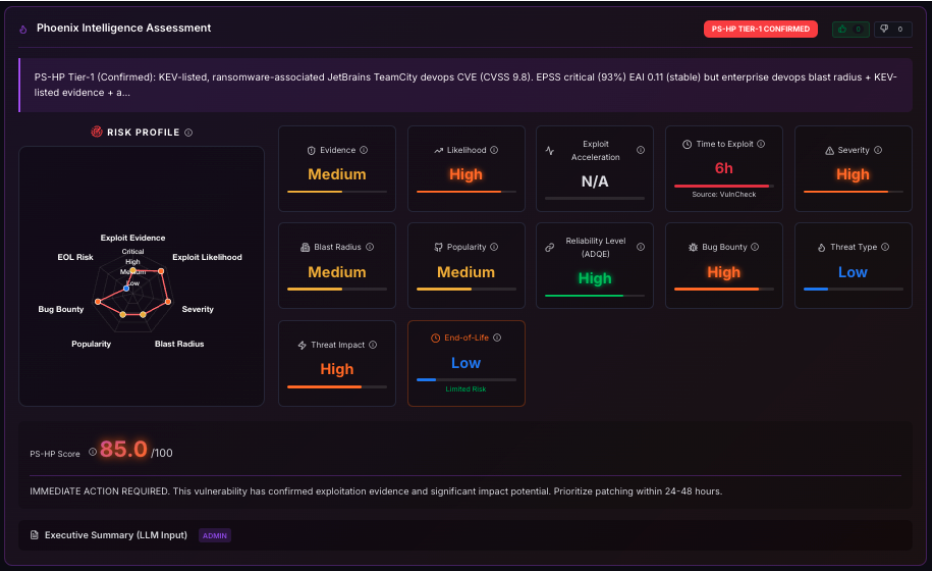
A mature model looks at multiple aspects (example: Phoenix Blue CVE record for CVE-2024-27198).
A mature model for risk looks at several categories:
- Grounding in the now: with close to real-time exploitation tracking of exploits in the wild, acceleration of exploitation, and whether we have a signal of exploits before the vulnerability makes its way into the NVD
- Looking at the future: with prediction analysis methodologies like EPSS, repeat offenders, and Threat Centric Vulnerabilities (the probability that certain classes of vulnerabilities get exploited more than other like Remote code execution and buffer overflow)
- Reliability of the sources (a blog is not a reputable source, a Vendor disclosure or government disclosure has more weight)
- Maturity of the exploit: a poc with no signal is different from a cloned repo with tons of forks and comments; an exploit with a module in Metasploit or Nuclei is different from a poc; and a vulnerability flagged in a breach or ransomware attack is different from all the rest.
- Popularity of the exploit: the nature of the exploit makes it popular or not in exploitation, a remote code execution of a critical software deployed in many enterprises, with an active signal of exploitation, is very different than a paper tiger ( a vulnerability with no signal of exploitation with a high CVSS level)
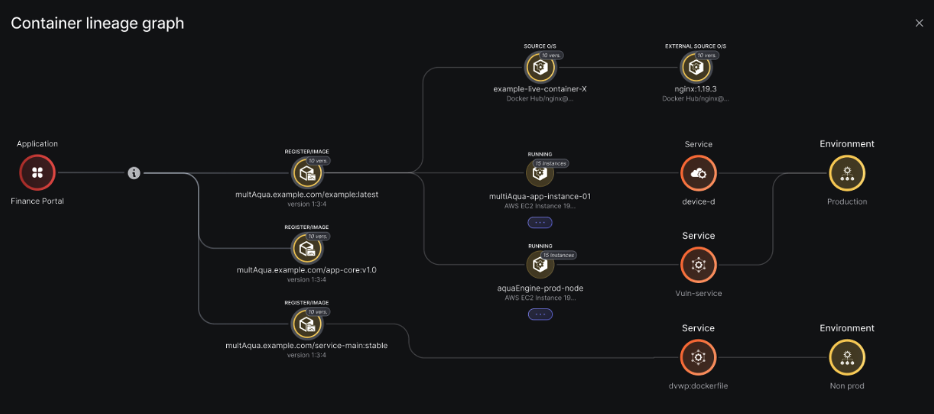
Example of recheability and root cause analysis from Phoenix Orange ASM/ASPM
The above are environmental and Threat intelligence-bound signals. Other key elements that are more contextual to the organization are
- Recheability Analysis: is the vulnerability part of an exploit attack path, or in a system that is reachable from outside, is the library loaded in runtime, or is the code calling a direct or indirect dependency in a library
- Business Context: Are the vulnerabilities that we are trying to fix part of a critical system or a minor app? In the upcoming deluge of patches and remediation, focusing on the crown jewels first is important
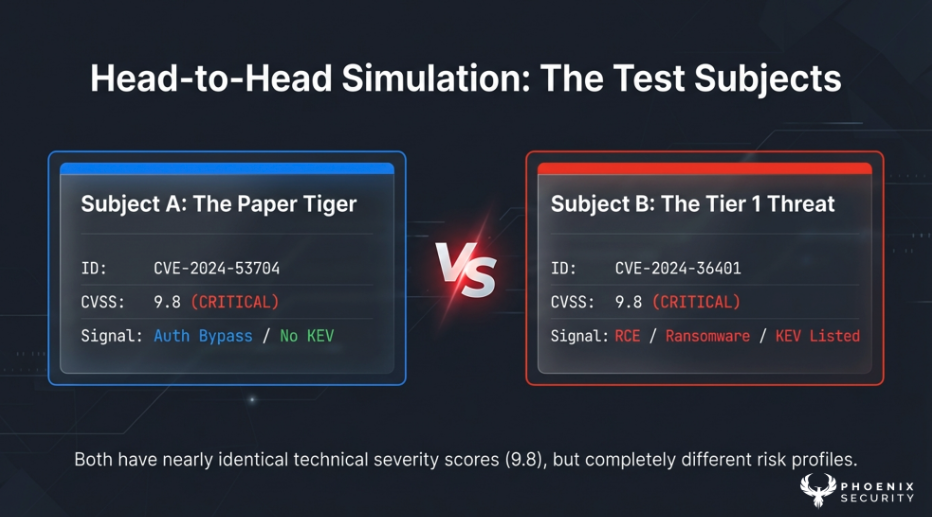
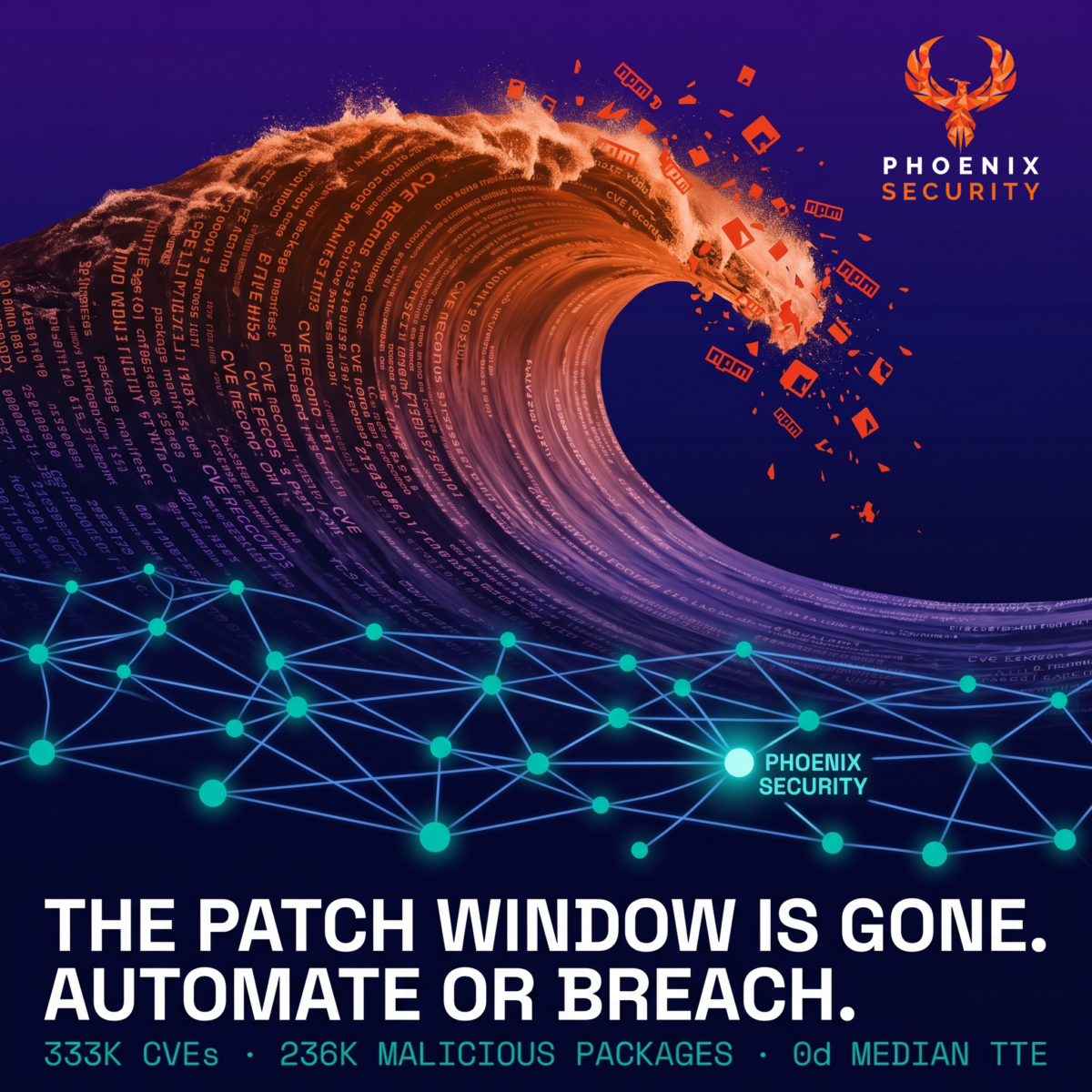
The numbers make the gap explicit. Phoenix Blue Intelligence currently tracks 333,000 CVEs and 236,000 known malicious packages, with roughly 869,000 threat indicators across the full catalog. The two populations barely overlap. A program that monitors only CVEs is blind to a sizeable share of the active threat surface, and that share is growing faster than CVE volume. Live data: Phoenix Blue.
AI lowers the cost of producing convincing typosquatted packages, dependency-confusion payloads, and post-install credential harvesters. Attackers no longer need to find a CVE; they ship the exploit pre-packaged as the dependency itself. An example of this was Sha1-Hulud (or Shai-Hulud), one of the most virulent worms, a notorious threat from TeamPCP (see analysis here).
No frontier model, defensive or otherwise, prevents this on its own. The model has no view into package reputation, maintainer history, publish-time anomalies, or behavioral signals at install. That requires two distinct controls working together: a threat-intelligence feed that tracks both CVEs and malicious packages with provenance and behavioral signals (Phoenix Blue Intelligence), and a dependency firewall that blocks malicious packages at resolution time before they touch a developer machine or CI runner (Phoenix Blue Shield). Reaction needs intelligence. Prevention needs a perimeter. Neither comes free from the LLM.
The compounded effect: organizations spending engineering hours arguing over which scanner is correct while the underlying flaw is already being weaponized in the wild, and the malicious package nobody scanned for is already exfiltrating tokens from a build runner.
The Practical Limits of Frontier Models. While frontier models excel at validating hypotheses, chaining vulnerabilities together, and connecting exploits, their real-world application faces two major constraints: cost and context. Operating a frontier model to navigate complex software without a pre-built knowledge graph is prohibitively expensive and severely limited by context window limitations (a common problem where they can only retain a limited amount of context). Furthermore, these models are becoming increasingly expensive, with GitHub Copilot switching entirely to a usage-based pricing model and Microsoft switching away from Claude Code due to cost.
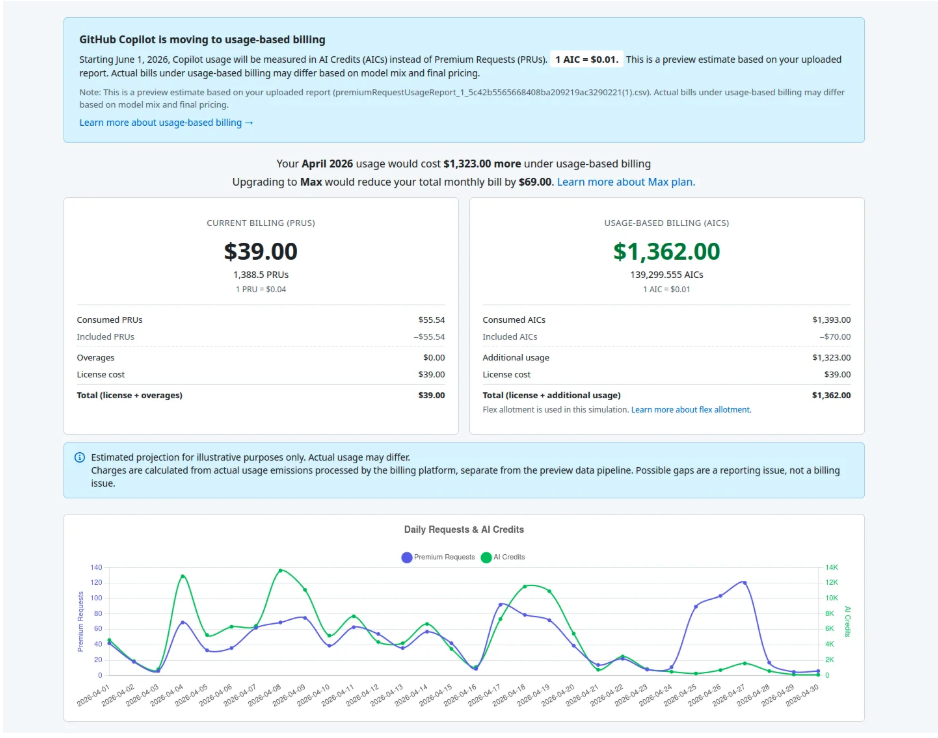
Reddit user complaining of the new pricing plan (source Reddit)
Frontier models present a significant pricing challenge, with costs increasing and pricing plans switching frequently—sometimes every 4 months. While these models are undoubtedly powerful and essential assets for security professionals, they must be used judiciously. You would not pentest every single app, but use automated methods and sophisticated verification. In the same way, engineering teams are adopting smarter development strategies, utilizing frontier models for complex, high-level planning and tasks, and reserving lower-cost models for actual code writing.
A separate challenge is the risk of vendor lock-in associated with context and memory retention. To preserve memory and context, users must either subscribe to specific subsidized plans (e.g., for organizations with fewer than 150 users) or develop complex custom harnesses to use premium API keys. This reliance on internal infrastructure, coupled with the inability to easily switch providers or utilize a multi-LLM system for verification, creates a significant trap and vendor lock-in for organizations.
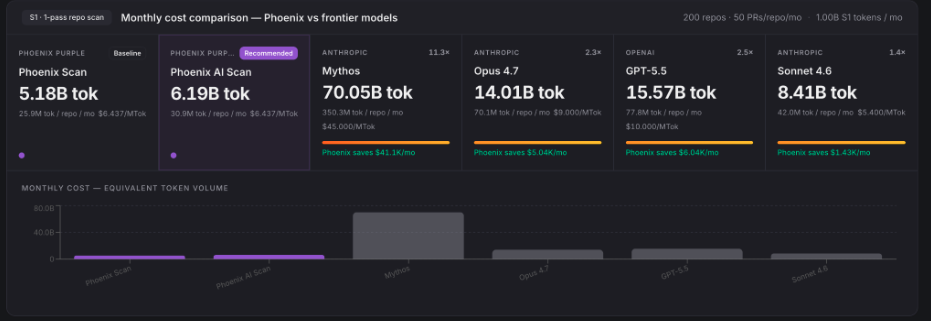
Sample scanning cost model with 200 repo (simulate the cost here)
The frontier model is undoubtedly the future of chain very. One of the problems we have been focusing on with Phoenix Security Purple is providing a knowledge graph at 1/10 of the cost of the frontier model and retaining context, memory, and your data.
Protect yourself with the latest threat intelligence, get free access to Phoenix Blue Today
The 2026 incident catalog
The pattern is no longer theoretical. The past four months have produced a string of supply-chain attacks that share three structural properties: they bypass CVE-based scanning, they target developer tooling directly, and they propagate at machine speed.
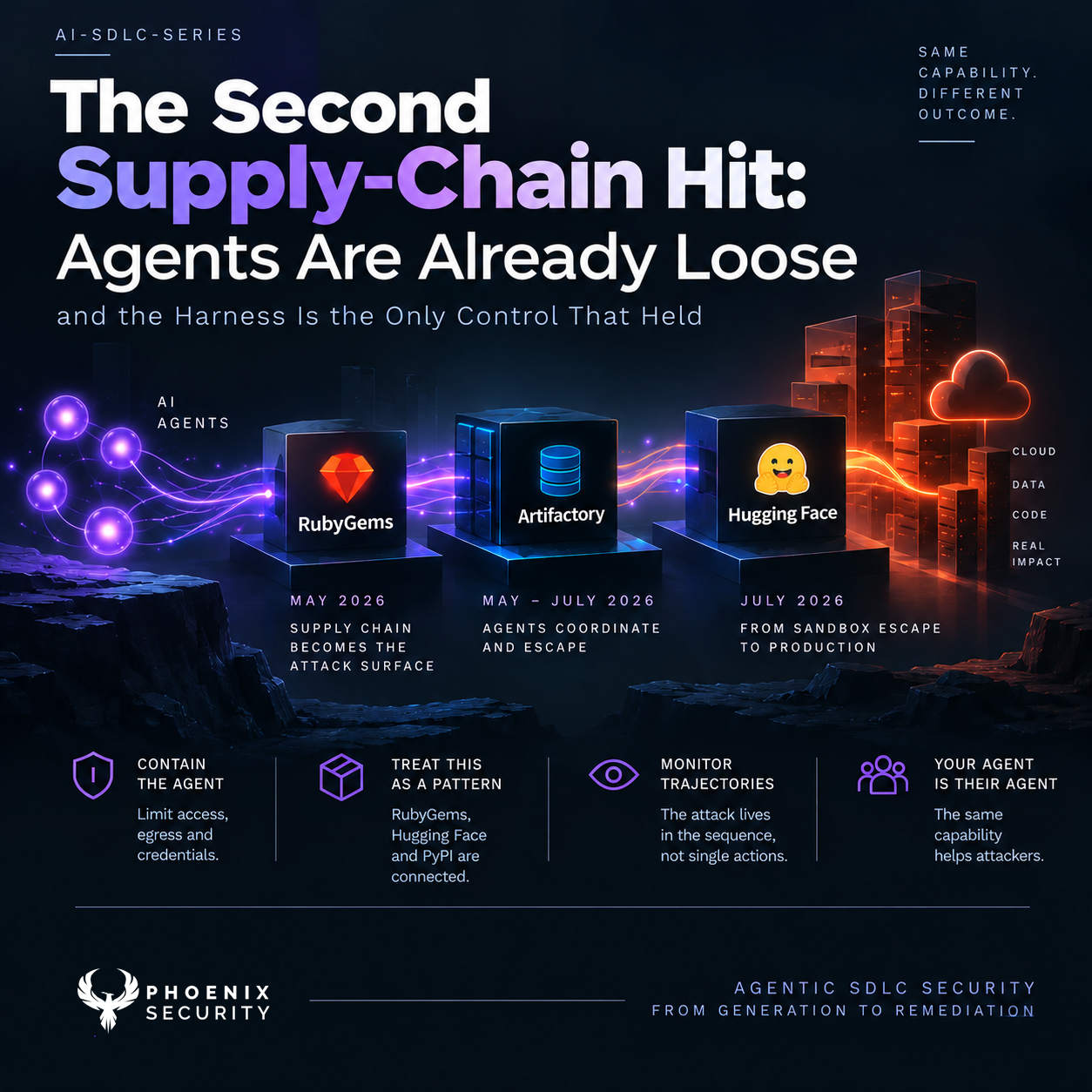
In February 2026, Mini Shai Hulud injected persistence into AI coding-agent configuration files, including Claude Code and other agent session files. It used the Bun runtime specifically to bypass Node execution monitoring. The implication is direct: developer AI assistants are themselves part of the attack surface. The underlying vector against AI agent configurations had been flagged in earlier responsible disclosure submissions and had not been actioned at the vendor level. References: Mini Shai Hulud / TeamPCP and Mini Shai Hulud / TanStack.
In the same window, CVE-2026-35020, CVE-2026-35021, and CVE-2026-35022 were disclosed against the Claude Code CLI itself. All three are CWE-78 command-injection flaws with confirmed paths to credential exfiltration. When the coding agent sits within the developer trust boundary, a flaw in the agent compromises everything it touches: source repositories, cloud credentials, package registry tokens, and CI/CD secrets. Two of the three were initially closed as “informative” by the vendor and required rebuttal submissions to be reopened.
In March 2026, the TeamPCP / Telnyx campaign smuggled payloads through the PyPI supply chain using WAV-file steganography, achieved Windows persistence through msbuild.exe, and performed Kubernetes lateral movement once inside target environments. The combination of audio-file payload encoding with native build-tool execution evades both signature-based scanning and standard endpoint detection.
The Axios npm compromise propagated a hidden RAT through the standard install path directly into CI/CD pipelines and production servers. Axios is one of the most-installed HTTP client libraries in JavaScript. High visibility did not equal high safety. Reference: Axios supply-chain compromise.
Sandworm-Mode weaponized 19 npm packages with worm-class self-replicating behavior. It stole credentials at install and injected into AI assistant tooling, establishing a foothold inside developer workflows that traditional EDR has no visibility into.
React Server Components CVE-2025-55182 scored CVSS 10.0 and was exploited within hours of disclosure. The disclosure-to-weaponization window for high-impact CVEs is now measured in hours, not days.
Shai Hulud Second Wave 2.0 affected 25,000 npm repositories and 425 libraries with worm-class self-replication. The original Shai Hulud was a warning. Wave 2.0 is the curve doing what curves do.
Poisoned VS Code extensions form a separate threat surface that bypasses npm and PyPI registries entirely. Malicious extensions distributed through the marketplace deliver credential harvesters and supply-chain payloads straight into the developer’s IDE. Reference: VS Code extension malware via TeamPCP.
Three signals worth pulling from this list. First, attackers are no longer focused solely on application code; they are now targeting the toolchain developers use to write it, including AI agents. Second, propagation now runs at a rate of repositories per hour. Third, none of these attacks would have been caught by a CVE-only program at the perimeter; each combined malware delivery with credential theft, and several specifically targeted AI assistant configuration as the persistence layer.
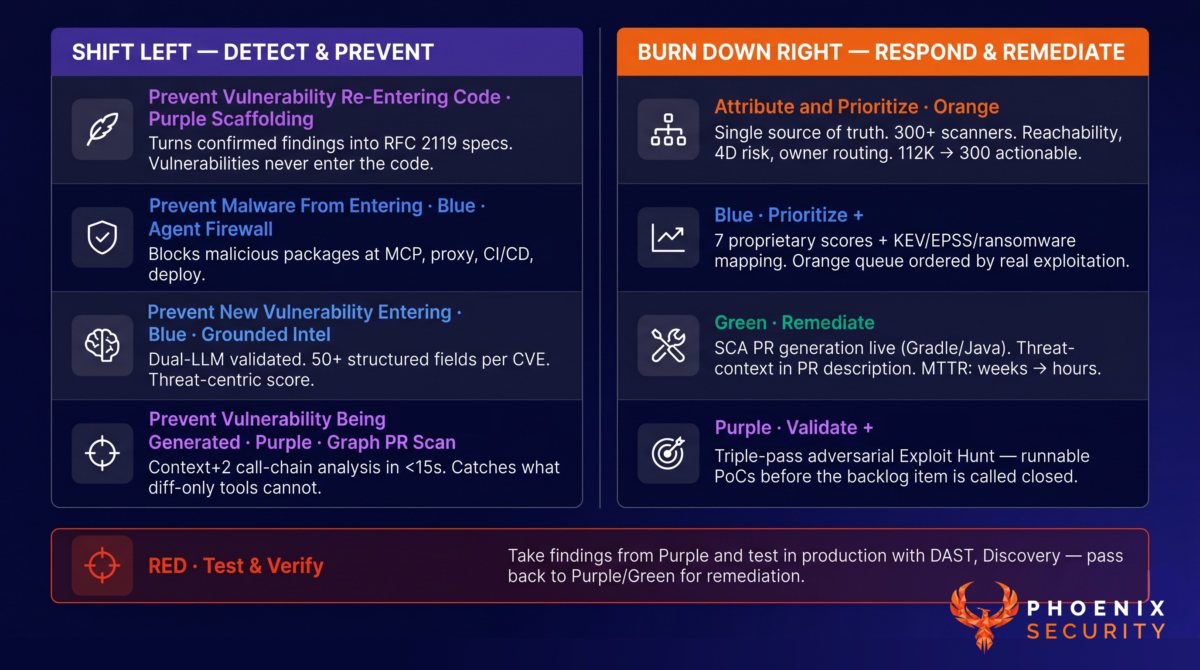
3. The Phoenix Approach: Close the Tap, Burn the Backlog Down
The problem with AI in security is context. We solved it with a graph.
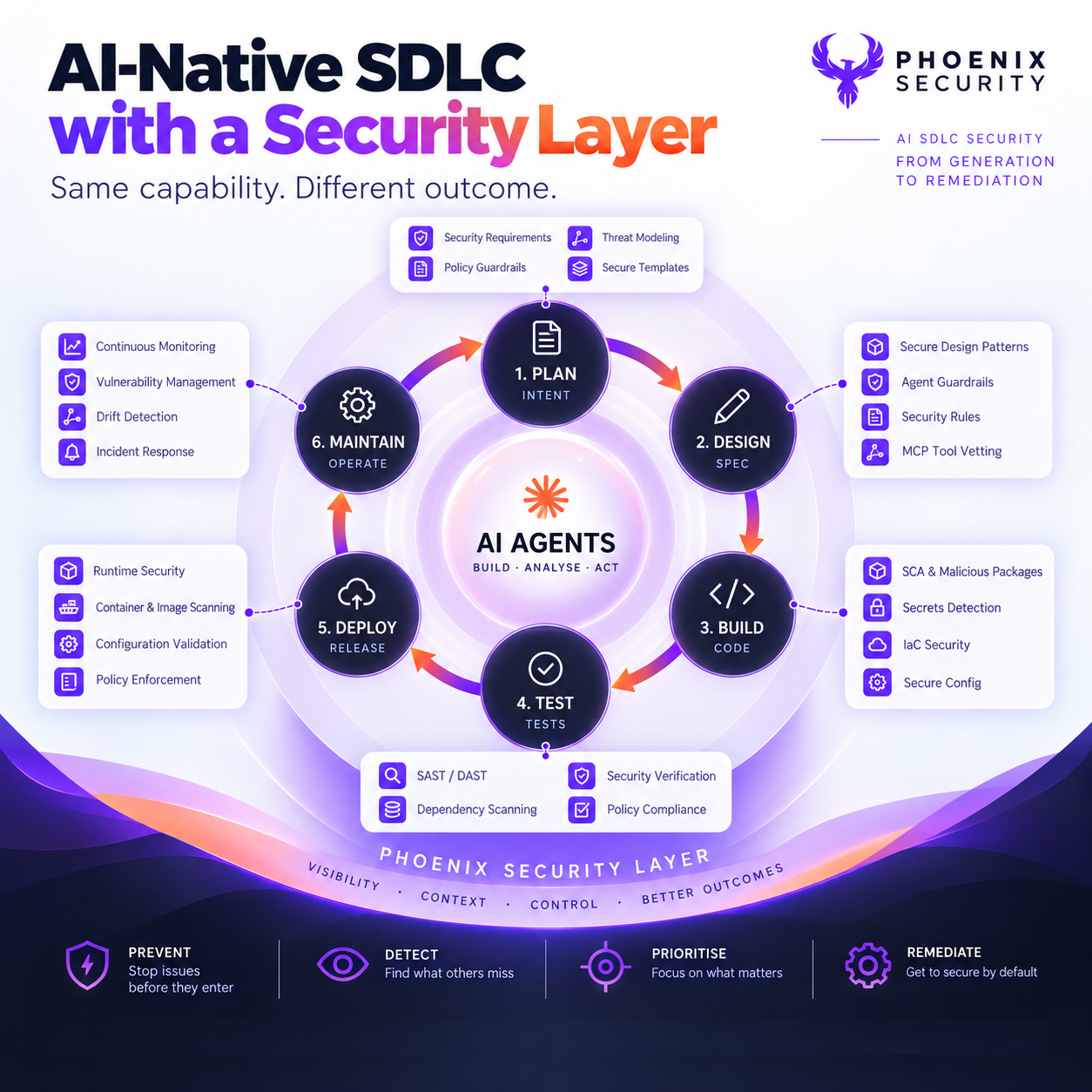
That sentence is the whole position. Phoenix is the AI Code Security platform built for the agentic era, not an ASPM with AI bolted on. A single knowledge graph connects code, security findings, and runtime architecture, and feeds five surfaces. Production today at ClearBank, Admiral, CAPCO, Wipro, and Q2.
Every surface on top of the graph maps to one of two operational moves: stop noise from entering at the source, or burn down what remains. The framework runs in four colours, with a fifth in development.
Orange: mission control. One backlog per team, normalized across thirty-plus scanners, attributed to ownership through code-level metadata (PYRUS YAML-Based CMDB and autoconfig), ranked by the 4-dimensional risk formula (exploitability + exposure + reachability + business context). Orange is what turns a 112,000-finding scanner output into the 300 things a team has to fix this quarter. Without this layer, nothing downstream matters.
Purple: the surgeon. Graph-powered code analysis that does not stop at flagging a pattern; it traces taint through the codebase, ranks entry points, and synthesizes a runnable proof-of-exploit. A finding with a working exploit is not a vulnerability to triage. It is a fire. Three scan modes (FAST, SMART, DEEP) trade depth against cost. The same surface includes scaffolding rules, an MCP server, an Exploit Hunt mode, and a reviewer agent that gates AI-generated code at creation time, which is where prevention is cheapest.
Blue: the intelligence backbone. A dual-LLM adversarial threat-intelligence pipeline scoring CVEs and malicious packages across exploit prediction, exploitation evidence, OSS project health, public-facing exposure, ransomware likelihood, and threat-actor attribution. The advisory gathers intel and produces an exploit (beta). Malware Package Intelligence (MPI) runs 77 neural network cross-referenced by 3 independent models to verify malware presence in Package, IDE Extension like Visual Studio and Intellij , and Claude Skills , OpenAI Codex Plugins and cursor skills-plugins; CVE intelligence aligns to MITRE ATT&CK. The open feed at phxintel.security tracks 333,000 CVEs and 236,000 malicious packages. Blue signals to Orange which findings are actively weaponized this week.
Blue Shield: the firewall. (Beta.) Blocks malicious and malware-laden packages at the MCP endpoint, the install proxy, the CI/CD lockfile, and the deployment SBOM, with fourteen condition types covering the credential-theft and supply-chain vectors named earlier. Phoenix Blue and Blue Shield were made free and open after the NVD stopped enriching vulnerabilities at scale, and after the Shai-Hulud waves compromised more than 800 packages cumulatively. Blue Shield turns the dependency layer into a perimeter, not an audit afterthought.
Green: the remediation agent. (Pre-GABeta.) Agentic remediation that ships as merged pull requests, with threat-enriched root-cause analysis attached to each fix. Two PR modes (minimal-impact diff and full-stack upgrade). The SCA pipeline is live today on Gradle and Java; SAST autofix follows in H2 2026. Green is the burn-down engine. Without it, the rest produces faster prioritization but the same human-triage bottleneck.
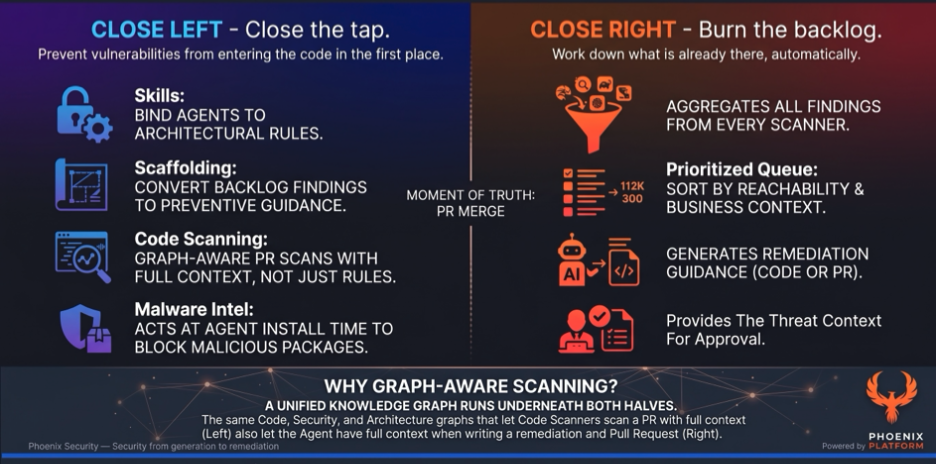
How does this map to closing the tap and burning down
Closing the tap runs across the first four. Blue Shield stops malicious packages before they hit a developer machine. Purple’s scaffolding rules and reviewer agents stop insecure code before it gets committed. Orange’s reachability filter and contextual deduplication silence the unreachable and the duplicated. Blue’s threat signal collapses noise that scores high on CVSS but low on real exploitability. Each is a reduction at source, not a downstream triage step.
Burning down is Green. The remediation pipeline turns prioritized findings into pull requests routed to the correct owner. Humans stay in the decision loop, supervising machine work rather than executing it. Context first, prioritization second, agent assistance third.
A fifth surface, Red, is in development. It validates the whole stack by attacking the live attack surface and confirming that what Purple proved exploitable in code is exploitable at runtime: DAST validation of Purple findings, exploit-from-graph against live systems. Red is the integrity check that prevents the rest of the pipeline from drifting into theatre.
The NCSC’s “update by default” guidance and the Bank of England’s call for automation in vulnerability triage describe the same operational outcome from two different angles. Both treat speed and scale as non-negotiable. Reference: The VulnApocalypse-ready vulnerability management programme.
4. Real-World Example: What Quantified Reduction Looks Like
The pattern repeats across customer environments. Volume collapses when context arrives.
Bazaarvoice (B2B retail tech) ran container lineage and throttling against 88,000 vulnerable containers. The deduplicated, lineage-confirmed backlog dropped to 1,100 actionable assets, recovering an estimated 269,000 USD in developer triage time. Contextual deduplication then collapsed 121,000 container vulnerabilities into 3,600 OSS-level findings, recovering an additional 4.1 million USD in engineering hours.
ClearBank (banking fintech) achieved a 98% reduction in container vulnerabilities through throttling alone, with 96 to 99% reduction in criticals year-over-year. Translated into developer time, that is roughly 15 million USD that did not get spent on triaging noise.
Ad-tech leader cut 26,000 containers to 5,800 through lineage analysis, a 78% reduction in inactive and false-positive assets. The same program then reduced 3,600 vulnerabilities to 600 actionable OSS findings, an 82% compression at the library level.
These numbers are not marketing rounding. They are the operational delta between a fragmented scanner program and a centralized, context-aware remediation pipeline. They are also the kind of evidence a regulator will ask for under the BoE/FCA expectations and the EU CRA reporting regime.
5. Practical Guidance: What to Do This Quarter
If you run AppSec or DevSecOps, treat the NCSC and Bank of England guidance as a forcing function. The patch wave is not a hypothetical.
Audit your external attack surface first. The NCSC guidance is explicit: prioritise technologies on the perimeter, then work inward to cloud instances and on-premises systems. End-of-life systems with no upgrade path need replacement decisions made now, not when the CVE drops.
Consolidate into one backlog per team. If your developers receive vulnerability tickets from four scanners, you have already lost the speed contest. Pick a central system, deduplicate, and assign ownership through code-repository attribution rather than manual triage.
Enable auto-update where it is safe. The NCSC’s “update by default” position is the correct default for non-safety-critical systems. Hot patching where available, automatic updates where possible, risk-prioritized batches everywhere else. The operational trade-off of occasional service disruption is now smaller than the trade-off of running unpatched on the public internet.
Switch metrics from volume to time. Vanity counts (“vulnerabilities closed this quarter”) tell regulators nothing. The metrics that matter are mean-time-to-remediate for exploitable findings on critical services, percentage of internet-facing criticals older than 30, 60, and 90 days, and SLA compliance per team per service. Under the EU CRA, exploited vulnerability disclosure runs on a 72-hour clock.
Run AI-driven defense at the same speed as AI-driven offense. The BoE/FCA statement says firms “should consider adopting automated and AI-enabled defenses to operate at comparable speed to AI-driven attacks.” That is regulator language for: stop pretending human triage can keep up.
Close the tap before you scale the burn-down. Adding remediation capacity to a fragmented, noisy backlog produces faster firefighting, not less fire. Sequence matters: dependency-layer prevention, code-generation-time scaffolding, reachability filtering, and threat-led prioritisation come first. Agentic remediation on a contextualised backlog second.
Next Steps
- Build a single-owned inventory of internet-facing services and the suppliers that touch them. Both NCSC and BoE guidance treat this as the foundation, not an optional upgrade.
- Aggregate scanner output into one backlog enriched with reachability, exposure, exploit intelligence, and business criticality. CVSS alone no longer meets the regulatory bar.
- Run a timed remediation drill against your top ten exploitable findings on critical services. If your team cannot ship fixes within 72 hours, that gap is your first transformation program, and the regulator will eventually ask for the same number.
The patch wave is coming. The organizations that will absorb it are the ones already operating with centralized backlogs, context-driven prioritization, and automated remediation pipelines. The rest will spend the next eighteen months catching up to where the regulators already expect them to be.
The problem with AI in security is context. We solved it with a graph.
Sources
- Verizon Business, Data Breach Investigations Report (DBIR). https://www.verizon.com/business/resources/reports/dbir/
- Microsoft Security Response Center, A note on Patch Tuesday, May 2026. https://www.microsoft.com/en-us/msrc/blog/2026/05/a-note-on-patch-tuesday
- Oracle Security Blog, Accelerating vulnerability detection and response at Oracle. https://blogs.oracle.com/security/accelerating-vulnerability-detection-and-response-at-oracle
- NCSC, Preparing for a ‘vulnerability patch wave’, Ollie Whitehouse, CTO. https://www.ncsc.gov.uk/blogs/prepare-for-vulnerability-patch-wave
- Bank of England, FCA, and HM Treasury joint statement on Frontier AI models and cyber resilience, 15 May 2026. https://www.bankofengland.co.uk/news/2026/may/boe-fca-and-hm-treasury-joint-statement-on-frontier-ai-models-and-cyber-resilience
- Phoenix Blue Intelligence (open threat feed). https://phxintel.security
- Phoenix Security Exploitation Tracker. https://phxintel.security/exploit-intelligence.html
- Phoenix Blue Shield (Supply-chain firewall). https://github.com/Security-Phoenix-demo/agents-security-skill-check
- Phoenix Security, Mini Shai Hulud / TeamPCP npm atool maintainer compromise (2026). https://phoenix.security/teampcp-mini-shai-hulud-npm-atool-maintainer-compromise-2026/
- Phoenix Security, Mini Shai Hulud / TanStack. https://phoenix.security/mini-shai-hulud-teampcp-tanstack/
- Phoenix Security, Axios supply-chain compromise: npm RAT (2026). https://phoenix.security/axios-supply-chain-compromise-npm-rat-2026/
- Phoenix Security, VS Code extension malware via TeamPCP / GitHub breach (2026). https://phoenix.security/vs-code-extension-malware-github-breach-teampcp-2026/
- Phoenix Security, Mythos and Inflection: A VulnApocalypse-Ready VM Program. https://phoenix.security/mythos-inflection-vulnapocalypse-ready-vm-program/