Executive Summary
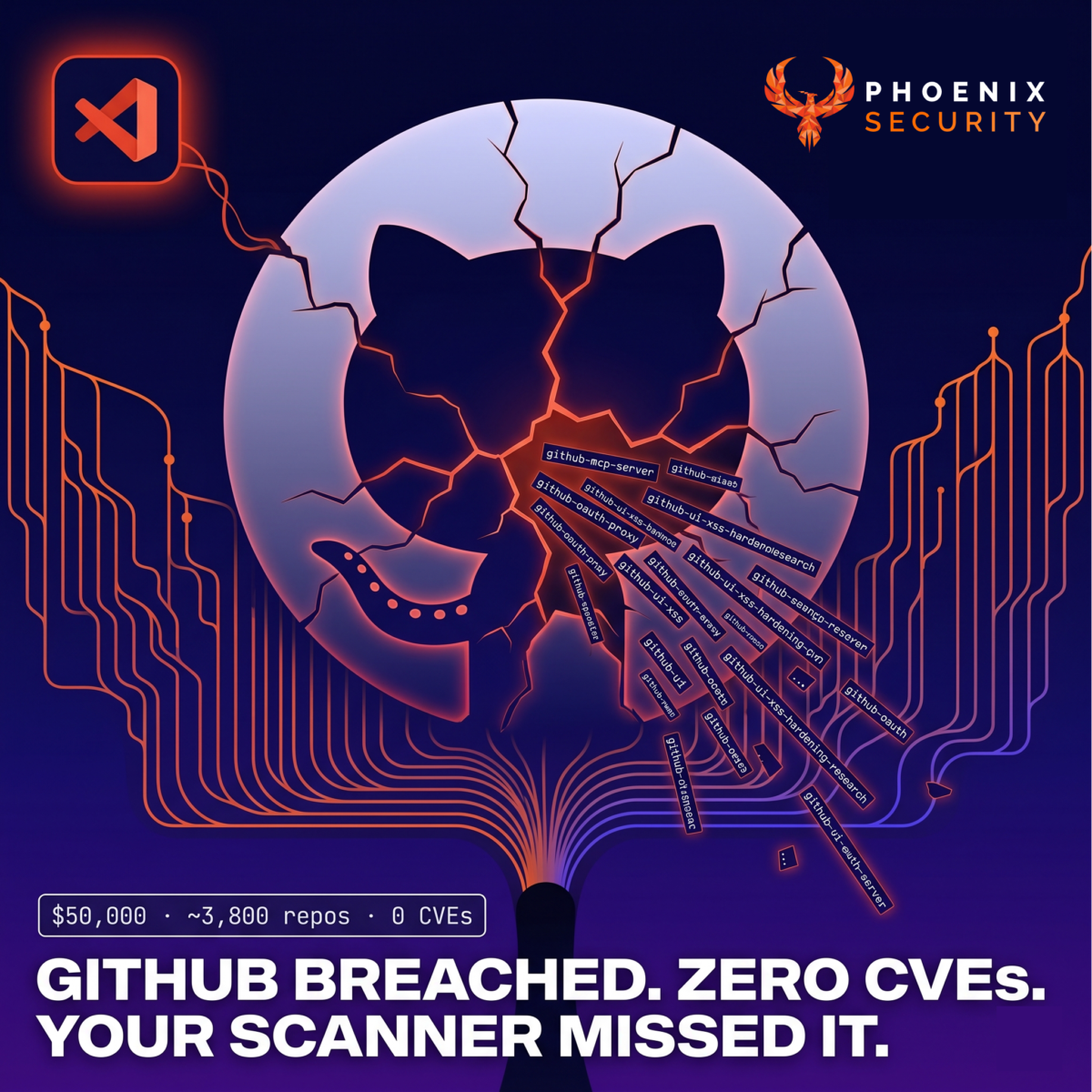
On May 19–20, 2026, two events landed within hours of each other. Wiz and Endor Labs documented three malicious versions of durabletask (1.4.1, 1.4.2, and 1.4.3) pushed to PyPI within a 35-minute window on May 19, the official Microsoft Azure Python SDK for the Durable Task workflow framework. The same day, GitHub confirmed that a poisoned VS Code extension on an employee device had led to the exfiltration of approximately 3,800 internal repositories. TeamPCP listed the source code for sale at $50,000: ‘it looks like our retirement is soon.’
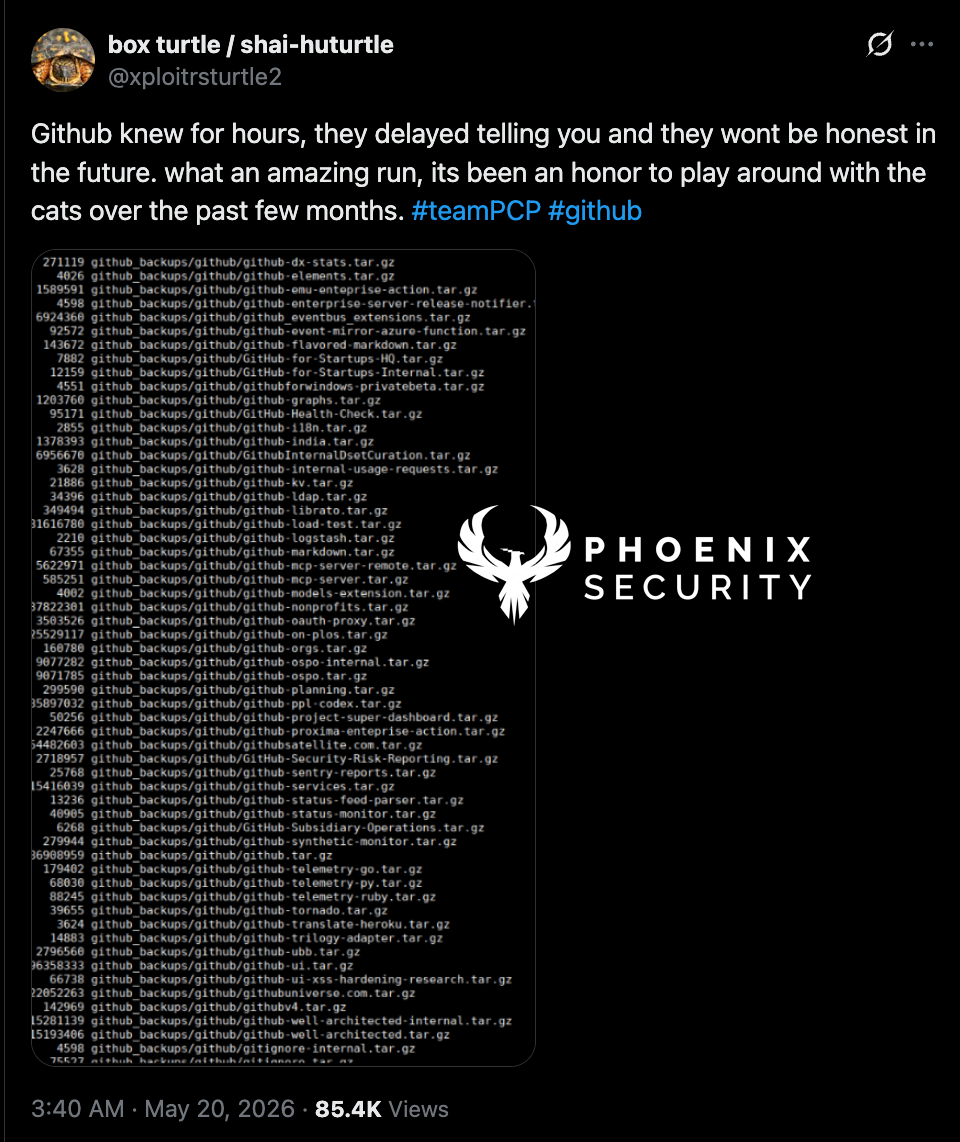
“Github knew for hours, they delayed telling you and they wont be honest in the future. what an amazing run, its been an honor to play around with the cats over the past few months.”
— @xploitrsturtle2 (box turtle / shai-huturtle, linked to TeamPCP), 3:40 AM · May 20, 2026 · 85.4K views
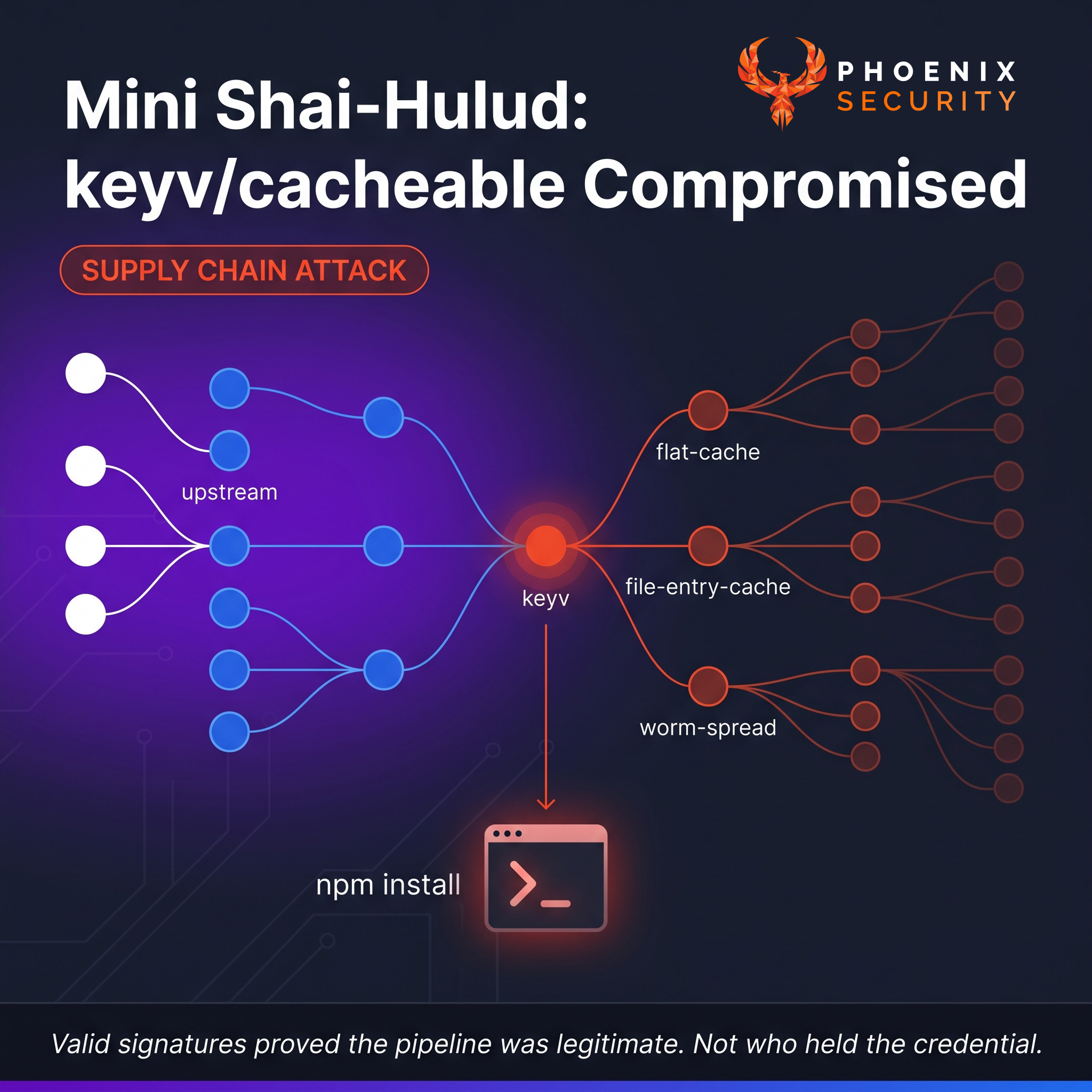
Both compromises trace to the same Mini Shai-Hulud worm infrastructure. durabletask drops rope.pyz from check.git-service[.]com, uses the FIRESCALE GitHub dead-drop for C2 rotation, and creates exfiltration repositories with Russian folklore names. All three behaviors were documented in prior TeamPCP waves going back to March 2026. Hunt.io’s infrastructure analysis puts C2 IP addresses from the 83.142.209.0/24 subnet across the March Checkmarx and Telnyx compromises and this wave. Same subnet, same operators.
The GitHub breach follows directly from the worm’s own mechanics. It steals GitHub tokens; those tokens get used to create exfiltration repos. A poisoned extension on a GitHub employee device is the same playbook: compromised developer tooling as the path to upstream infrastructure. Nine weeks in, TeamPCP has GitHub’s internal source code. Zero CVEs exist for any package across this entire campaign. Your scanner has no record of any of it.
TL;DR for Engineering Teams
What it is: Self-propagating supply chain worm (Mini Shai-Hulud) compromising PyPI/npm packages and developer tooling. Wave Four: durabletask 1.4.1–1.4.3 backdoored; GitHub employee device compromised via poisoned VS Code extension, ~3,800 internal repos exfiltrated. Zero CVEs produced.
Where it bites: Linux CI/CD runners, cloud VMs (AWS/Azure/GCP/Kubernetes), developer machines running affected packages, GitHub Actions workflows with publish tokens.
Why it matters: 417,000 monthly downloads of durabletask. Active exploitation confirmed. Self-replicating via AWS SSM and kubectl exec. FIRESCALE C2 rotation via signed GitHub commits makes domain blocking insufficient.
Patch status: durabletask 1.4.1, 1.4.2, 1.4.3 yanked from PyPI. Pin to 1.4.0. No patch required — these versions must be avoided entirely.
Immediate action: Run: pip show durabletask — pin to 1.4.0. Check /tmp/managed.pyz on every Linux host. Rotate all cloud credentials, GitHub tokens, and CI/CD secrets on any host that imported an affected version. Block check.git-service[.]com and t.m-kosche[.]com at egress. Audit VS Code extensions on developer and CI machines.
Check malware at https://phxintel.security/malware.html
Campaign Overview
| Field | Value |
|---|---|
| Threat Actor | TeamPCP (attributed with high confidence by Wiz, Aikido, StepSecurity, Hunt.io) |
| Campaign Name | Mini Shai-Hulud (Wave Four) |
| Attack Type | Supply chain compromise — malicious package injection + developer tooling poisoning |
| Primary CVEs | None. Zero CVEs produced across all stages. |
| CWE | CWE-494 (Download of Code Without Integrity Check), CWE-506 (Embedded Malicious Code) |
| CVSS Score | 10.0 (Critical) — supply chain RCE with lateral movement and data exfiltration |
| Affected Packages | durabletask 1.4.1, 1.4.2, 1.4.3 (PyPI); poisoned VS Code extension (unconfirmed name); TanStack npm (prior wave) |
| Active Exploitation | Confirmed — GitHub breach confirmed May 20, 2026 |
| C2 Infrastructure | check.git-service[.]com, t.m-kosche[.]com, 83.142.209.0/24 subnet |
| Campaign Start | March 2026 (Trivy, Checkmarx KICS, Telnyx, LiteLLM) |
| Wave Four Date | May 19–20, 2026 |
Campaign Timeline and Wave Structure
TeamPCP has run the same worm infrastructure since at least March 2026, hitting new ecosystems with each wave.
| Date | Incident | Ecosystem | Key Impact |
|---|---|---|---|
| March 2026 | Trivy, Checkmarx KICS, LiteLLM, Telnyx compromised | PyPI, npm, Docker Hub, GitHub Actions, VS Code | CI/CD credential theft; zero CVEs |
| March 31, 2026 | Malicious Axios library via GitHub Actions workflow | npm | OpenAI macOS signing certificate exposure (attributed to UNC1069 separately) |
| April 2026 (early) | SAP-ecosystem npm packages (mbt, @cap-js/db-service, @cap-js/sqlite, @cap-js/postgres) | npm | SAP developer environment compromise; Mini Shai-Hulud worm deployed |
| May 11, 2026 | TanStack compromised — 84 malicious versions across 42 @tanstack/* packages | npm | Two OpenAI employee devices compromised; code-signing certs exfiltrated |
| May 14–15, 2026 | Mistral AI, UiPath, Guardrails AI, OpenSearch packages compromised | npm, PyPI | Hundreds of packages across high-profile AI namespaces |
| May 19, 2026 | durabletask 1.4.1–1.4.3 published with dropper | PyPI | 417,000 monthly downloads targeted; Azure Durable Functions workloads |
| May 20, 2026 | GitHub internal breach — ~3,800 repos exfiltrated via poisoned VS Code extension | GitHub platform | GitHub source code listed for sale at $50,000. Operator @xploitrsturtle2 posts: ‘what an amazing run, its been an honor’ — suggesting campaign wind-down |
Protect yourself with the latest threat intelligence, get access to PHOENIX BLUE Today
GitHub Incident Response Timeline
The following is a reconstructed timeline of public statements from GitHub and the threat actor on May 20, 2026, ordered chronologically. Times are approximate where only relative timestamps (‘8h ago’, ‘3h ago’) were available at time of capture.
| Time (May 20, 2026) | Actor | Event |
|---|---|---|
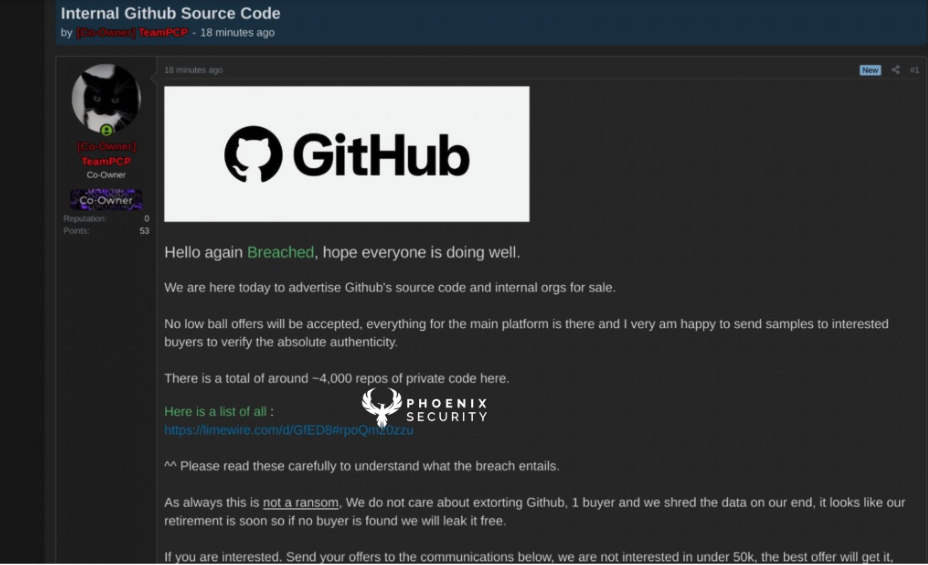
| ~12:43 AM UTC (est.) | TeamPCP [Co-Owner] | Posts GitHub source code for sale on Breached forum. Claims ~4,000 private repos. Asking price $50,000. ‘As always this is not a ransom… if no buyer is found, we will leak it free.’ |
| ~3:40 AM UTC | @xploitrsturtle2 (TeamPCP-linked) | ‘Github knew for hours, they delayed telling you and they wont be honest in the future. what an amazing run, its been an honor to play around with the cats over the past few months. #teamPCP #github’ |
| ~12:43 AM – ~5:04 AM UTC | @github | Initial statement: ‘We are investigating unauthorized access to GitHub’s internal repositories.’ Confirms no evidence of customer data impact outside internal repos. |
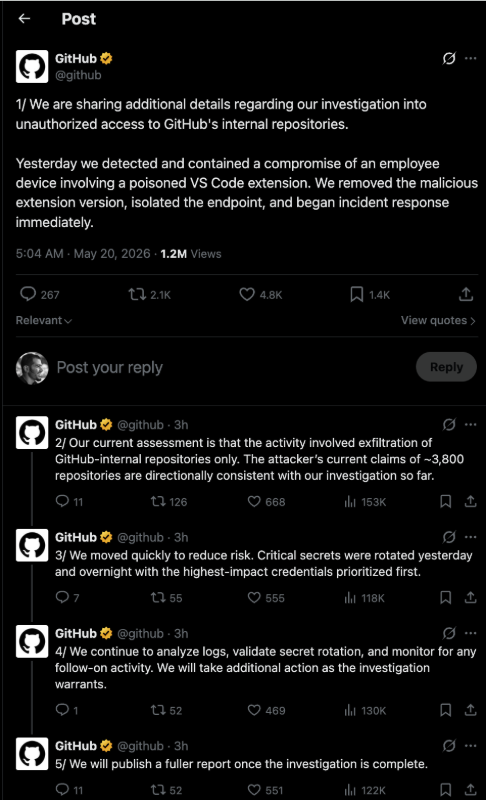
| 5:04 AM UTC | @github (thread 1/5) | ‘Yesterday we detected and contained a compromise of an employee device involving a poisoned VS Code extension. We removed the malicious extension version, isolated the endpoint, and began incident response immediately.’ (1.2M views) |
| 5:04 AM UTC +3h | @github (thread 2/5) | ‘Our current assessment is that the activity involved exfiltration of GitHub-internal repositories only. The attacker’s current claims of ~3,800 repositories are directionally consistent with our investigation so far.’ |
| 5:04 AM UTC +3h | @github (thread 3/5) | ‘We moved quickly to reduce risk. Critical secrets were rotated yesterday and overnight with the highest-impact credentials prioritized first.’ |
| 5:04 AM UTC +3h | @github (thread 4/5) | ‘We continue to analyze logs, validate secret rotation, and monitor for any follow-on activity. We will take additional action as the investigation warrants.’ |
| 5:04 AM UTC +3h | @github (thread 5/5) | ‘We will publish a fuller report once the investigation is complete.’ |
GitHub Official Statements — Primary Source
GitHub’s initial statement (posted approximately 8 hours before the 8:43 AM screenshot capture):
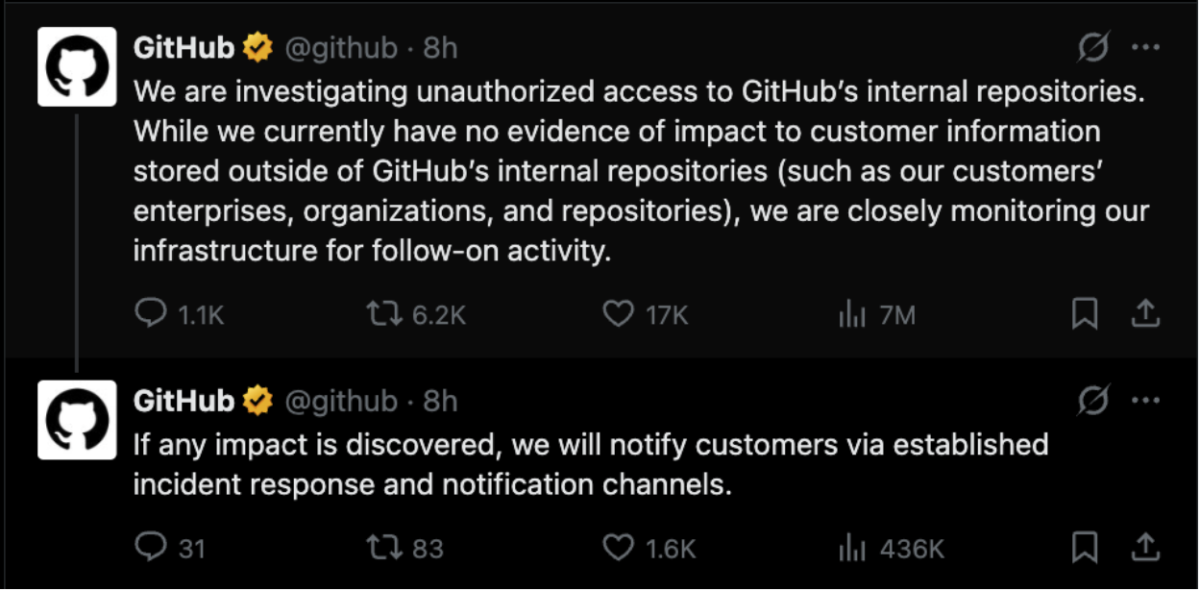
“We are investigating unauthorized access to GitHub’s internal repositories. While we currently have no evidence of impact to customer information stored outside of GitHub’s internal repositories (such as our customers’ enterprises, organizations, and repositories), we are closely monitoring our infrastructure for follow-on activity.”
— @github, initial statement · 17K likes · 6.2K retweets · 7M views
“If any impact is discovered, we will notify customers via established incident response and notification channels.”
— @github, follow-up · 1.6K likes · 436K views
GitHub’s detailed thread, published 5:04 AM May 20, 2026 (1.2M views):
1/ “Yesterday we detected and contained a compromise of an employee device involving a poisoned VS Code extension. We removed the malicious extension version, isolated the endpoint, and began incident response immediately.”
2/ “Our current assessment is that the activity involved exfiltration of GitHub-internal repositories only. The attacker’s current claims of ~3,800 repositories are directionally consistent with our investigation so far.”
3/ “We moved quickly to reduce risk. Critical secrets were rotated yesterday and overnight with the highest-impact credentials prioritized first.”
4/ “We continue to analyze logs, validate secret rotation, and monitor for any follow-on activity. We will take additional action as the investigation warrants.”
5/ “We will publish a fuller report once the investigation is complete.”
— @github thread, 5:04 AM · May 20, 2026 · 1.2M views
Threat Actor Statement — TeamPCP Operator
The operator post on X from @xploitrsturtle2 (account associated with ‘box turtle / shai-huturtle’) was published at 3:40 AM May 20, 2026, approximately 80 minutes before GitHub’s detailed thread. The phrasing ‘GitHub knew for hours’ and the present tense suggest the actor had visibility into GitHub’s internal response before public disclosure. The statement ‘its been an honor to play around with the cats over the past few months’ is consistent with the retirement framing in the Breached forum post. Attribution of this account to TeamPCP is based on consistent campaign branding (#teamPCP, shai-huturtle naming referencing Mini Shai-Hulud) and operational timing; this assessment carries medium-to-high confidence.
Scope of Exposed Repositories
The file listing shared by TeamPCP as proof of breach contains repository archives across GitHub’s internal infrastructure. Selected repositories visible in the leaked listing include:
| Repository Name | Inferred Function / Sensitivity |
|---|---|
| github-mcp-server | GitHub’s Model Context Protocol server — high sensitivity given MCP is developer tooling infrastructure |
| github-mcp-server-remote | Remote MCP server component |
| github-models-extension | GitHub Models product extension code |
| github-Security-Risk-Reporting | Internal security risk reporting tooling |
| github-ui-xss-hardening-research | Internal XSS hardening research — knowledge of unfixed attack surface |
| github-oauth-proxy | OAuth proxy infrastructure — credential flow code |
| github-InternalDSFCuration | Internal developer success tooling |
| github-internal-usage-requests | Internal usage request tooling |
| github-ospo-internal | Open Source Programs Office internal tooling |
| github-sentry-reports | Error monitoring and telemetry reports |
| github-synthetic-monitor | Synthetic monitoring infrastructure |
| github-telemetry-go / -py / -ruby | Multi-language telemetry pipeline code |
| github-load-balancers / github-load-test | Load balancing infrastructure and test tooling |
| github-satellite.com | GitHub Satellite conference infrastructure |
| github-enterprise-server-release-notifier | Enterprise Server release automation |
| github-well-architected / -internal | Internal architecture standards and tooling |
| github-gitignore-internal / github-gitignore-Eternal | Internal gitignore tooling |
| github-for-Startups-HQ / -Internal | GitHub for Startups program infrastructure |
| github-githubfundingprivatebeta | GitHub Sponsors / funding private beta code |
| github-Subsidiary-Operations | Subsidiary operations tooling |
| github-ppl-codex | People and codex internal tooling |
| github-project-super-dashboard | Internal project management dashboard |
| github-sponsors | GitHub Sponsors platform code |
| githubuniverse.com | GitHub Universe conference site code |
| github-v4 | Likely GitHub GraphQL API v4 related code |
The repository list includes github-mcp-server and github-mcp-server-remote. Given MCP is now a core integration layer between AI coding agents and developer infrastructure, exposure of this code is particularly relevant for teams building on GitHub’s MCP surface.
The full claimed list runs to approximately 4,000 entries. GitHub’s own statement (‘~3,800 repositories are directionally consistent with our investigation’) confirms the order of magnitude. The repositories above represent a selection of those with the highest inferred sensitivity based on naming conventions visible in the leaked file listing. This is not an exhaustive list, and the actual contents of each archive are unknown.
Technical Analysis
Root Cause: Credential Theft Enabling Package Publishing
The durabletask compromise follows the same access pattern documented by Wiz: credentials stolen in a prior attack compromised a GitHub account, repository secrets were dumped, and a recovered PyPI publishing token was used to push malicious versions directly. Three versions in 35 minutes: 1.4.1 at 16:19 UTC, 1.4.2 at 16:49, 1.4.3 at 16:54. Each release added more injection points to cover more import paths.
The GitHub breach came through a different vector. GitHub confirmed a poisoned VS Code extension on an employee device. The Nx Console project had a concurrent compromise pushing a multi-stage credential stealer; GitHub hasn’t publicly confirmed the extension name, but timing and mechanism align. From there the malware harvested credentials with access to GitHub’s internal repositories.
Attack Chain: durabletask Wave
The durabletask attack runs in three stages:
- Stage 1 — Import-time dropper: A 13-line block injected at the top level of __init__.py (and progressively more module files across versions 1.4.1–1.4.3) runs on any import durabletask call. The dropper is Linux-only, detaches via start_new_session=True, swallows errors via except: pass, and downloads rope.pyz from check.git-service[.]com to /tmp/managed.pyz before launching it as a background process. No function call needed; cold start in Azure Functions triggers it before any user code runs.
- Stage 2 — Second-stage payload (rope.pyz): A Python zipapp with 19 modules. Pre-flight checks exit on non-Linux, Russian locale ($LANG starting with ru), or CPU count <= 2 (sandbox evasion). The FIRESCALE dead-drop searches GitHub commit API for ‘FIRESCALE’ patterns containing base64-encoded C2 URLs with RSA-SHA256 signatures, providing the attacker a censorship-resistant C2 rotation mechanism requiring only a public Git commit.
- Stage 3 — Full credential harvest and worm propagation: Eight concurrent credential modules via ThreadPoolExecutor target: AWS IAM/SSM/Secrets Manager (all 19 regions), Azure service principals/Key Vaults, GCP service account keys/Secret Manager, Kubernetes secrets across all contexts, HashiCorp Vault KV v1+v2, 1Password, Bitwarden, pass/gopass. Additionally targets AI developer tooling configs: claude_desktop_config.json, Cursor MCP config, VS Code MCP config, Codeium, Zed, Continue. Propagates to up to five AWS EC2 instances via SSM SendCommand and up to five Kubernetes pods via kubectl exec.
Check malware at https://phxintel.security/malware.html
Version Expansion Pattern
Each version published by TeamPCP expanded the dropper’s injection coverage:
| Version | Infected Files | Import Paths Covered |
|---|---|---|
| 1.4.1 | durabletask/__init__.py | import durabletask |
| 1.4.2 | __init__.py + task.py | + from durabletask.task import … |
| 1.4.3 | 5 files: __init__.py, task.py, entities/__init__.py, extensions/__init__.py, payload/__init__.py | All major import paths covered |
FIRESCALE Dead-Drop Mechanism
When the primary C2 (check.git-service[.]com) is unreachable, rope.pyz queries the GitHub commit search API:
GET https://api.github.com/search/commits?q=FIRESCALE&sort=committer-date&order=desc&per_page=30
Each result is inspected for the pattern:
FIRESCALE <base64_url>.<base64_signature>
The base64 URL is only trusted if the RSA-SHA256 signature verifies against a hardcoded 4096-bit public key baked into the binary. The upshot: the attacker rotates C2 by pushing a single signed commit anywhere on GitHub. Taking down check.git-service[.]com doesn’t stop the worm. Only rotating the FIRESCALE signing key does.
GitHub Breach — Infrastructure Linkage
Hunt.io tied the GitHub breach to the same TeamPCP infrastructure through overlapping C2 IP ranges. Three addresses in the 83.142.209.0/24 subnet: 83.142.209.194 on the TanStack wave, 83.142.209.11 and .203 on the March 2026 Checkmarx and Telnyx attacks. Both .11 and .203 had SSH active from November 15–21, 2025, roughly four months before TanStack went public. Pre-staged infrastructure, not coincidence. The same subnet shows up across every TeamPCP wave Hunt.io tracked through May 2026.
TeamPCP provisions C2 servers months before activation to build clean reputation histories. IP reputation and domain age signals give security teams false confidence on this group.
Exfiltration with GitHub Token Abuse
When both C2 channels fail, rope.pyz uses stolen GitHub tokens to create public repositories named after Russian folklore (BABA-YAGA, KOSCHEI, FIREBIRD, PTITSA, RUSALKA, MOROZKO, LESHY, DOMOVOI, VODYANOY) and uploads the encrypted credential bundle as results.json. The victim’s own GitHub account becomes the exfil channel. From the outside it looks like ordinary repository activity.
Destructive Payload
On hosts fingerprinted as Israeli or Iranian (timezone, /etc/timezone, /etc/localtime, $LANG, $LC_ALL, $LC_MESSAGES checks for he_IL or fa_IR), roulette.py rolls a 1-in-6 die. On a hit: downloads audio.mp3 from check.git-service[.]com, sets system volume to 100% via pactl, plays it through mpv, then runs rm -rf /*. The payload is operator-activated. The attacker triggers it by returning HTTP 200 from /v1/models during the check-in call.
Check malware at https://phxintel.security/malware.html
Affected Packages and Versions
| Package | Ecosystem | Malicious Versions | Clean Version | SHA-256 (tar.gz) | Status |
|---|---|---|---|---|---|
| durabletask | PyPI | 1.4.1, 1.4.2, 1.4.3 | 1.4.0 | 1.4.1: 3de04fe2a76262743ed089efa7115f4508619838e77d60b9a1aab8b20d2cc8bf | Yanked |
| durabletask | PyPI | 1.4.2 | 1.4.0 | 85f54c089d78ebfb101454ec934c767065a342a43c9ee1beac8430cdd3b2086f | Yanked |
| durabletask | PyPI | 1.4.3 | 1.4.0 | c0b094e46842260936d4b97ce63e4539b99a3eae48b736798c700217c52569dc | Yanked |
| rope.pyz (payload) | C2 delivery | Any | N/A | 069ac1dc7f7649b76bc72a11ac700f373804bfd81dab7e561157b703999f44ce | Attacker-controlled |
| @tanstack/* (42 packages) | npm | 84 malicious versions | Latest clean | See TanStack post-mortem | Yanked (May 11 wave) |
| VS Code extension (unconfirmed) | VS Code marketplace | Poisoned version | Verified clean | Not published | Removed |
Exposure Analysis
| Environment | Risk Level | Exposure Reason |
|---|---|---|
| Azure Functions / Durable Task workloads | Critical | durabletask imported at cold start before user code runs — payload fires automatically on any Linux host |
| CI/CD pipelines (GitHub Actions, Jenkins, GitLab) | Critical | Cloud credentials, publish tokens, and GitHub PATs in environment — primary theft target; worm propagation confirmed |
| AWS EC2 fleets with SSM agent | Critical | SSM SendCommand propagation to up to 5 instances per infected host — exponential spread potential |
| Kubernetes clusters | Critical | kubectl exec propagation into up to 5 pods per infected workload |
| Developer machines (Linux) | High | Credential files, SSH keys, Docker credentials, .env files, AI tooling configs |
| GitHub Actions workflows publishing to PyPI/npm | High | Publishing token theft enables further package compromise — the worm’s self-replication mechanism |
| VS Code users (all platforms) | Medium–High | Poisoned extension vector used against GitHub employee; any developer with auto-update enabled is at risk |
durabletask pulls roughly 417,000 downloads a month, according to Endor Labs. Any Linux system that upgraded past 1.4.0 before the packages were yanked should be treated as fully compromised. Azure Durable Functions runs in exactly the kinds of environments where production cloud credentials exist: workflow automation, document processing, AI agent infrastructure.
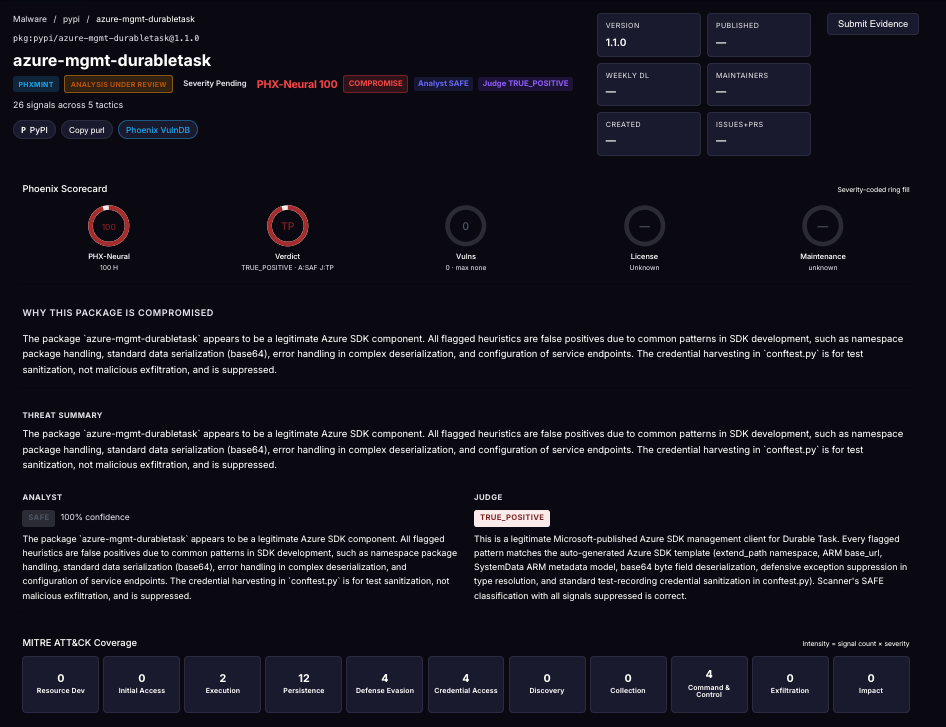
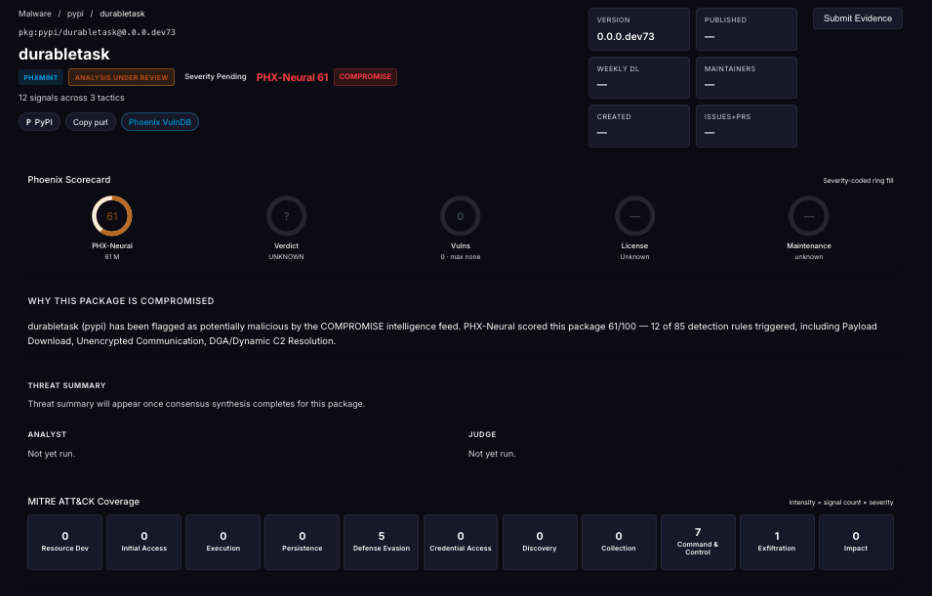
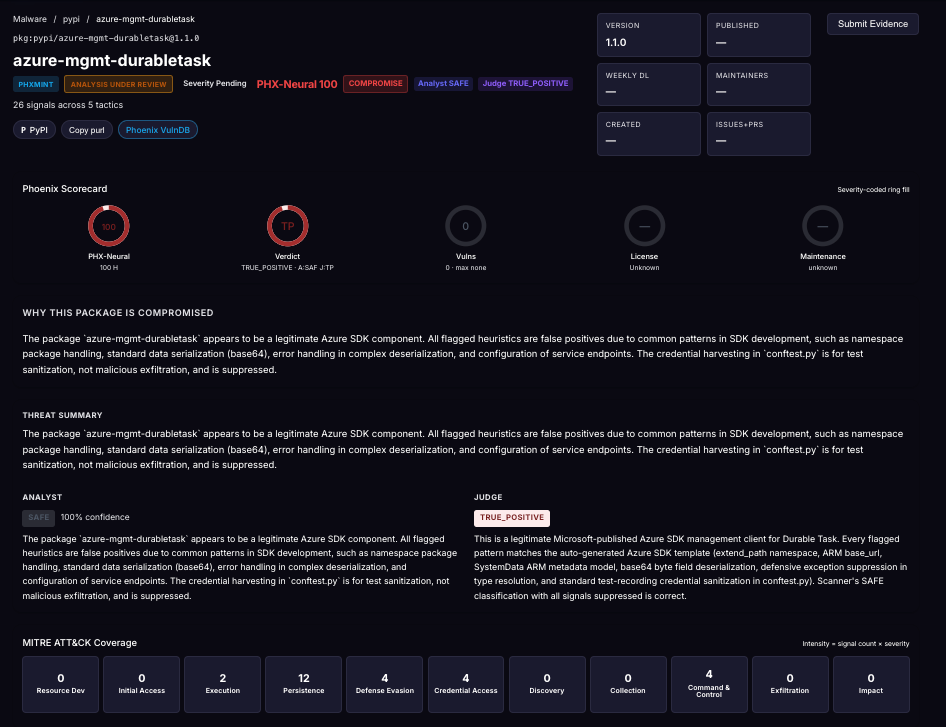
Phoenix PHX-Neural scored durabletask at 61/100 (COMPROMISE, Analysis Under Review), with 12 of 85 detection rules firing: Payload Download, Unencrypted Communication, and DGA/Dynamic C2 Resolution. The related azure-mgmt-durabletask package scored 100/100; both Analyst and Judge confirmed it as a legitimate Microsoft Azure SDK component with all signals suppressed as false positives.
Detection Guidance
Immediate Verification Commands
# Check installed version
pip show durabletask
# Scan lockfiles
grep -r ‘durabletask’ requirements*.txt poetry.lock Pipfile.lock uv.lock 2>/dev/null
# Check for dropped payload on disk
ls -la /tmp/managed.pyz 2>/dev/null
# Check for worm propagation markers
ls ~/.cache/.sys-update-check ~/.cache/.sys-update-check-k8s 2>/dev/null
# Check for persistence service
systemctl status pgsql-monitor.service 2>/dev/null
ls /usr/bin/pgmonitor.py ~/.local/bin/pgmonitor.py 2>/dev/null
# Scan installed package for injected code
grep -r ‘git-service.com’ $(pip show durabletask | grep Location | awk ‘{print $2}’) 2>/dev/null
Log and Network Indicators
- DNS / proxy logs: Any query to check.git-service[.]com or t.m-kosche[.]com is a confirmed compromise indicator. Block *.git-service[.]com and *.m-kosche[.]com at the domain level.
- Process creation: python3 /tmp/managed.pyz launched as a detached process (start_new_session=True) with stdout/stderr redirected to /dev/null.
- Network egress: Outbound HTTPS POST to check.git-service[.]com/api/public/version; outbound connections to IPs in 83.142.209.0/24.
- GitHub API calls: Commit search queries for ‘FIRESCALE’ from non-GitHub infrastructure. Public repository creation with Russian folklore names (BABA-YAGA, KOSCHEI, FIREBIRD, etc.) followed by results.json file creation.
- AWS CloudTrail: ssm:SendCommand events using AWS-RunShellScript document from compromised instance. Unexpected Secrets Manager or SSM Parameter Store GetSecretValue/GetParameter calls across multiple regions.
- Kubernetes audit logs: kubectl exec commands originating from unexpected source pods.
- Systemd: New service pgsql-monitor.service registered, described as ‘PostgreSQL Monitor’ — cover identity for persistence payload.
IOC Reference Table
| Indicator Type | Indicator | Notes |
|---|---|---|
| PyPI package | durabletask==1.4.1 | Malicious — do not install |
| PyPI package | durabletask==1.4.2 | Malicious — do not install |
| PyPI package | durabletask==1.4.3 | Malicious — do not install |
| File hash (SHA-256) | 3de04fe2a76262743ed089efa7115f4508619838e77d60b9a1aab8b20d2cc8bf | durabletask-1.4.1.tar.gz |
| File hash (SHA-256) | 85f54c089d78ebfb101454ec934c767065a342a43c9ee1beac8430cdd3b2086f | durabletask-1.4.2.tar.gz |
| File hash (SHA-256) | c0b094e46842260936d4b97ce63e4539b99a3eae48b736798c700217c52569dc | durabletask-1.4.3.tar.gz |
| File hash (SHA-256) | 069ac1dc7f7649b76bc72a11ac700f373804bfd81dab7e561157b703999f44ce | rope.pyz second-stage payload |
| Domain | check.git-service[.]com | Primary C2 and payload delivery — block domain |
| Domain | t.m-kosche[.]com | Secondary payload delivery — block domain |
| Domain wildcard | *.git-service[.]com | Block full domain — subdomains used for exfil |
| Domain wildcard | *.m-kosche[.]com | Block full domain — subdomains may be used |
| URL | https://check.git-service[.]com/rope.pyz | Payload download |
| URL | https://check.git-service[.]com/v1/models | C2 check-in / wiper activation endpoint |
| URL | https://check.git-service[.]com/api/public/version | Primary exfiltration endpoint |
| URL | https://check.git-service[.]com/audio.mp3 | Wiper audio file |
| URL | https://t.m-kosche[.]com/rope.pyz | Fallback payload delivery |
| IP range | 83.142.209.0/24 | TeamPCP C2 subnet — confirmed across all waves |
| IP address | 83.142.209.194 | TanStack wave C2 |
| IP address | 83.142.209.11 | March 2026 Checkmarx/Telnyx C2 |
| IP address | 83.142.209.203 | March 2026 Checkmarx/Telnyx C2 |
| File path | /tmp/managed.pyz | Dropped payload — confirmed compromise indicator |
| File path | ~/.cache/.sys-update-check | Worm propagation marker (AWS SSM) |
| File path | ~/.cache/.sys-update-check-k8s | Worm propagation marker (Kubernetes) |
| File path | /usr/bin/pgmonitor.py | Persistence payload (root install) |
| File path | ~/.local/bin/pgmonitor.py | Persistence payload (non-root install) |
| Service name | pgsql-monitor.service | Persistence service — disguised as PostgreSQL Monitor |
| GitHub pattern | FIRESCALE <base64>.<base64> | Dead-drop beacon in public commit messages |
| GitHub repo names | BABA-YAGA, KOSCHEI, FIREBIRD, PTITSA, RUSALKA, MOROZKO, LESHY | Russian folklore names — exfiltration repos created with stolen tokens |
| Domain registration | git-service[.]com registered 2026-05-16 | Three days before attack; NameSilo, privacy-guarded |
Scanner References
- Phoenix Security scanner: github.com/Security-Phoenix-demo/Shai-Hulud-Sha1-Hulud-V2-npm-compromise-scanner
- Phoenix PHX-Neural scored durabletask 0.0.0.dev73 at 61/100 — 12 of 85 detection rules triggered. Live tracking: sha1hulud-phoenix.pplx.app
- Endor Labs: Detected durabletask 1.4.1 within 2 minutes of publication (16:19 to 16:21 UTC)
- Aikido Security: Behavioral analysis of rope.pyz payload documented
- StepSecurity: SSM propagation mechanics documented
- Wiz: Root cause analysis of PyPI token compromise vector
- SafeDep: 28KB Python stealer analysis including HashiCorp Vault KV and password manager targeting
- Hunt.io: C2 infrastructure correlation across all TeamPCP waves
- SBOM scanning: Any SBOM containing durabletask without explicit version == 1.4.0 pin should be flagged
Remediation Guidance
Immediate Actions
- 1. Pin durabletask to 1.4.0: pip install durabletask==1.4.0. If using poetry: poetry add durabletask@1.4.0. If using uv: uv add durabletask==1.4.0. Do not install 1.4.1, 1.4.2, or 1.4.3.
- 2. Check for active compromise: Run ls -la /tmp/managed.pyz. If the file exists, the payload ran. Isolate the host immediately before credential rotation.
- 3. Check propagation markers: ls ~/.cache/.sys-update-check && ls ~/.cache/.sys-update-check-k8s. Presence confirms the worm’s lateral movement logic ran.
- 4. Rotate all credentials on affected hosts: AWS IAM keys, session tokens (check CloudTrail for unexpected API calls). Azure service principal credentials, managed identity tokens. GCP service account keys (check audit logs). Kubernetes service account tokens and kubeconfig. HashiCorp Vault tokens. 1Password and Bitwarden sessions. GitHub tokens/PATs (check for new public repos with Russian folklore names). npm, pip, PyPI tokens. SSH private keys. CI/CD pipeline secrets. Contents of any .env files accessible to the process.
- 5. Block C2 infrastructure: Add check.git-service[.]com, *.git-service[.]com, t.m-kosche[.]com, *.m-kosche[.]com to DNS blocklists and egress proxy deny lists. Block 83.142.209.0/24 at network egress.
- 6. Check for persistence: systemctl status pgsql-monitor.service. If found: systemctl stop pgsql-monitor.service && systemctl disable pgsql-monitor.service && rm /etc/systemd/system/pgsql-monitor.service && rm /usr/bin/pgmonitor.py (or ~/.local/bin/pgmonitor.py).
- 7. Audit VS Code extensions: Review all installed extensions across developer and CI machines. Any extension with network access that was auto-updated recently warrants manual review of the published version’s source.
- 8. Check AWS SSM propagation: Review CloudTrail for ssm:SendCommand events using AWS-RunShellScript from any compromised instance. Investigate all target instances as potentially infected.
Temporary Mitigations (If Immediate Patching Is Delayed)
- Restrict outbound egress from CI runners and cloud workloads to known-good domains. The dropper requires DNS resolution of check.git-service[.]com to execute the payload.
- Implement pip –require-hashes with a pinned requirements file. A hash mismatch on 1.4.1–1.4.3 would have failed the build before any code ran.
- Disable auto-update on VS Code extensions in developer environments pending review.
- Monitor for the FIRESCALE pattern in GitHub commit search API calls originating from your infrastructure.
- Restrict SSM agent permissions using AWS IAM policy conditions to limit lateral movement blast radius.
Longer-Term Hardening
- Enforce minimum release age controls on package managers (OpenAI deployed this as a post-Axios control — the two affected employee devices had not yet received the updated configuration).
- Require SBOM generation and signing for all builds. Alert on transitive dependency version changes between builds.
- Scope CI pipeline permissions to least privilege. Credential harvesting only pays off when those credentials exist on the build machine.
- Review all package __init__.py files for network calls. SDKs do not make outbound connections at import time. Any urllib, requests, or subprocess call in a package’s __init__.py warrants investigation.
- Implement GitHub Actions permissions pinning (pin actions to commit SHA, not tag) to prevent workflow token exfiltration via tampered action versions.
Phoenix Security Platform Recommendations
Traditional CVE-based scanners have no record of any package in this campaign. No CVEs exist for durabletask 1.4.1–1.4.3, the VS Code extension, or the TanStack wave. PHX-Neural flagged durabletask on behavioral signals alone, without a CVE to match against.
- Supply chain compromise detection: Phoenix PHX-Neural behavioral analysis flagged durabletask as COMPROMISE-tagged with 12 behavioral signals triggered. This detection does not depend on CVE assignment — it operates on package behavior, network call patterns, and code heuristics. Teams using Phoenix’s package intelligence feed received a COMPROMISE signal on durabletask within the publication window.
- FIRESCALE campaign tracking: Phoenix maintains active tracking of the Mini Shai-Hulud / FIRESCALE campaign lineage at sha1hulud-phoenix.pplx.app with live IOC feeds and affected package lists. Package intelligence at phxintel.security/package.html provides per-package assessment against known campaign IOCs.
- Reachability analysis: For teams where durabletask is a transitive dependency, Phoenix reachability analysis identifies which workloads actually import the package at runtime versus which have it in the dependency graph but never execute it. This narrows remediation prioritization to environments where the payload would have fired.
- Attack surface management: Phoenix ASM identifies internet-facing services and CI pipelines running affected package versions. For the GitHub breach vector, identifying which developer machines and CI runners had the compromised VS Code extension installed — and which repositories those machines had access to — defines the blast radius for credential rotation.
- Remediation campaigns: Create a TeamPCP Wave Four remediation campaign in Phoenix, assign owners by repository and team, track the pin-to-1.4.0 fix across all services, and verify remediation via SBOM re-scan. The credential rotation scope (AWS, Azure, GCP, GitHub, Vault) can be tracked per-service against the reachability-confirmed exposure list.
Phoenix maps compromise signals to actual workload exposure: which pipelines ran affected packages, which developers had the extension, which repositories were in scope for credential rotation. The campaign is sprawling. The remediation backlog shouldn’t be.
MITRE ATT&CK Mapping
| Technique ID | Name | Description |
|---|---|---|
| T1195.001 | Supply Chain Compromise: Compromise Software Dependencies | Malicious versions of durabletask, TanStack packages published via stolen PyPI/npm tokens |
| T1059.006 | Command and Scripting Interpreter: Python | rope.pyz executes Python modules for credential theft, propagation, and persistence |
| T1078 | Valid Accounts | Stolen GitHub tokens, cloud credentials used for lateral movement and exfiltration |
| T1552 | Unsecured Credentials | Credential files (~/.aws, ~/.kube, ~/.vault-token, .env, Docker socket, etc.) harvested |
| T1021.007 | Remote Services: Cloud Services (SSM) | AWS SSM SendCommand used to propagate worm to up to 5 EC2 instances per infected host |
| T1609 | Container Administration Command (kubectl exec) | Kubernetes pod lateral movement via kubectl exec |
| T1041 | Exfiltration Over C2 Channel | Encrypted credential bundles POSTed to check.git-service[.]com |
| T1567.001 | Exfiltration to Code Repository | GitHub token abuse to create exfiltration repositories with Russian folklore names |
| T1071.001 | Application Layer Protocol: Web Protocols | HTTPS used for C2, payload delivery, and exfiltration |
| T1485 | Data Destruction | rm -rf /* on Israeli/Iranian-fingerprinted hosts via roulette.py |
| T1547.001 | Boot or Logon Autostart: Systemd Service | pgsql-monitor.service persistence registered as ‘PostgreSQL Monitor’ |
| T1102.001 | Web Service: Dead Drop Resolver (GitHub) | FIRESCALE mechanism uses GitHub commit search API for C2 rotation with RSA-signed URLs |
External References
1. GitHub statement on internal repository compromise (May 20, 2026) — @github on X
2. Wiz: durabletask compromise analysis — ‘The attacker compromised a GitHub account via a previous attack, dumped GitHub secrets…’ (May 19, 2026)
3. Endor Labs: durabletask malicious package analysis — detection within 2 minutes of 1.4.1 publication (May 19, 2026)
4. Aikido Security: rope.pyz payload behavioral analysis — SSM propagation, kubectl exec, roulette.py wiper
5. StepSecurity: SSM SendCommand propagation mechanics and FIRESCALE documentation
6. SafeDep: 28KB Python stealer module analysis including HashiCorp Vault and password manager targeting
7. Hunt.io: C2 infrastructure correlation — 83.142.209.0/24 subnet across all TeamPCP waves (May 16, 2026)
8. The Hacker News: ‘GitHub Investigating TeamPCP Claimed Breach of ~4,000 Internal Repositories’ (May 20, 2026)
9. The Hacker News: ‘TanStack Supply Chain Attack Hits Two OpenAI Employee Devices, Forces macOS Updates’ (May 16, 2026)
10. OpenAI: ‘Our response to the TanStack npm supply chain attack’ — openai.com/index/our-response-to-the-tanstack-npm-supply-chain-attack (May 15, 2026)
11. BleepingComputer: ‘OpenAI confirms security breach in TanStack supply chain attack’ (May 14, 2026)
12. Socket Security: TanStack compromise attribution to Mini Shai-Hulud operation
13. Phoenix Security scanner (Shai-Hulud): github.com/Security-Phoenix-demo/Shai-Hulud-Sha1-Hulud-V2-npm-compromise-scanner
14. Phoenix Security live tracking: sha1hulud-phoenix.pplx.app — Mini Shai-Hulud campaign IOC feed
15. Phoenix Package Intelligence: phxintel.security/package.html
16. Phoenix Security editorial archive: phoenix.security/?s=sha1
17. @xploitrsturtle2 (box turtle / shai-huturtle, linked to TeamPCP) — ‘Github knew for hours, they delayed telling you and they won’t be honest in the future.’ X post, 3:40 AM May 20, 2026. x.com/xploitrsturtle2/status/2056927898771067006