Executive summary
Phoenix Security has been accepted into Anthropic’s Cyber Verification Program (CVP) and is now an integration partner of OpenAI’s Daybreak Defense Factory. Phoenix Purple, our agentic code scanner and pentest, gets verified access to frontier models for defensive work. Phoenix findings arrive in the fix loop already deduplicated, checked for reachability and assigned to an owner, and an engineer still reviews every change.
Key takeaways
- Measure your program by fixes merged, not findings filed. Frontier models have already made finding cheap.
- Deduplicate, check reachability and assign an owner before a finding reaches an AI agent. Agent time spent on unreachable code is wasted spend.
- Give every finding a file, a line and proof before anyone writes a patch.
- Keep a human at the merge. Both programs and Phoenix are built that way.
- If your team does defensive work with frontier models, check whether you qualify for verified access programs like CVP.
What happened
This week we posted two small graphics on LinkedIn. On the first, our phoenix sits above the line “The Cyber Verification Program (CVP) by Anthropic”. On the second, it sits under a sunrise and the words “Daybreak Defense Factory, Integration partner”.
Both are about the same thing. Phoenix Security, and Phoenix Purple, our agentic code scanner and pentesting product, now work inside the defensive programs of two frontier AI labs.
We’re happy about it. We also know a logo next to another logo fixes nothing. So this post is mostly about the engineering: what each program does, what it changes in Phoenix, and why the hard part is still the fix.
1. The problem: finding got cheap, fixing did not
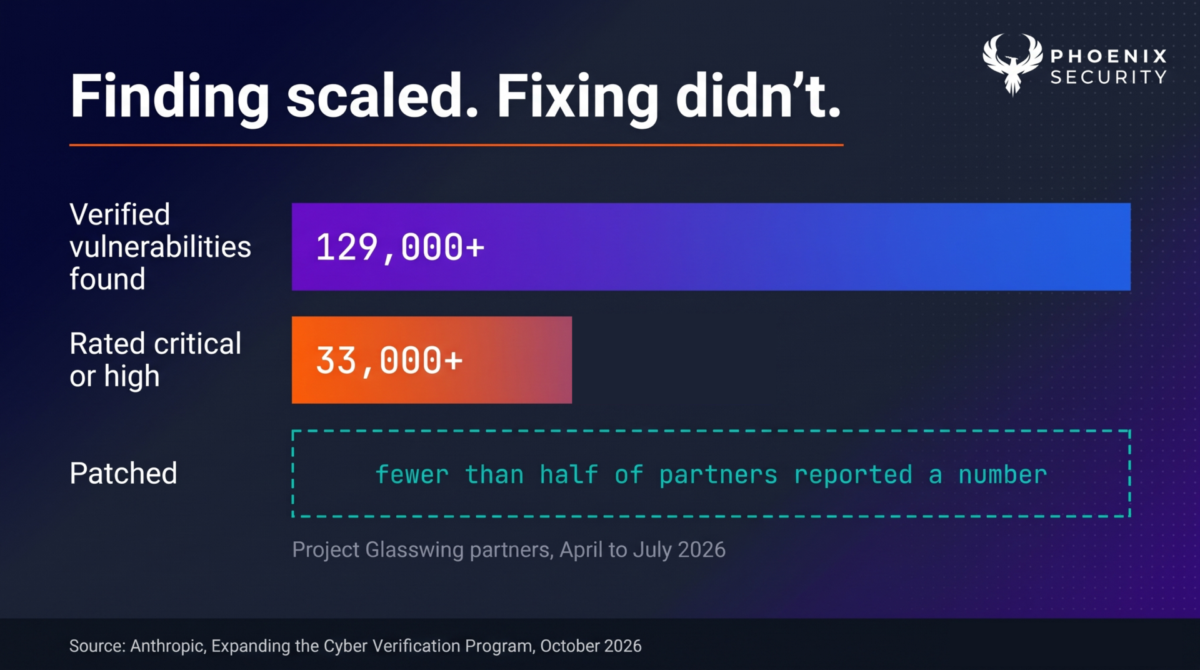
Anthropic opened Project Glasswing in April 2026. It gave a group of organizations securing critical software access to Claude Mythos. Between April and July, partners found at least 129,000 verified software vulnerabilities. More than 33,000 were rated critical or high. Anthropic says the real number is likely higher, because the data covers only part of the partners.
The fix side of the same report is thinner. Fewer than half of the partners shared how many issues they had patched, often because the fixes were still in progress.
On November 9, Anthropic released Claude Mythos 5.2. It scored 76.3% on CyScenarioBench and 89.6% on Anthropic’s internal CVE Rediscovery evaluation. Three days later, OpenAI introduced Daybreak Defense Factory. Its whole job is the other half of the work: take findings, trace them through the code, and prepare a patch for an engineer to review.
So both labs point at the same gap. Models now find more than teams can fix. A longer list doesn’t help a team that can’t close the one it has.
We’ve said it before. Detection was never the bottleneck. Now it’s even less of one.
2. Technical analysis: why frontier findings stall before the merge
Follow a finding after a model reports it. It usually gets stuck in one of five places.
- Duplicates. The same vulnerable library shows up in the repo, the build, three container images and a runtime scan. That’s four tools, four tickets and one problem. OpenAI’s write-up of its own internal Defense Factory names this: duplicates blur priority, so the factory merges them before triage.
- Reachability. Most flagged code is never reached from an entry point an attacker can touch. A model that spends tokens on an unreachable path is slow and expensive. A patch for it takes review time away from something real.
- Ownership. A finding with no owner waits. OpenAI lists this as a common bottleneck too. Its target state is a verified owner for every finding.
- Location. A pentest finding names a URL and a payload. A developer needs a file, a function and a change. If nothing connects the two, the patch is a guess.
- Cost. Running a frontier model file by file across a codebase on every change adds up fast. The bill grows with lines of code, not with real problems.
None of this is new. The volume is. A frontier model doesn’t get tired, so these five problems now arrive at machine speed.
3. The Phoenix approach: give the model the right finding
Our rule is context first, model second.
Phoenix keeps one knowledge graph across code, security findings and architecture. It pulls from 30+ scanner integrations and follows a finding from code to build, container, runtime and cloud. Before any model looks at a finding, the graph has already answered four questions. Is it a duplicate? Is it reachable? Who owns it? Where in the code does it live?
What CVP changes for Phoenix Purple
CVP is Anthropic’s verification program for security teams. Anthropic’s generally available models ship with conservative cyber safeguards that block most cyber work. CVP gives verified organizations fewer of those blocks, in three tiers: Defense Access, Red Team Access and Specialized Access. Organizations in the program accept data retention, so Anthropic can monitor for misuse.
Anthropic tested the tiers on Claude Opus 5.5 with CyScenarioBench. Without CVP, every task was blocked on the first prompt. In the Red Team Access tier, nothing was blocked and the model completed 34 of 50 tasks.
For us this matters in two places. Purple Hunt builds exploit chains from the code graph and tries to disprove each candidate before it calls anything an exploit. Purple Pentest Deep attacks a registered application from the outside, records the exchange that proves each exploit, and then checks the code behind every finding. Both are dual-use by nature. Verified access means fewer false blocks in the middle of a legitimate scan on a system the customer owns.
The graph still decides where the model looks. Take a modeled fleet of 26 repositories at 250,000 lines each. A file-by-file harness on a frontier model came to about $598 a month and $64.30 per confirmed vulnerability. Phoenix Purple on the same model and fleet came to $74.88 a month and $3.60 per confirmed vulnerability. A stronger model doesn’t change that math. It makes each confirmed finding better.
What Daybreak Defense Factory changes for Phoenix findings
Daybreak is OpenAI’s cyber defense program. It brings together OpenAI models, Trusted Access for Cyber, Codex Security and partners. Since its research preview launched in March, Codex Security cloud has scanned more than 30 million commits across more than 30,000 codebases.
Defense Factory is the fix side. Teams bring in findings from their security tools. Agents trace each one through the code and develop a patch. Engineers review and test the patch before merge. Right now it runs as a preview plugin in ChatGPT for workspaces with Daybreak access.
As an integration partner, Phoenix feeds that loop. What goes in is the point. A Phoenix finding arrives already deduplicated across code and containers and filtered by reachability. It’s ranked with the 4D risk formula, assigned to a team and tied to a file and line. A pentest finding also carries the recorded request that proves the exploit and a code verdict. The agent starts on the fix, not on the investigation.
What we shipped this quarter
Both programs plug into work that’s already live in Phoenix.
- Purple Hook runs inside AI coding assistants. It has been generally available since October 29. At session start, after a push and when the agent opens a pull request, it checks with Phoenix and puts the answer back into the session. Only findings in the changed lines can block.
- Green AI Remedy builds remediation plans from deduplicated, prioritized findings. It has been generally available since November 3. It shows the cost in US dollars before any model runs, so reviewers spend time on fixes that will ship.
- Purple Pentest Deep attacks a registered app from the outside, inside a declared scope and a budget a person sets. Each finding gets one of five code verdicts with a file and line. Each fix comes with a regression test and a curl command that reproduces the issue.
- Blue Shield blocks malicious packages and AI agent skills at install time: in the agent session, on the workstation and in CI/CD. It doesn’t wait for a CVE.
Together, the Purple pieces run as one loop. Hunt starts from the code and Pentest Deep checks from the outside. The fix arrives with a code location, a remedy and a test. Guardrails and hook policies stop the same pattern coming back, and the pull request review is the last gate.

Protect yourself with Phoenix Purple – find TRUE critical chainable vulnerabilities with exploits
4. Real-world example: 100+ findings, 8 hypotheses, 3 CVEs
In March 2026, a 59.8 MB source map shipped inside Claude Code v2.1.88 on npm. Our research team started looking the same evening.
Static analysis returned more than 100 findings. We triaged them on the Purple code graph with Claude Opus and cut them to 8 hypotheses worth testing. We generated exploits with Codex, then used Claude Opus again to check that our assumptions held. Three hypotheses became CVEs: CVE-2026-35020, CVE-2026-35021 and CVE-2026-35022. All three are OS command injection (CWE-78) with one root cause. They chain from a malicious config file to credential exfiltration.
That run used models from both labs. It’s a small version of what these programs are for. The models did the heavy reading, the graph told them where to read, and people decided what was real.
At program scale, the same discipline shows up in customer results. ClearBank cut container vulnerabilities by 98%. Bazaarvoice cut them by 94% and saved $6.3M in developer time. AdTech Leader cut active container vulnerabilities by 78% and saved $1.95M in time. Reachability analysis on its own has cut noise by up to 91%.
5. Practical guidance
Before you buy more model access, count two numbers for last quarter: findings created and fixes merged. If the first grows faster than the second, more findings won’t help.
Then check what your agents receive. An AI agent that gets a raw scanner finding spends its first steps on work your platform should already have done. It looks for duplicates, checks reachability and tries to work out the owner and the file. Do that before the agent starts.
Set a budget for every model run that touches security, and see the cost before it runs. Green AI Remedy and Pentest Deep both work this way.
Keep one gate nobody can switch off locally: the review at merge. Purple Hook and Phoenix’s pull request review sit there. So does the engineer review in Defense Factory.
Last, look at your supply chain. Frontier models find flaws in code. A malicious package usually has no flaw to find. It does what it was written to do, and nobody assigns it a CVE.
Next steps
- Pull your found-versus-fixed numbers for the last 90 days and share them with engineering leadership.
- Connect your scanners to one backlog with deduplication and reachability before you connect any AI agent to it.
- Book a Phoenix demo to see a finding go from proof, to a file and line, to a pull request your team reviews.
FAQ
What is Anthropic’s Cyber Verification Program? CVP is Anthropic’s program for vetted security organizations. It reduces cyber safeguard blocks on Anthropic’s most capable models for defensive work and, in the higher tiers, for authorized red teaming. It has three tiers: Defense Access, Red Team Access and Specialized Access. Even in the higher tiers, Anthropic still blocks actions that could cause physical harm or mass disruption, such as deploying ransomware. CVP runs on the Claude Platform, Google Cloud’s Vertex AI and Microsoft Foundry.
What is OpenAI’s Daybreak Defense Factory? It’s the remediation product inside OpenAI’s Daybreak program. Teams bring findings from their security tools, agents trace each one through the code and draft a patch, and engineers review and test it before merge. It launched on November 12 as a preview plugin in ChatGPT for workspaces with Daybreak access.
Does Phoenix let AI merge code on its own? No. Phoenix AI is assistive. Agents investigate, propose and draft. Engineers review, approve and merge. Defense Factory works the same way.
Do I need CVP or Daybreak access to use Phoenix? No. Phoenix works on its own. To send Phoenix findings into Defense Factory, your workspace needs Daybreak access from OpenAI.
Why does reachability matter more now? Model time costs money and reviewer time is limited. A finding nobody can reach still takes tokens to investigate and an engineer to review the patch. Filtering by reachability first keeps both spent on real risk.
Which Phoenix products are involved? Phoenix Purple for code scanning, Hunt, Pentest Deep and Purple Hook. Phoenix Orange for one backlog, deduplication and the 4D risk formula. Phoenix Green for remediation plans. Phoenix Blue for supply chain intelligence and Blue Shield.
References
- Anthropic, Expanding the Cyber Verification Program (October 2026): the three tiers, CyScenarioBench results and Project Glasswing numbers.
- Claude Help Center, how the Cyber Verification Program works and who can apply.
- Anthropic, Claude Mythos 5.2 model page with benchmark results.
- SecurityWeek, coverage of the three-tier CVP.
- OpenAI, Daybreak Defense Factory product page.
- OpenAI, how OpenAI built its own Defense Factory: architecture, bottlenecks and the defense loop.
- OpenAI Developers, scaling cyber defenders with Daybreak and Codex Security.
- Phoenix Security, three CVEs in Claude Code CLI and the chain that connects them.
- Phoenix Security, Purple Hook is generally available.
- Phoenix Security, Green AI Remedy is generally available.
- Phoenix Security, Phoenix Purple: graph-native scanning for AI-generated code.
- Phoenix Security, Blue Shield launch: a supply chain firewall for packages and agent skills.