Join our Mailing list!
Get all the latest news, exclusive deals, and feature updates.

SAST, SCA, IaC, container and secret scanning that finds the bugs that are actually reachable, proves they're exploitable, and opens the fix as a pull request. Built for teams shipping AI-generated code at pace.
The problem
Every sprint ships more generated code, more dependencies, more paths, and more possible mistakes. The old scanner model was built for a slower world.
More code lands. AI assistants generate pull requests no human can fully read line by line.
Context disappears. Legacy scanners see files and findings, not intent, ownership, or reachable execution paths.
Risk hides in noise. Thousands of alerts arrive with no proof they are exploitable, while the few real issues move toward production.
Why teams choose Phoenix Purple
Findings are checked against reachability, exploitability and real code paths before they reach a developer.
Phoenix catches the novel patterns AI assistants introduce, then explains the evidence in language engineers can trust.
Autofix opens pull requests and labels them safe to merge or needs review, so remediation keeps moving.
One graph connects every check
Phoenix Purple connects every finding to code paths, runtime context, ownership and exploitability evidence — so security sees chains, not scanner output.
Token efficiency
Phoenix Purple uses graph context and targeted analysis instead of repeatedly sending full repository context to expensive LLMs. Compare how scan costs change across 1,000 repositories.
Large code and vulnerability context gets sent repeatedly for every repo, PR and finding.
 Phoenix Purple
Cached intelligence, reachability evidence and targeted model use reduce token spend at scan scale.
Knowledge graph
Phoenix builds a living map of your entire codebase — every function, every connection, every data path. That graph proves which findings are real and traces the chains an attacker could follow. It also gives your AI coding tools the full context of how your software actually works.
How it works
Every module feeds the same reachability engine, so SAST, SCA, IaC, containers and secrets land as validated findings, not another backlog.
Scroll next: raw findings collapse into reachable risk, then into pull requests. That is the loop.











Ready for the next step?
Prioritize the reachable risk, route it to the right workflow, and keep remediation moving without adding another noisy dashboard.
Prioritization
Phoenix collapses raw scanner output into a smaller set of proven actions: graph-validated risk, human review, and autofix-ready pull requests.
Code, packages, infrastructure, containers and secrets normalized into one evidence graph.
Reachable, exploitable, owned and routed with evidence attached.
Grouped remediations Phoenix can open as safe-to-review pull requests.
Ambiguous chains escalate to deeper reasoning with human control.
Where you work
Security that shows up in the tools your team already uses — not in another dashboard they have to remember to check.
Catch and fix issues as you write, right inside VS Code, Cursor, JetBrains and Windsurf.
Run a full scan from the CLI, in any pipeline or none, and get results in seconds.
Phoenix connects to Claude Code, Cursor and MCP assistants, so agents can scan, query and fix in context.
Drop Phoenix into your agent's skillset so security reasoning is part of how it builds, not a step bolted on afterwards.
Ask the graph
Ask a question in plain language. Phoenix walks the knowledge graph, follows the real chains, and answers with the evidence. Then it turns that into a fix.
No query language, no rules to write. Type "Which findings can actually reach remote code execution?" straight into the Agentic Code Triager.
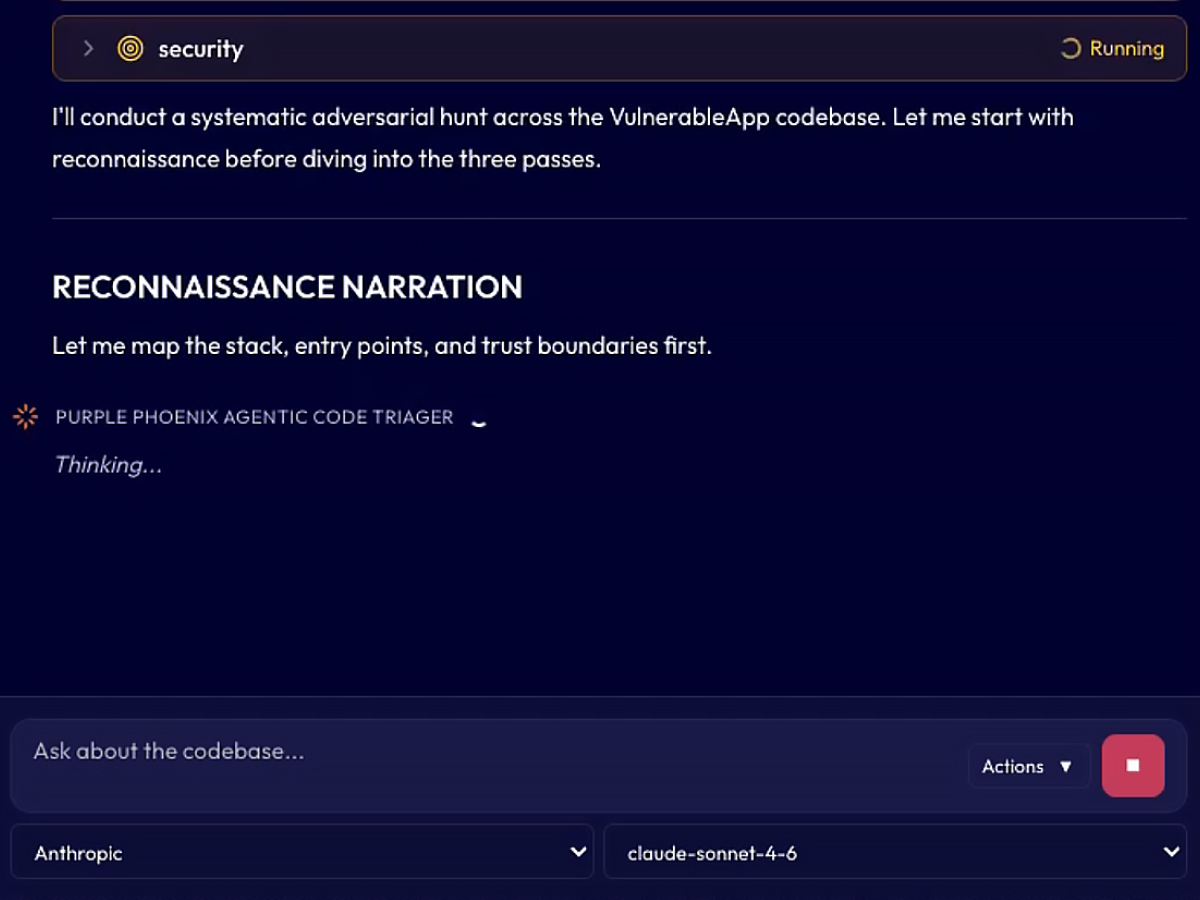
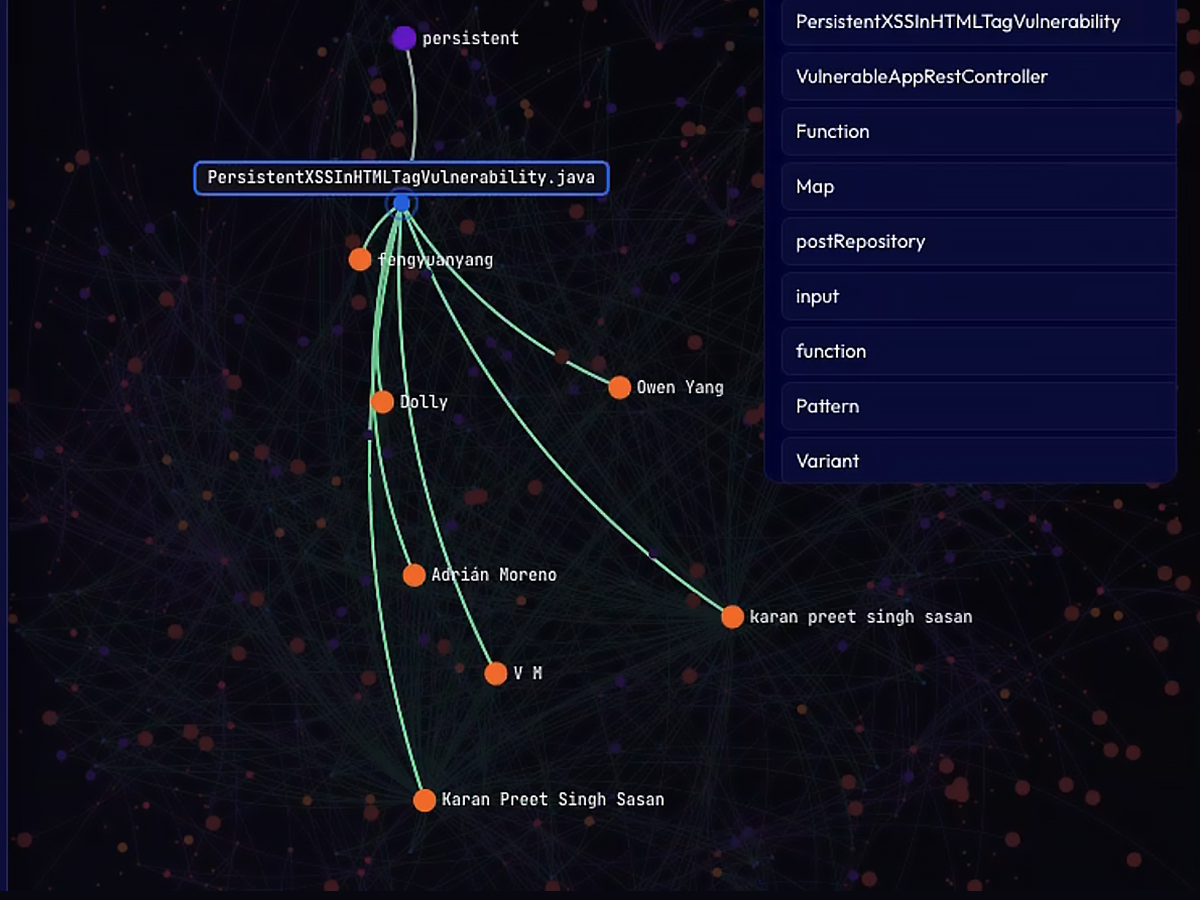
It traces every function, call and data path across all 1,918 nodes and 2,720 edges to find the chains that actually connect — not the ones that only look scary.
Every claim is backed by the exact files and lines on the chainability map, so you can trust the answer instead of guessing or re-checking it by hand.
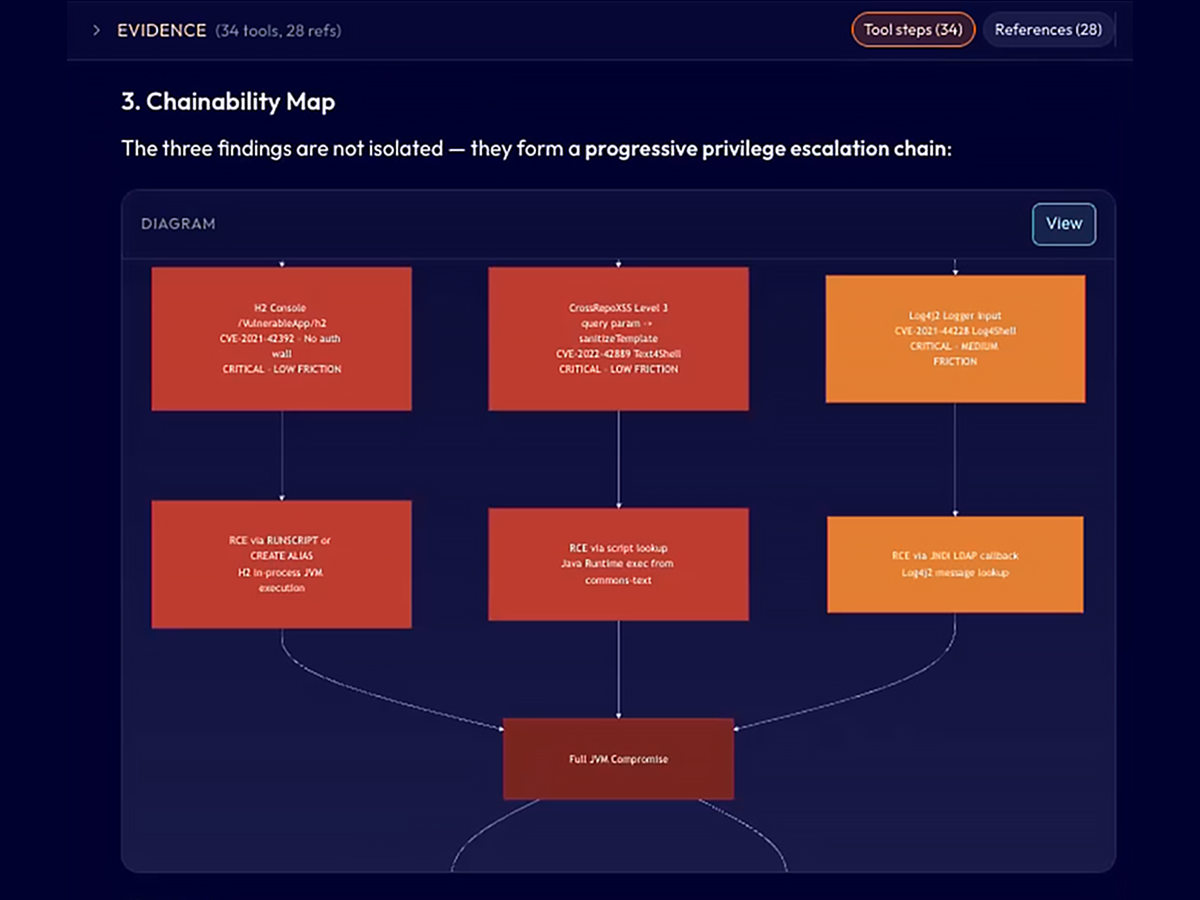
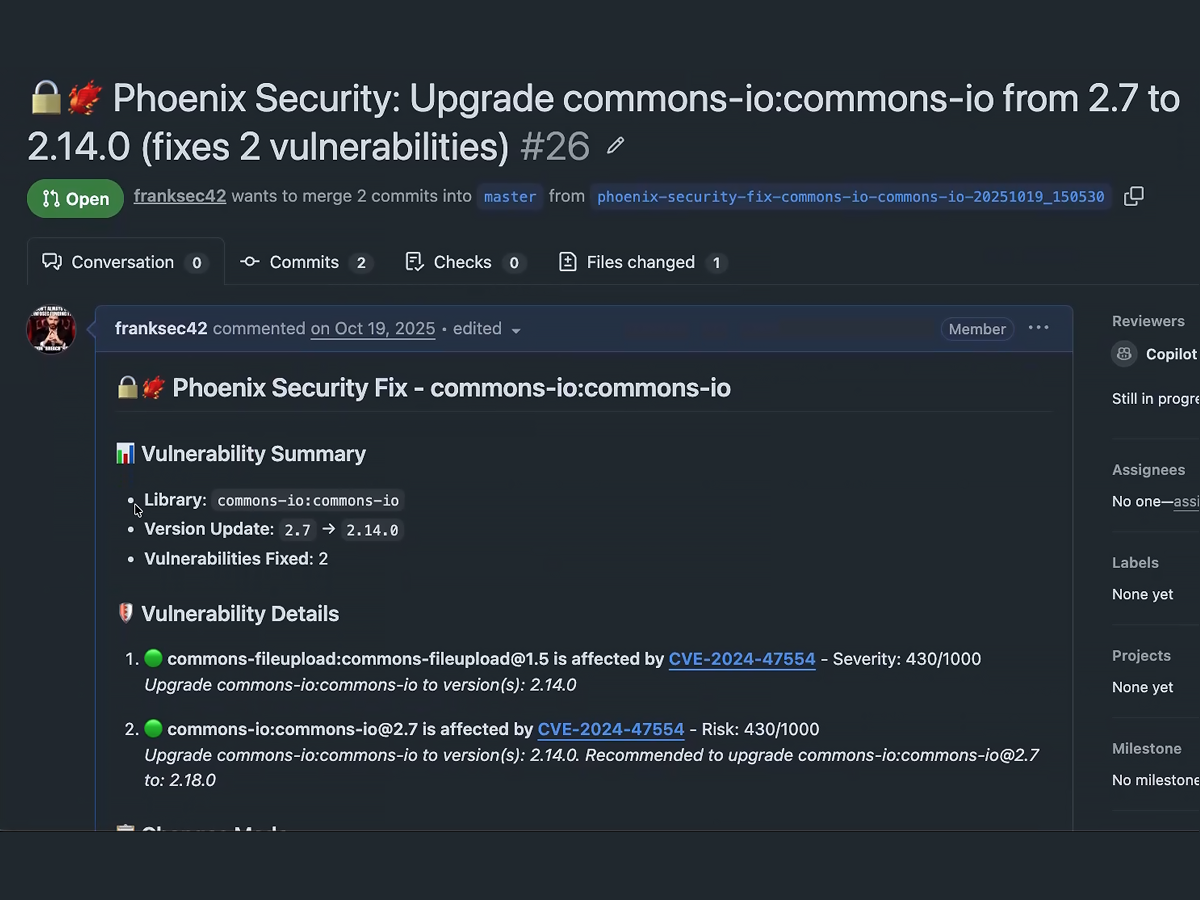
Promote the answer straight into an autofix PR, tiered safe to merge or needs review — the same engine that found it writes the remediation.
Remediation plan
A real upgrade plan for a vulnerable Spring application: safe fixes first, reviewed changes next, and blocked migrations clearly separated from automation.
| ID | Package | Current → Fix | Tier | CVEs (key) | PR eligible |
|---|---|---|---|---|---|
| F-02 | commons-text | 1.8→1.10.0 |
SAFE | CVE-2022-42889 (Text4Shell) | Auto |
| F-07 | commons-io | 2.7→2.15.1 |
SAFE | CVE-2021-29425 | Auto |
| F-08 | assertj-core | 3.17.2→3.25.3 |
SAFE | ReDoS / info-disclosure | Auto |
| F-04 | org.json:json | 20190722→20231013 |
MODERATE | CVE-2022-45688, CVE-2023-5072 | PR |
| F-05 | nimbus-jose-jwt | 8.3→9.37.3 |
MODERATE | CVE-2023-52428 | PR · compile check |
| F-06 | commons-fileupload | 1.5→1.5 · pin |
MODERATE | CVE-2023-24998 (already patched) | PR |
| F-01 | h2 | 1.3.176→2.2.224 |
BREAKING | CVE-2021-42392 (JNDI RCE) | Reviewed |
| F-03 | spring-boot BOM | 2.4.5→2.7.18 → 3.2.x |
BREAKING | CVE-2022-22965 (Spring4Shell) | Reviewed · 2-step |
| F-03 | spring-boot 3.x | — migration — | BLOCKED | jakarta.* + CommonsMultipartResolver removal | Never |
| F-01 | H2 console | — intentional — | BLOCKED | Intentional design | Never |
See it on your own code
We'll show you the knowledge graph scanning your repos, the modules in action, and how autofix PRs look on code like yours.
Trusted by security teams at