

Every exploit arrives with the request that proves it and the file and line behind it, so teams fix the cause and break the chain in one change.
LONDON — 19 November 2026 — Autonomous pentest agents can now find real vulnerabilities at machine speed. Attackers will run them continuously. Security teams that still buy one pentest a year, and receive it as a PDF, are testing on a calendar while the other side tests on a loop. Phoenix Security today announced the general availability of Purple Pentest Deep, the agentic tier of Phoenix’s web and API pentest.
Purple Pentest Deep attacks a registered application from the outside, like an attacker. Then it does the defender’s half of the work in the same run. Every exploit carries the recorded exchange that proves it. Every finding gets a code verdict with a file and line. The report opens with the attack chains and a fix-first list, and each fix comes with a regression test and a command that reproduces the issue.
Where the cost lands
In December 2025 a team from Stanford, Carnegie Mellon and Gray Swan AI published “Comparing AI Agents to Cybersecurity Professionals in Real-World Penetration Testing” (arXiv 2512.09882). They put six existing AI agents and their own multi-agent system, ARTEMIS, against 10 professional penetration testers on a live university network of about 8,000 hosts.
ARTEMIS placed second overall and beat 9 of the 10 humans. It found 9 valid vulnerabilities with an 82% valid submission rate. Some ARTEMIS variants ran at about $18 an hour, against about $60 an hour for a professional tester. The same paper notes that the agents filed more false positives than the humans.
The cost of an outside-in test is falling toward the cost of a scan. The real cost now sits after the report lands.
A pentest finding names a URL, a parameter and a payload. A developer needs a file, a function and a change. Nothing in a traditional report connects the two. Someone reads the finding, guesses which handler serves that route, and writes a ticket. When the guess is wrong, the ticket bounces. When the guess is right but shallow, the team patches the symptom and leaves the cause.
Chains are where this hurts most. A debug endpoint leaks a secret, the secret forges a token, and the token reaches an admin action. Each step on its own looks medium. The chain is critical. A report that lists the three steps as three separate tickets hides the one fix that breaks the chain. An agent that files more findings, with a higher false positive rate, just delivers a larger backlog, faster.
What Purple Pentest Deep changes
The test starts from what the business depends on. Before any agent attacks, Purple Pentest Deep crawls the application inside the declared scope. It reads robots.txt, sitemap.xml, any OpenAPI description and the site map the team saved on the target. It also reads what the workspace already knows: the threat model, the business impact analysis and the workspace description. Secrets in that text are redacted before any agent sees them. A coordinating agent then splits pages, endpoints and attack classes across helper agents, which run in parallel inside an isolated sandbox. Every scan has a spending budget that a person sets, raises or stops.
An exploit counts only when it is proven. Each helper agent records the exchange that proves the exploit, and every report can turn it into a single curl command. When the scan ends on an application with a linked repository, Purple reads the code behind every finding. Each finding gets one of five verdicts: confirmed in code, seen at runtime only, plausible in code, refuted by code, or undetermined. The verdict cites the file and line. A finding the code disproves is flagged as refuted, so nobody spends a sprint on it. A finding confirmed at runtime and in code goes to the top of the queue. During the attack, the agents can also read the workspace’s code graph and look at the handler behind an endpoint before they aim the next request.
Findings end as changes a developer can merge. One click on Assess all builds the attack chains with a citation for every hop and ranks findings by business priority. Propose remediation turns each finding into the cited code, the fix, a regression test and the reproduction request. One change that breaks a chain is shown as one fix, not three tickets. Hunt, Phoenix’s code-side exploit hunter, works from the inside out and now shares one view with Purple Pentest Deep. Every Hunt finding that the live pentest also saw carries the label “Seen in Pentest scan”. Those are the ones to fix first.
Executive perspective
“An agent can break into an application in minutes now. Finding the hole was never the slow part. Purple Pentest Deep hands the developer the proof, the line of code and the fix, so a pentest ends as a merged change.”
— Francesco Cipollone, CEO and Co-Founder, Phoenix Security
How teams use it
We ran Purple Pentest Deep against our deliberately vulnerable benchmark application, so these numbers illustrate the workflow, not a benchmark. One Deep scan returned 81 findings. The triage agent ranked them by risk and reduced them to three attack paths:
- Direct code execution on /api/calc, with no chain needed.
- /api/system/info or /api/debug/env to internal key leakage, then command execution on localhost through /internal/run.
- /api/debug/env to the JWT signing secret, to a forged admin token, to /api/admin/plugins/load.
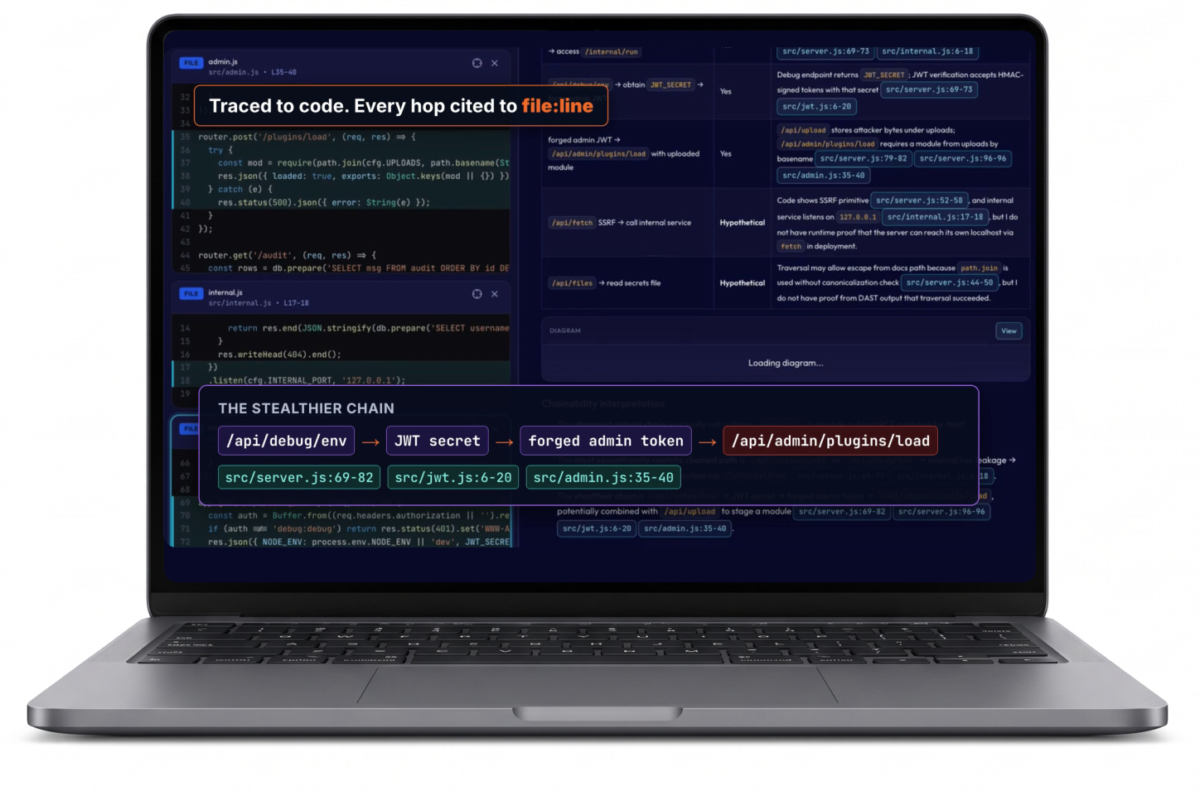
Assess all cited src/server.js:69-82, src/jwt.js:6-20 and src/admin.js:35-40 for the hops of the last chain. Then it ranked a fix-first list and a phased rollout. Rotating the secret and removing the debug endpoint breaks the chain. Adding an auth check to the debug endpoint alone would not.
A team starting out picks one internet-facing application, registers it, proves ownership and gives it a site map and a workspace description. It runs one Deep scan with a modest budget and sorts the findings by code verdict. Then it runs a Hunt on the same repository with the scan attached, and hands the top fix to the owning team with the regression test and the reproduction command in the same ticket. Engineers still review and merge every fix.
At programme scale, this is the discipline Phoenix already applies to prioritisation. ClearBank, a Phoenix customer, reported a 98% reduction in container vulnerabilities, going from 467,000 to about 8,000 container findings through container lineage. Purple Pentest Deep applies the same rule to runtime findings. A finding earns a place in the queue only when it carries proof, a code location and an owner.
Availability
Purple Pentest Deep is generally available today. Teams register an application, prove ownership and set a budget for each scan. Documentation and demos are at phoenix.security.
About Phoenix Security
Phoenix Security is an Actionable ASPM platform that correlates vulnerabilities from code to cloud, turning fragmented findings into a single, prioritized remediation flow. Through reachability analysis, contextual deduplication and risk-based prioritization, Phoenix helps security and engineering teams cut the noise, fix what counts and scale without scaling headcount. Phoenix Purple brings graph-native scanning to AI-generated code. Phoenix AI is assistive and human-aligned: teams review, approve and merge.


