AppSec and vulnerability management teams already pay for defences that stop whole classes of attack: web application firewalls, API gateways, input-validation frameworks, network filtering. Their risk scores rarely know those defences exist. A critical finding behind a gateway that filters malicious input looks the same as one on an open service. Teams either spend sprint time on it or hide it behind an exception that an auditor will ask about later. Phoenix Security announced the general availability of Compensating Controls in the Phoenix platform.
Compensating Controls lets a security team record a defence once, map it to the CWE classes it protects against, and assign it where it runs. Phoenix then lowers the calculated risk of matching findings, shows the reason on each one, and keeps the finding open until someone fixes it.
Where the time goes
In most programmes the defences and the backlog live in different places. The network team knows which services sit behind the gateway. The AppSec team sees a list of criticals. The developer who owns the service gets a ticket either way.
When the two views never meet, teams pick between two poor options. They treat every finding as unprotected and spend engineering time on risk that is already reduced. Or they file risk exceptions to push findings down, and the reason a finding was deprioritised ends up in a ticket comment that nobody reviews again.
What changes
A defence is recorded once and follows the architecture. Controls attach to applications, environments, components, services or assets. A network firewall or API gateway set on an environment flows down to the services deployed in it, and the application composition graph shows where each control is inherited. Where one service has its own protection, or none, a deliberate override stops inheritance at that point.
Risk drops only where the defence applies. Each control is mapped to the CWEs it protects against. An input-validation framework lowers the risk of an improper input validation finding (CWE-20), and does nothing for a heap overflow (CWE-122) on the same asset. Teams rate each control Low, Medium or High, and each organisation sets the reduction behind those ratings. When several controls match, Phoenix applies the strongest one instead of adding them up.
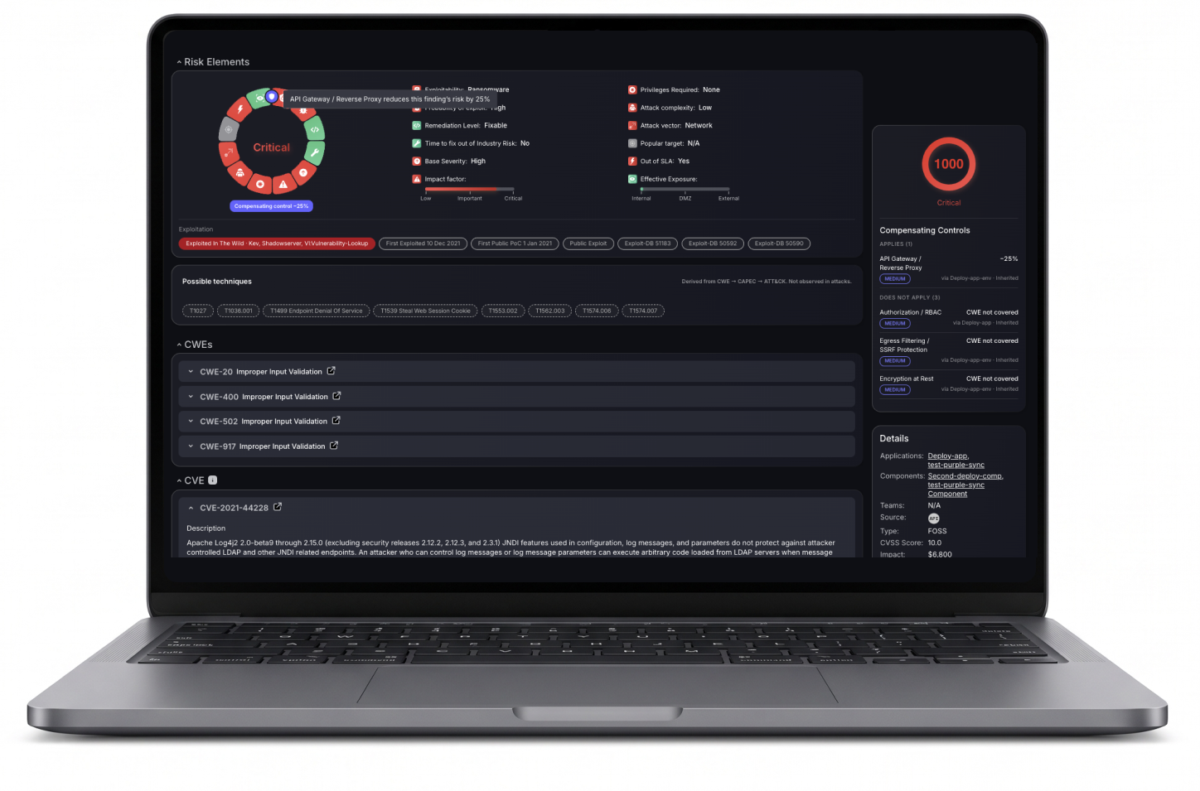
Every reduction shows its reason. Finding details name the control that applied, its rating, the reduction and whether it was inherited, next to the controls that do not apply and why. The findings list also flags controls that could apply but are not yet assigned, so a team can see where an existing defence would count and switch it on.
Controls and exceptions are never counted twice. A compensating control contributes when a finding has no risk exception or a Mitigation exception. Risk Acceptance, Not Applicable, Risk Recasting and False Positive decisions keep their own logic. Where a manual mitigation also exists, Phoenix keeps the stronger reduction within the organisation’s cap.
From weakness to attacker
Each finding’s Risk & Threat Actors view traces its CWE through MITRE CAPEC attack patterns to ATT&CK techniques and the threat actor groups linked to them, using threat intelligence from Phoenix Blue. The same view shows which compensating controls sit on that path and whether they are applied, applicable or disabled. A technique match gives the analyst context. It does not change the score; only a CWE match on an enabled, assigned control does.
Executive perspective
“A gateway in front of a service changes the risk of what sits behind it. Phoenix now counts that, only for the weaknesses the gateway covers, and the finding stays on the board until someone fixes it.”
— Francesco Cipollone, CEO and Co-Founder, Phoenix Security
Context first
Compensating Controls adds one more input to how Phoenix reduces volume before anyone picks what to fix. Phoenix correlates code and cloud findings, removes duplicates across scanners, and scores risk on exploitability, reachability, deployment context and business criticality. ClearBank, a Phoenix customer, reported a 98% reduction in container vulnerabilities after applying that context. Phoenix Security was named a Major Player in the IDC MarketScape: Worldwide ASPM 2025 Vendor Assessment.
How teams use it
An AppSec lead looks at a production environment that sits behind an API gateway and a network firewall. Its high-risk findings are a mix of input validation issues and memory safety bugs. The lead records the gateway as a Medium-strength control, maps it to CWE-20 and CWE-400, and assigns it to the environment.
The services deployed there inherit the control, except a legacy worker that the platform team has marked with an override because it bypasses the gateway. After recalculation, the input validation findings on the protected services show a lower risk, with the gateway named as the reason. The heap overflow on the same service keeps its score, because the gateway does not cover that class. That is where the sprint goes. Every finding is still in the backlog, and the control’s owner, scope and evidence are on record for the next review.
Availability
Compensating Controls is generally available for Phoenix Enterprise and Unlimited organisations. Controls are managed under Security > Compensating Controls. Viewing controls requires the Compensating Controls read permission; creating, editing, importing or assigning them requires the update permission. Documentation is available at docs.phoenix.security. To see it on your own backlog, book a demo: https://phoenix.security/request-a-demo/
About Phoenix Security
Phoenix Security is an Actionable ASPM platform that correlates vulnerabilities from code to cloud, turning fragmented findings into a single, prioritised remediation flow. It ties each finding to the team that owns the fix and prioritises on real risk, using exploitability, reachability, deployment context and business criticality rather than severity alone. Its AI agents are assistive and human-aligned: teams review, approve and merge.