Executive Summary
CVE-2026-134814 is a code injection bug (CWE-94) in binary-parser. It’s an npm library that builds fast parsers for binary data from a declarative definition.
Every version up to and including 2.3.0 turns that definition into JavaScript and runs it with the Function constructor. Several string options go into that code without any check. If someone controls one of those values, they control code inside your Node.js process. That code gets the process’s credentials, file access and network reach.
This is part two of an older story. Version 2.3.0 was published to npm on November 26, 2025. CERT/CC disclosed it as CVE-2026-1245 on January 20, 2026. That release checked field names and encodings. It did not check length, lengthInBytes, key, tag, offset or the namely() alias. Teams that moved to 2.3.0 and closed the January ticket stayed exposed.
The maintainer shipped 2.3.1 and advisory GHSA-xmxc-6c22-m377 on November 11, 2026. VulnCheck assigned the CVE on November 22.
Triage comes down to one question. Who writes your parser definitions?
The maintainer says parsing hostile bytes with a trusted definition is safe. The real risk sits in platforms that build parsers from tenant-editable schemas, device profiles, protocol mappings or JSON configs. There, a low-privileged user who can edit a format profile can get code execution on a backend worker. Everywhere else, this is a routine dependency bump with one breaking change to plan for.
TL;DR for Engineering Teams
| Question | Answer |
|---|---|
| What it is | CVE-2026-134814, code injection in binary-parser through string-typed parser options. CVSS 4.0 9.2 (Critical), CVSS 3.1 8.1 (High), both scored by VulnCheck as CNA. |
| Where it bites | binary-parser 2.3.0 and earlier, in any Node.js service that builds a Parser from data outside the app’s trust boundary: tenant schemas, uploaded protocol definitions, configs stored in a database, plugin manifests. |
| Why it matters | It’s an incomplete fix for CVE-2026-1245, so “we patched in January” doesn’t cover you. 31,002 npm downloads in the week of November 16 to 22, 2026. No confirmed exploitation as of November 23, 2026. |
| Patch | Fixed in 2.3.1 (npm, November 11, 2026). Also fixed in 3.0.0 (November 22, 2026), which needs Node.js 22.12 or later and is ESM-only. |
| Do now | Pin binary-parser@2.3.1 (or 3.0.0 if you already run Node.js 22.12+). Force it through transitive trees with overrides or resolutions. Audit stored parser definitions for option strings that aren’t plain field paths. |
Vulnerability Overview
| Field | Value |
|---|---|
| Vendor | Keichi Takahashi (keichi/binary-parser, open-source maintainer) |
| Product | binary-parser (npm) |
| Vulnerability type | Code injection via unsanitized interpolation into generated JavaScript |
| CWE | CWE-94: Improper Control of Generation of Code |
| CVSS | 9.2 Critical (CVSS:4.0/AV:N/AC:H/AT:P/PR:N/UI:N/VC:H/VI:H/VA:H/SC:N/SI:N/SA:N); 8.1 High (CVSS:3.1/AV:N/AC:H/PR:N/UI:N/S:U/C:H/I:H/A:H) |
| CVE | CVE-2026-134814 (NVD); advisories GHSA-xmxc-6c22-m377 and GHSA-hhq6-2gpv-hrf4; EUVD-2026-132849 |
| Related CVE | CVE-2026-1245, field name and encoding injection, fixed in 2.3.0 (OSV entry) |
| Patch available | Yes: 2.3.1, 3.0.0 |
| Active exploitation | Not confirmed |
| EPSS (Nov 23, 2026) | 0.608%, 50th percentile (FIRST EPSS) |
Expect different severity labels for the same bug. The maintainer’s repository advisory says High. The GitHub Advisory Database entry tied to the CVE says Critical. Your scanner will show 9.2 or 8.1, depending on which CVSS version it reads.
Both vectors have high attack complexity, and the v4 vector adds an attack requirement. AV:N describes the worst-case setup. It doesn’t mean every service that imports the package has a network path to the bug.
Technical Anatomy
Root Cause
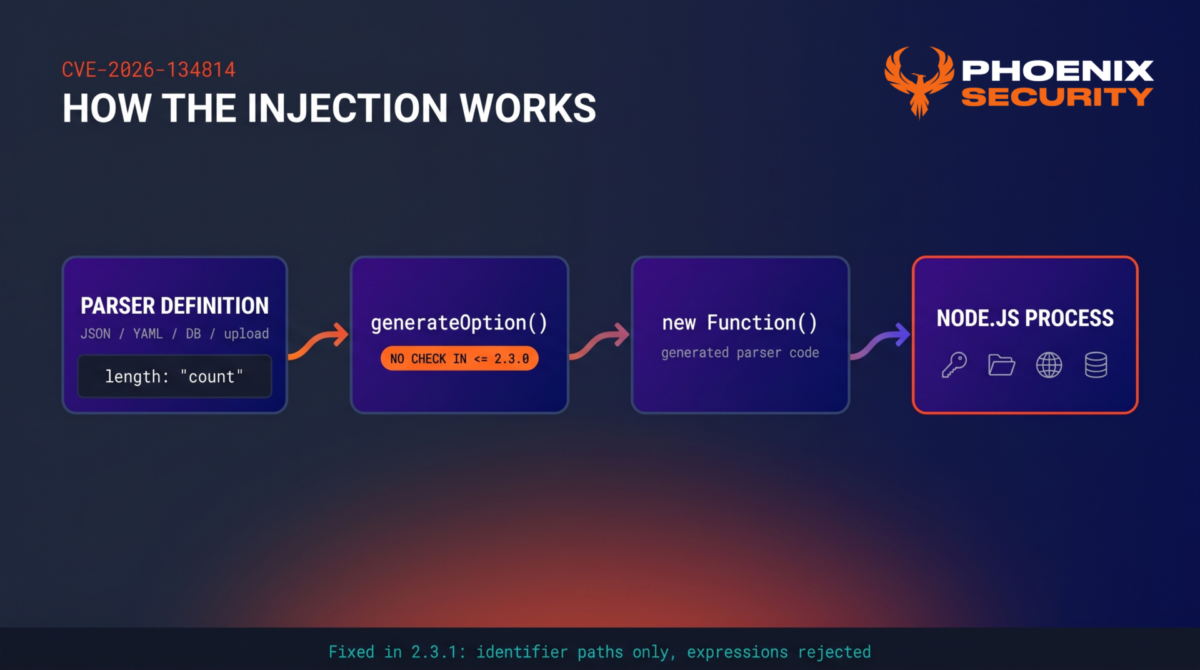
binary-parser is fast because it generates code. A Context object walks each Parser chain and appends JavaScript statements to a string. Then compile() turns that string into a function:
javascript
// binary-parser 2.3.0, dist/binary_parser.js (published package)
this.compiled = new Function(importPath, "TextDecoder",
  `return function (buffer, constructorFn) { ${ctx.code} };`)(ctx.imports, TextDecoder);
Many options take a number, a function or a string that names another field. For example, length: “count” or length: “$parent.len”. Context.generateOption() handles the string case:
javascript
// binary-parser 2.3.0
generateOption(val) {
  switch (typeof val) {
    case "number": return val.toString();
    case "string": return this.generateVariable(val); // no validation
    case "function": return `${this.addImport(val)}.call(${this.generateVariable()}, vars)`;
  }
}
generateVariable() joins the current scope path with the string and returns it as is. Whatever the string contains ends up inside the generated function body. You can see it in the v2.3.0 source.
The CVE-2026-1245 fix added an identifier check to sanitizeFieldName(). That covers field names and encodings. It never touched generateOption().
And generateOption() is the path for a lot of options. length on string, buffer, array and seek. lengthInBytes and key on array. tag on choice. offset on pointer.
Two more sinks sat outside generateOption() completely. wrapped() read its length straight from this.options.length. The alias passed to namely() was never sanitized.
We didn’t rely on release notes for the fix. We diffed the published 2.3.0 and 2.3.1 tarballs from the npm registry.
Version 2.3.1 adds a sanitizeReference() helper. It splits the string on dots and requires every segment to match ^[a-zA-Z_$][a-zA-Z0-9_$]*$. Anything else throws Invalid reference: <value>.
generateOption() now sends strings through that helper. wrapped() now calls generateOption(). Array key is checked. namely() aliases go through sanitizeFieldName(). Version 3.0.0 has the same checks. The changes are in commits 110206b and 4b26e04.
Exploit Path
- Entry point. The attacker supplies or edits a parser definition that the app later turns into new Parser() calls. Usual carriers are JSON or YAML schemas stored per tenant, device or sensor profiles in IoT platforms, protocol mappings uploaded through an admin UI, or a plugin manifest. The attacker doesn’t need to control the binary data being parsed.
- Trigger. One of the affected string options contains characters that aren’t part of a field path. generateOption() pastes the value into the code string. The attacker’s text becomes JavaScript inside the generated parser function.
- Impact. The injected code runs when the parser is compiled and called in the host Node.js process. It gets everything that process has: environment variables and cloud credentials, the filesystem, any module it can require, outbound network, and any tenant data the worker touches.
We’re not publishing a payload. Test strings already circulate in third-party writeups. You don’t need one to check your exposure. The definition audit in Detection Guidance answers the question without running anything.
What’s Confirmed and What Isn’t
| Claim | Status | Source |
|---|---|---|
| Affected options, affected range 2.3.0 and earlier, fix in 2.3.1, trusted definitions not affected | Confirmed by vendor | GHSA-xmxc-6c22-m377, v2.3.1 release notes |
| Fix mechanism (sanitizeReference(), field-path regex) | Confirmed in code | Phoenix diff of npm tarballs 2.3.0 vs 2.3.1 |
| CVSS 9.2 / 8.1 vectors, published November 22, 2026 | Confirmed | CVE record via NVD, VulnCheck as CNA |
| Incomplete fix of CVE-2026-1245 | Confirmed | Vendor advisory; The Hacker News |
| Finder credit | Pending verification | CVE record, single source |
| Not listed in CISA KEV | Checked November 23, 2026 | CISA catalog |
Two wrong claims are going around, so watch for them if you write tickets about this bug.
One auto-generated CVE site quotes “release notes” for 2.3.1 that say options are escaped against a whitelist. The real release notes say options are validated as identifier paths and expressions are rejected. The same site calls the flaw remote and unauthenticated. The vendor advisory doesn’t support that.
The Hacker News coverage from November 23 says CVE-2026-1245 was fixed in January 2026. The 2.3.0 fix was on npm on November 26, 2025. January 20, 2026 was the disclosure date (original coverage).
Also watch for CVE-2026-1245 and CVE-2026-134814 getting swapped in tickets and scanner exceptions. It happens easily.
Timeline
Publish dates below come from the npm registry metadata.
| Date | Event |
|---|---|
| Sep 20, 2022 | 2.2.1 published. Many projects stayed on it for years |
| Nov 26, 2025 | 2.3.0 published with field name and encoding validation |
| Jan 20, 2026 | CVE-2026-1245 disclosed by CERT/CC (CVSS 3.1 6.5) |
| Nov 11, 2026 | 2.3.1 and GHSA-xmxc-6c22-m377 published by the maintainer |
| Nov 21, 2026 | Dependabot PRs bumping 2.3.0 to 2.3.1 seen in downstream repos |
| Nov 22, 2026 | CVE-2026-134814 published by VulnCheck; 3.0.0 published |
| Nov 23, 2026 | EPSS 0.608%; first press coverage |
The 11 days between the GitHub advisory and the CVE matter. Scanners and SLA clocks that only key on CVE IDs saw nothing for this bug until November 22.

Affected Versions
| Package | Vulnerable versions | Fixed version | Notes |
|---|---|---|---|
| binary-parser | 2.3.0 and earlier (all 0.x, 1.x, 2.x through 2.3.0) | 2.3.1 | Drop-in for 2.x users on Node.js 14+. Breaking change: string options accept identifier paths only |
| binary-parser | Below 2.3.0 | 2.3.1 | Also vulnerable to CVE-2026-1245. Skip 2.3.0 |
| binary-parser | n/a | 3.0.0 | Contains the fix. Needs Node.js 22.12+, ESM-only (“type”: “module”, no separate CommonJS build) |
| Forks and vendored copies | Any copy of lib/binary_parser.ts older than commits 110206b and 4b26e04 | Backport both commits | Version labels on forks aren’t reliable. Check the code |
Exposure Analysis
| Environment | Risk level | Why |
|---|---|---|
| Multi-tenant SaaS and IoT platforms that compile tenant-editable parser definitions | Critical | Low-privileged users get code execution on shared backend workers that hold cross-tenant data and cloud credentials |
| Internal tools where operators upload protocol or format definitions | High | An insider or a compromised operator account reaches the worker’s service identity |
| CI/CD jobs that generate parsers from specs in the repo | High | Anyone with PR access to the spec can run code in the runner and reach pipeline secrets, especially in pull_request_target style workflows |
| Cloud workloads parsing untrusted bytes with hard-coded definitions | Low | Not affected per the maintainer. Upgrade on your normal schedule |
| Developer machines | Low to Medium | Exposed only when developers load third-party definitions locally. Secrets on the laptop raise the stakes |
There’s no Shodan fingerprint for this bug. binary-parser is an in-process library with no listener and no banner.
External attack surface scanning can find the services that accept definition uploads. It can’t tell you which library those definitions go to. For that you need SCA plus a look at the code.

Real-World Impact
npm recorded 31,002 downloads of binary-parser between November 16 and 22, 2026. That’s all versions, including CI re-installs and mirrors. It’s not a count of vulnerable deployments.
Typical users are protocol and file-format decoders. Home automation adapters, for example. Dependabot opened a 2.3.0 to 2.3.1 bump in the ioBroker Roborock adapter on November 21. Also telemetry and sensor ingestion, network capture tools, and game or device protocol libraries.
As of November 23, 2026 we found no confirmed report of exploitation in the wild and no CISA KEV listing. EPSS is at 0.608%. That’s a forecast across everyone who uses the package. It says nothing about the one service in your estate where customers edit schemas that a privileged worker compiles.
The realistic attacks follow the trust boundary.
A tenant on an IoT ingestion platform edits a device profile. They get code execution on the shared decoder fleet, take the worker’s cloud role credentials, and read other tenants’ telemetry.
A contributor submits a protocol spec change to a repo whose CI generates and runs parsers. They take the runner’s tokens.
A compromised partner account in a data-exchange integration changes a format mapping. It plants persistence in a long-running worker.
Detection Guidance
Log and Runtime Indicators
Stored parser definitions are your main evidence. Look at every value for length, lengthInBytes, key, tag, offset and every namely() alias. If it’s a string and doesn’t match this pattern, it needs a human look:
^[A-Za-z_$][A-Za-z0-9_$]*(\.[A-Za-z_$][A-Za-z0-9_$]*)*$A string that fails the pattern is either a legitimate expression that will break on 2.3.1, or an injection attempt. You need to know which one.
After the upgrade, compile-time errors with Invalid reference: or Invalid field name: are a strong signal. Send them to security, not only to the owning team’s error budget. Check who last edited that definition.
On the worker side, look for Node.js parser or decoder processes that spawn shells or child processes. Also unexpected outbound connections from decoder services, and reads of credential paths or instance metadata endpoints soon after a definition was created or changed.
Scanner References
Phoenix Security SCA ingestion and reachability analysis flag binary-parser 2.3.0 and earlier across repositories, container images and SBOMs, mapped to the owning teams.
GitHub Dependabot and the GitHub Advisory Database carry both GHSA-xmxc-6c22-m377 and GHSA-hhq6-2gpv-hrf4. Any SCA or SBOM tool keyed to CVE-2026-134814 will match. Check if your tool reports by GHSA, CVE or both. If you don’t, you’ll double-count, or miss the 11 days before the CVE existed.
A SAST rule that tracks data from request bodies, database reads or file loads into new Parser() option arguments shows you the code paths that matter.
Verification Steps for Teams
- Find installs:
npm ls binary-parser --all(orpnpm why binary-parser,yarn why binary-parser) in every repo and in built images, not only in source lockfiles. - For each hit, run
npm explain binary-parserto find the parent package. Then confirm the version in the deployed artifact. - Find every place a parser gets built: search for
new Parser(and binary-parser imports. Mark whether the options come from code literals or from data (JSON, database rows, API input, uploaded files). - For data-driven places, find out who can write that data and which service identity compiles it.
- Audit stored definitions against the pattern above. Review every value that doesn’t match.
- Check your external attack surface for endpoints that accept definition or schema uploads. Tie them back to the services from step 3.
Remediation Guidance
Immediate Actions
- Upgrade direct dependencies:
npm install binary-parser@2.3.1 --save-exact. Use binary-parser@3.0.0 only if the service already runs Node.js 22.12 or later and can take an ESM-only package. - Force transitive copies to the fixed version, then regenerate the lockfile and rebuild images:
json
// npm
"overrides": { "binary-parser": "2.3.1" }
// Yarn
"resolutions": { "binary-parser": "2.3.1" }
// pnpm
"pnpm": { "overrides": { "binary-parser": "2.3.1" } }- Run your tests against existing definitions. Expressions like “len – 1” now throw at compile time. Replace them with functions your app owns:
javascript
length: function () { return this.len - 1; }Don’t bring back eval of config strings to keep the old behavior.
- Redeploy and restart long-running workers. Compiled parsers stay cached in memory. A new lockfile does nothing until the process restarts.
- If you confirm a reachable data-driven path, treat the compiling service’s credentials as exposed. Rotate cloud role credentials, API keys and database secrets for that identity. Review the definition change history back to the first vulnerable deploy.
Temporary Mitigations
- Validate definitions when they’re written, with the same field-path rule the fix uses. Reject anything else before it reaches storage.
- Limit who can create or edit parser definitions. Remove that permission from tenant and partner roles where the business doesn’t need it.
- Move parser compilation into an isolated worker with a minimal identity. No cloud admin roles, no shared database credentials, egress limited to what decoding needs. Use the Node.js permission model (
--permission) where your runtime supports it. - Pin the dependency and block latest resolution in scaffold or E2E jobs that install fresh.
A WAF won’t help here. The payload travels as stored configuration, often through authenticated admin APIs. A backend worker runs it later. Validate at the schema API and in the persistence layer instead.
How Phoenix Security Handles This
The same bug shows up in three places: a Dependabot alert on GHSA-xmxc-6c22-m377, an SCA finding on CVE-2026-134814, and a container image finding for the package. Phoenix Security’s contextual deduplication folds them into one backlog item per affected asset. One ticket, one SLA, one owner.
Reachability analysis does the triage this bug needs. It separates services where binary-parser is a dormant transitive dependency from services where it’s loaded at runtime in a deployed workload. The first wave of work goes to services that compile definitions in production.
Attack surface management ties internet-facing schema and upload endpoints back to the services running vulnerable versions. That’s where a Critical label is earned.
Track It as a Campaign
Remediation campaigns turn the response into a tracked program. Create a CVE-2026-134814 campaign. Ownership attribution assigns each affected repo and image to its team. You track upgrades to 2.3.1 or 3.0.0 and check closure against runtime inventory, not lockfile diffs.
Here’s the campaign config. Import it into Phoenix to start tracking right away.
json
{
  "name": "BINARY-PARSER-CVE-2026-134814 - campaign",
  "description": "Code injection in binary-parser <= 2.3.0 via string-typed parser options (length, lengthInBytes, key, tag, offset, namely alias). Incomplete fix of CVE-2026-1245. Fixed in 2.3.1 and 3.0.0. Priority: services that compile parser definitions from tenant, partner or stored data.",
  "enabled": true,
  "responsibleUserEmail": "<owner@yourcompany.com>",
  "config": {
    "filters": [
      {
        "organizationId": null,
        "cwes": [94],
        "cvssVector": "CVSS:3.1/AV:N/AC:H/PR:N/UI:N/S:U/C:H/I:H/A:H",
        "exploitabilities": null,
        "severityLevels": ["CRITICAL", "HIGH"],
        "assetKey": null,
        "assetLocality": null,
        "teamIds": null,
        "applicationId": null,
        "scannerIds": null,
        "scannerCategory": "SCA",
        "tagFilter": null,
        "productValue": null,
        "libraries": [
          { "name": "binary-parser", "version": "2.3.0" },
          { "name": "binary-parser", "version": "2.2.1" }
        ],
        "duplicateType": null,
        "openWithinLast": null,
        "search": "CVE-2026-134814",
        "remedy": null,
        "assetFilter": {
          "osNames": null, "hostnames": null, "netbiosNames": null,
          "vpc": null, "subnet": null, "resourceType": null,
          "resourceGroup": null, "repository": null, "fqdn": null, "ipRanges": null
        },
        "negateFilter": null
      }
    ],
    "selectedIds": null,
    "notificationThreshold": null
  },
  "summary": "Affected: binary-parser <= 2.3.0 (all 0.x, 1.x, 2.x). Fixed: 2.3.1 (Node.js 14+), 3.0.0 (Node.js 22.12+, ESM-only). Advisories: GHSA-xmxc-6c22-m377, GHSA-hhq6-2gpv-hrf4. CVSS 4.0 9.2 / CVSS 3.1 8.1. No confirmed exploitation as of 2026-11-23."
}
Phoenix Security links vulnerable components to runtime workloads, finds exposed services through attack surface management, and assigns remediation owners. The result is a smaller blast radius and a backlog your teams own and can track.
Want to see which of your services compile parser definitions from data? Book a demo.
External References
- CVE-2026-134814, CVE record
- NVD entry for CVE-2026-134814
- Vendor advisory GHSA-xmxc-6c22-m377
- GitHub Advisory Database GHSA-hhq6-2gpv-hrf4
- binary-parser release v2.3.1
- binary-parser release v3.0.0
- Fix commit 110206b
- Fix commit 4b26e04
- Vulnerable code in v2.3.0
- VulnCheck advisory
- FIRST EPSS data, November 23, 2026
- npm downloads, November 16 to 22, 2026
- npm registry metadata (publish times, engines)
- CVE-2026-1245 on OSV (GHSA-m39p-34qh-rh3w)
- CERT/CC VU#102648
- The Hacker News, CVE-2026-134814 coverage
- The Hacker News, CVE-2026-1245 coverage
- EUVD-2026-132849