Executive Summary
On 19 November 2026 the PHP project shipped 8.2.36, 8.3.37, 8.4.28 and 8.5.13, plus 8.6.0 final. The release closes seven critical vulnerabilities. Each one carries a PHP CVSS v4.0 score of 9.2.
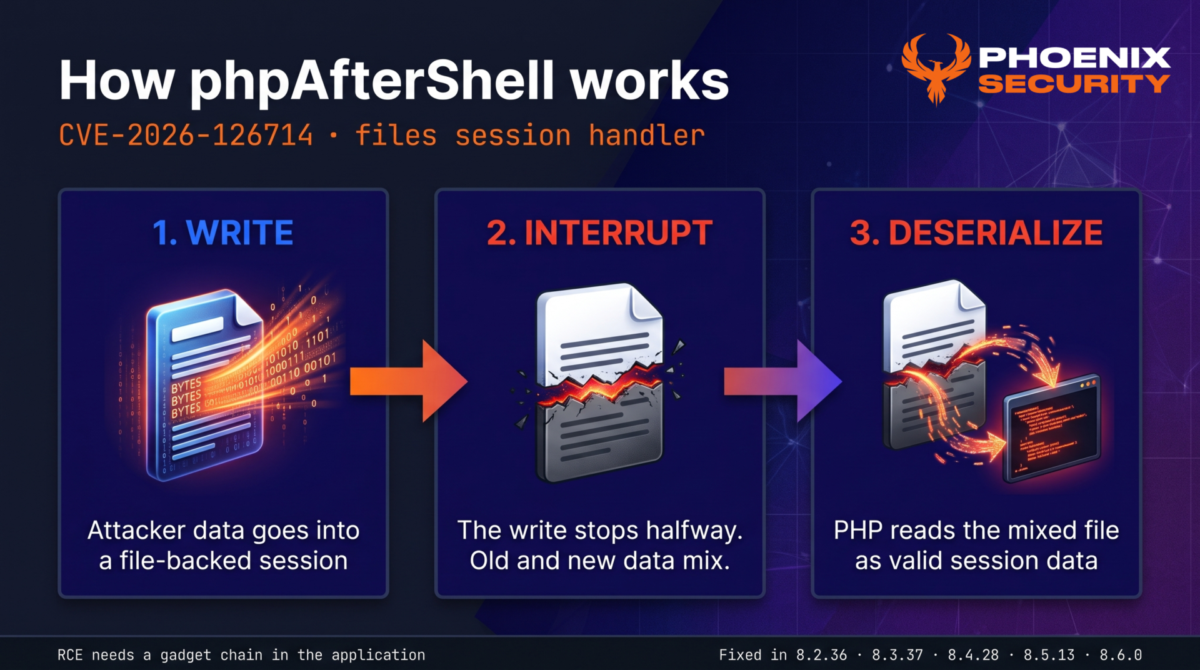
The headline bug is phpAfterShell, tracked as CVE-2026-126714 (PHP advisory GHSA-fm2m-fjf5-v3cp). It is a flaw in PHP’s built-in files session handler. An interrupted write can leave a session file that mixes the start of a new session with the tail of the old one. On a later request, PHP reads that mixed file back as valid session data. If an attacker can influence session contents, this opens a path to object injection. With a suitable gadget chain, it leads to remote code execution.
phpAfterShell is CVE-2026-126714. It is a different bug from CVE-2026-115560 (PHP advisory GHSA-658j-r8rw-q6mx). Both touch PHP sessions, so people mix them up. Their failure modes don’t overlap. phpAfterShell makes PHP trust a partially overwritten session file. CVE-2026-115560 needs two contexts that read and write the same session with incompatible serializers. The preconditions, fixes and blast radius are all different. A wrong CVE number on a remediation ticket sends teams chasing the wrong configuration.
The release also has a second route to unauthenticated code execution, and this one doesn’t need sessions. CVE-2026-129289 is a PHP-FPM request smuggling flaw (PHP advisory GHSA-qc49-hpvq-g2w6). On some deployments, the front end reuses its FastCGI connection to the worker pool. There, a single crafted request can run attacker-controlled PHP as the FPM worker. It needs no sessions, no memory corruption and no race. That makes it the most reliable bug in the batch and the one to patch first.
TL;DR for Engineering Teams
- What it is: phpAfterShell (CVE-2026-126714, CVSS v4.0 9.2) corrupts PHP’s default file-based session store, so a later read deserializes attacker-influenced data. It is part of a seven-CVE PHP release from November 2026.
- Where it bites: PHP 8.2 to 8.5 with
session.save_handler = files(the default). The parallel FPM bug (CVE-2026-129289) hits any 8.2 to 8.5 host whose front end reuses backend FastCGI connections. - Why it matters: PHP runs roughly 68% of websites with a known server-side language (W3Techs). The October PHP2Shell bugs sit in the same session and upload-progress code. They were exploited before patches shipped, and CISA added them to KEV on 26 October (CISA alert). No in-the-wild use of the November CVEs is reported yet. But 26 GitHub repositories naming the related CVE-2026-115560 appeared within ten days of its 23 October pre-advisory.
- Patch status: Fixed. The first patched releases are 8.2.36, 8.3.37, 8.4.28 and 8.5.13. 8.6.0 final also has the fixes. End-of-life branches (8.1 and older) get no upstream fix.
- Immediate action: Today, patch any host with FastCGI connection reuse (CVE-2026-129289). Then patch every host on default file sessions (phpAfterShell and CVE-2026-115560). If you can’t patch at once, disable front-end-to-FastCGI connection reuse and set
session.upload_progress.enabled=0in server config. Then restart workers.
Vulnerability Overview
| Field | Value |
|---|---|
| Vendor | PHP Group |
| Product | PHP (ext/session files handler) |
| Vulnerability Type | Session-file corruption leading to object injection / RCE |
| CWE | CWE-367 (TOCTOU), CWE-662 |
| CVSS Score | 9.2 (PHP CVSS v4.0) |
| CVE | CVE-2026-126714 (phpAfterShell) |
| Advisory | GHSA-fm2m-fjf5-v3cp |
| Patch Available | Yes (8.2.36 / 8.3.37 / 8.4.28 / 8.5.13 / 8.6.0) |
| Active Exploitation | Not confirmed as of 19 November 2026 |
Technical Anatomy
Root cause
The files session handler writes the new serialized blob into the existing session file. It doesn’t clear the file first. When the write completes, the new data fully overwrites the old. When the write stops partway, the file can hold the start of the new session followed by the leftover end of the previous one. A fatal error or a process limit hit in the middle of pwrite can cause this. PHP’s advisory describes the result as a file with parts of two different serialized sessions.
A broken file on its own would be harmless. The problem is that PHP still parses the mixed file as valid session data the next time the session opens. An attacker needs two things: control over part of the session contents, and a way to interrupt the write at a chosen point. With both, they can steer what PHP deserializes on the next request.
PHP notes the issue is not limited to upload progress or to PHP 8.6. Upload progress is one easy way to get attacker bytes into a session before application code runs. But any application that stores attacker-controlled values in a file-backed session is in scope.
Exploit path
- Entry point. The attacker sends a request that makes PHP write attacker-influenced data into a file-backed session. Then they force the replacement write to stop at a controlled offset. With upload progress on, PHP updates the session while it parses a multipart body, before application code runs. So the target endpoint doesn’t need its own upload feature.
- Trigger. On a later request, PHP opens the session and reads the mixed file. The serialized stream now has attacker-steered object data stitched to a trusted prefix. PHP deserializes it like a normal session.
- Execution impact. The deserialized objects drive a gadget chain in the application’s loaded code toward remote code execution in the PHP worker process.
A note on the public evidence. The researchers who reported the bug to PHP in late October 2026 named it phpAfterShell. They say they chained it with a separate PHP-native deserialization-to-RCE finding to reach code execution. PHP’s advisory frames the final RCE as conditional on a suitable gadget chain in the application. Until the full write-up is validated, treat any claim that end-to-end RCE needs no application gadget as a researcher claim. The researchers also say the exploits worked against default configurations. PHP’s pre-release notice said the critical issues need non-default or uncommon setups. That disagreement is worth tracking.
The parallel route: CVE-2026-129289 (PHP-FPM request smuggling)
This bug needs no sessions at all. That is why it leads the patch order.
A malformed multipart/form-data body stops PHP’s multipart parser at a predictable position. If the application opens php://input and doesn’t read it to the end, the leftover bytes stay on the persistent backend connection. PHP-FPM then parses those bytes as a new FastCGI request. The front end never created or authorized that request.
The forged request controls SCRIPT_FILENAME, REMOTE_ADDR and PHP_ADMIN_VALUE. Setting allow_url_include=1 with auto_prepend_file=php://input runs the request body as PHP. The injected admin settings can also persist for later requests on the same worker.
PHP states the attack crosses the HTTP-to-backend trust boundary with a single request. It doesn’t need memory corruption, address knowledge or a race. For the LSAPI SAPI, the advisory confirms request desynchronization, not code execution.

Affected Versions
| Package | Vulnerable Versions | Fixed Version | Notes |
|---|---|---|---|
| PHP (phpAfterShell, CVE-2026-126714) | 8.2.x to 8.5.x before the fixed releases | 8.2.36 / 8.3.37 / 8.4.28 / 8.5.13 / 8.6.0 | Requires files session handler (default) |
| PHP-FPM / LSAPI (CVE-2026-129289) | 8.2.x to 8.5.x (bug present since 5.6.0) | 8.2.36 / 8.3.37 / 8.4.28 / 8.5.13 / 8.6.0 | Needs front-end FastCGI connection reuse; EOL 5.6 to 8.1 unfixed |
| PHP session serializer (CVE-2026-115560) | 8.2.x to 8.5.x | 8.2.36 / 8.3.37 / 8.4.28 / 8.5.13 / 8.6.0 | Needs upload progress + mismatched session.serialize_handler |
| PHP engine, magic-method backtrace (CVE-2026-129474) | 8.5.x | 8.5.13 / 8.6.0 | 8.5 only; zend.exception_ignore_args=1 blocks the path |
| PHP date, timezone cache (CVE-2026-129496) | 8.2.x to 8.5.x | 8.2.36 / 8.3.37 / 8.4.28 / 8.5.13 / 8.6.0 | Depends on file-based error_log startup diagnostics |
| PHP engine, backtrace after shutdown (CVE-2026-129182) | 8.5.x | 8.5.13 / 8.6.0 | 8.5 only; use-after-free, no demonstrated RCE |
| PHP session shutdown (CVE-2026-129481) | 8.3.x to 8.5.x | 8.3.37 / 8.4.28 / 8.5.13 / 8.6.0 | Incomplete fix for October CVE-2026-109619 |
All seven report CVSS v4.0 9.2 with Attack Requirements present. That means each one depends on deployment conditions. Prioritize by your configuration, not by the shared score.
Exposure Analysis
| Environment | Risk Level | Reason |
|---|---|---|
| Internet-exposed PHP-FPM behind a reusing front end | Critical | CVE-2026-129289 gives single-request unauthenticated code execution with no gadget or memory work |
| Internet-exposed apps on default file sessions | High | phpAfterShell and CVE-2026-115560 reach deserialization through attacker-influenced session data |
| CI/CD pipelines running PHP | High | Worker compromise exposes build credentials and artifact signing material |
| Cloud workloads / shared hosting | High | Shared session storage across FPM pools or vhosts widens CVE-2026-115560 reach |
| Developer environments | Medium | Local file sessions and debug error logging raise the timezone-cache path (CVE-2026-129496) |
Scale context: W3Techs reports PHP on roughly 68% of sites with a known server-side language. PHP 8 runs on about 68% of PHP sites. Internet scans during the October response put internet-facing PHP hosts in the low millions. Session storage isn’t visible from outside, so nobody can measure how many of those hosts use default file sessions. Files is the default. Assume most self-managed deployments are in scope until you prove otherwise.
Real-World Impact
As of 19 November 2026, no source reports in-the-wild exploitation of any November CVE. No reports doesn’t mean no exploitation. Two signals still argue for urgency.
First, PHP published an informational advisory for CVE-2026-115560 on 23 October. Between 21 and 31 October, 26 GitHub repositories naming that CVE were created. At least six describe a proof of concept, a lab or an exploit framework.
Second, the October PHP2Shell bugs sit in the same session and upload-progress code. Exploitation attempts were seen four days before those bugs were disclosed. CISA added CVE-2026-109618 and CVE-2026-109619 to KEV on 26 October (CISA alert). Public reporting later documented real compromises tied to them.
Realistic attack scenarios:
- An attacker runs code as the FPM worker through CVE-2026-129289 and pivots into cloud credentials mounted on the host.
- An attacker poisons a file-backed session on a multi-tenant host to deserialize into a known framework gadget.
- A shared-hosting tenant reads another tenant’s session where storage isn’t isolated between pools.
Detection Guidance
Log indicators
Look for multipart/form-data POSTs with malformed or truncated boundaries. Correlate them with FPM worker deaths (SIGSEGV or SIGABRT) and memory_limit fatal errors in the same window.
Watch for session files that fail to decode. Watch for object notation in sessions where the application stores only scalars, and for unexpected upload_progress_ keys.
For CVE-2026-129289, look for requests that reach scripts your front-end routing doesn’t expose. Also look for allow_url_include or auto_prepend_file values taking effect that you never set. A worker that keeps running doesn’t prove you’re safe. A successful exploit leaves the worker alive.
Scanner references
Phoenix Security scanners identify affected PHP runtime versions across your estate. Each finding is tied to the deployment that serves traffic. Pair that with SCA and SBOM review for PHP runtime version strings, and with external attack surface scanning for internet-facing FPM listeners. Host inventory then shows the effective session.save_handler, the upload-progress setting and the front-end FastCGI reuse flags. Those settings decide whether a given host is actually exploitable.
Verification steps for teams
- Inventory every running web worker’s PHP build or vendor package revision, not just a CLI
php -v. - Record the effective
session.save_handler,session.serialize_handlerandsession.upload_progress.enabledper pool. - Check the front end for FastCGI connection reuse: nginx
fastcgi_keep_conn, Apachemod_proxy_fcgienablereuse, HAProxy FastCGI retained connections, or LSAPI. - Confirm the patched build is the one serving requests after rollout. A clean Composer scan doesn’t prove the runtime was replaced.
Remediation Guidance
Immediate actions
- Upgrade the serving runtime to 8.2.36, 8.3.37, 8.4.28 or 8.5.13, or to 8.6.0 (see the PHP 8 ChangeLog). For distribution or appliance builds, take the vendor’s fixed package revision. Don’t judge by the upstream version string, because downstream backports often leave
PHP_VERSIONunchanged. - Rebuild and roll out affected container images or restart affected services. Then verify every replica is on the fixed build.
- On PHP 8.5 hosts, confirm
zend.exception_ignore_args=1(the php.ini-production default). This closes the CVE-2026-129474 path (PHP advisory GHSA-8mjj-2r7p-4hg2). Check FPM pool overrides for it too.
Temporary mitigations if patching is delayed
- Disable front-end-to-FastCGI connection reuse on unpatched FPM hosts (
fastcgi_keep_conn off,enablereuse=off). This fully removes the demonstrated CVE-2026-129289 attack. It is the highest-value stopgap. - Set
session.upload_progress.enabled=0in php.ini or the FPM pool config, before request processing. An application-levelini_set()runs too late. This blocks the demonstrated upload-progress route into phpAfterShell and CVE-2026-115560. It doesn’t block every route that puts untrusted data into file sessions. - If upload progress stays on after the upgrade, align
session.serialize_handleracross every application, pool and CLI job that shares a session store. Or isolate the stores. Separate FPM pools don’t automatically mean separate session storage. - Fix startup configuration warnings or switch
error_logto syslog to close the CVE-2026-129496 path. Then restart the master and all workers.
Patch order to take
- FastCGI-reusing hosts first (CVE-2026-129289).
- All default-file-session hosts (phpAfterShell and CVE-2026-115560).
- PHP 8.5 hosts (CVE-2026-129474, CVE-2026-129182).
- The condition-heavy CVE-2026-129496 and CVE-2026-129481.
End-of-life branches get no upstream fix. Migrate PHP 8.1 and older, or apply a vendor backport.

Phoenix Security Recommendations
Phoenix Security turns a seven-CVE release into one owned, trackable backlog instead of seven parallel fire drills.
Contextual deduplication correlates PHP runtime findings across SCA, container and attack-surface scanners. You get a single prioritized item per deployment, so the same host doesn’t generate seven separate tickets. Reachability analysis shows which PHP workers actually serve traffic and which carry the exploitable configuration. The FastCGI-reusing and file-session hosts rise to the top, instead of every PHP install at once.
Remediation campaigns let a team create a campaign for the November PHP release, assign owners by service and track upgrades to the specific fixed version. The team can then verify that the patched build is the one serving requests at runtime. Vulnerability ownership attribution maps each finding to the responsible team automatically. Attack surface management flags internet-facing FPM listeners running vulnerable runtimes. The blast radius shrinks to the hosts that are actually exploitable, with an owner and a verified fix on each.
The Phoenix campaign for this release
We’ve prepared a campaign config for the November PHP release: “PHP November 2026 Critical Release – phpAfterShell + FPM smuggling”. It’s an exposure campaign. The target is every PHP runtime in your estate.
What the campaign matches: four packages, php, php-fpm, php-cli and php-cgi, across all versions. Findings land in one campaign backlog, mapped to the owning team.
Priority inside the campaign follows the patch order above. FastCGI-reusing hosts come first, then default file-session hosts, then PHP 8.5, then the rest. End-of-life branches (8.1 and older) are flagged for migration or a vendor backport.
CWE mapping used by the campaign:
| CVE | CWE |
|---|---|
| CVE-2026-126714 (phpAfterShell) | CWE-367, CWE-662 |
| CVE-2026-129289 | CWE-444, CWE-670 |
| CVE-2026-115560 | CWE-20, CWE-502 |
| CVE-2026-129474 | CWE-416 |
| CVE-2026-129496 | CWE-416, CWE-459 |
| CVE-2026-129182 | CWE-416 |
| CVE-2026-129481 | CWE-416, CWE-459 |
Detection signals the campaign tracks:
| Signal | Where |
|---|---|
| Malformed multipart POST + FPM worker SIGSEGV/SIGABRT in the same window | Web/FPM logs |
| Session file holds object notation where the app stores scalars | Session store |
| Request reaches a script not exposed by front-end routing | Access logs |
allow_url_include / auto_prepend_file in effect but never configured | FPM runtime |
| Child process (sh, curl, wget) spawned by the PHP service account | Host EDR |
Find the PHP an attacker can reach before they do. Test it with Phoenix Orange, free.
External References
- PHP session-file advisory GHSA-fm2m-fjf5-v3cp (CVE-2026-126714)
- PHP-FPM request smuggling advisory GHSA-qc49-hpvq-g2w6 (CVE-2026-129289)
- PHP session serializer advisory GHSA-658j-r8rw-q6mx (CVE-2026-115560)
- PHP magic-method backtrace advisory GHSA-8mjj-2r7p-4hg2 (CVE-2026-129474)
- PHP 8 ChangeLog: fixed releases and GHSA list
- CISA adds PHP2Shell CVE-2026-109618 and CVE-2026-109619 to the KEV catalog
- The Hacker News: PHP fixes seven critical flaws (November 2026)
- W3Techs: PHP usage statistics (November 2026)