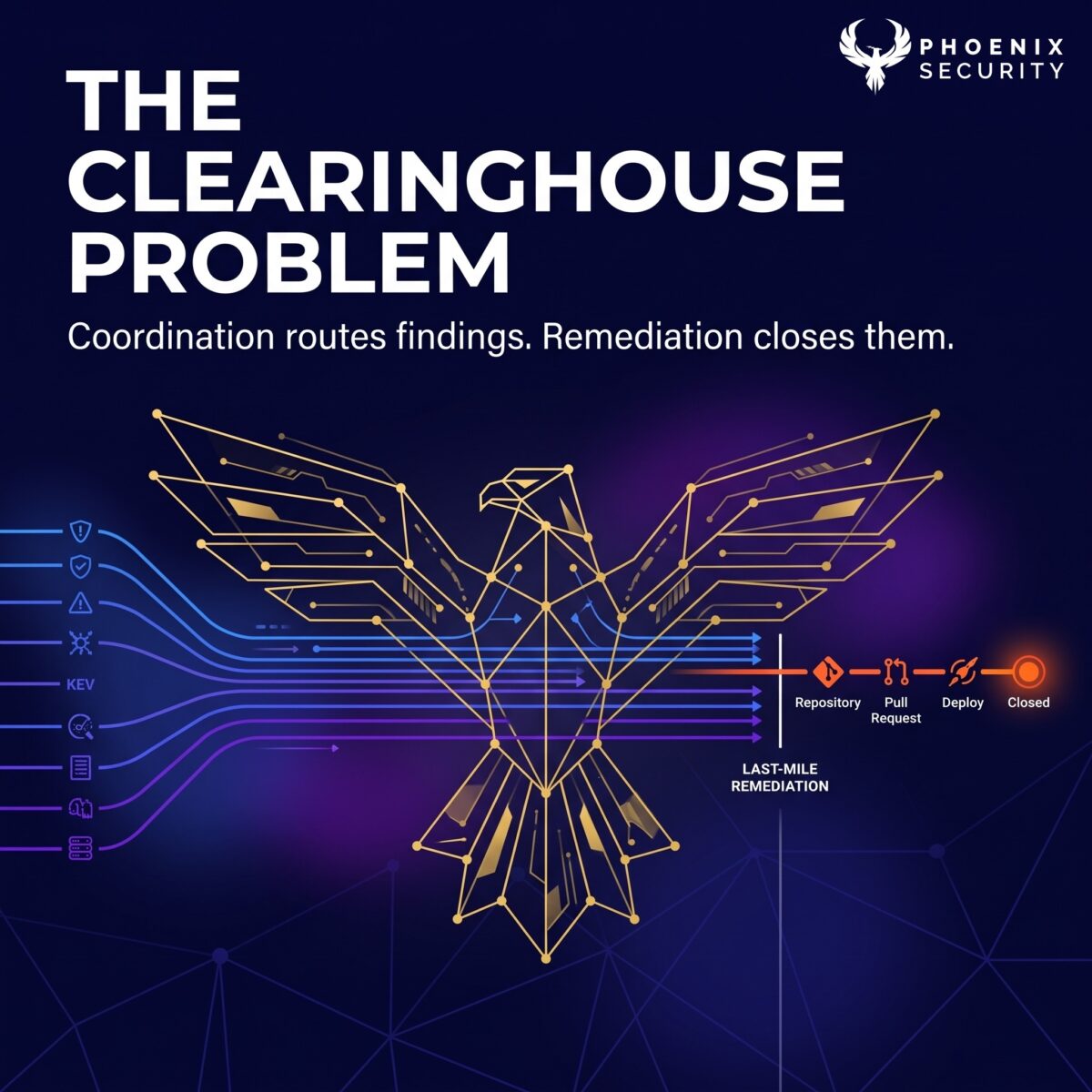
Gold Eagle solves a real coordination and prioritization gap, but it never touches the last mile of remediation velocity, fix bundling, and ownership attribution, which is where vulnerability programs actually fail.
Key Takeaways
- Gold Eagle is a coordination clearinghouse built on existing CERT/CC infrastructure, not a remediation engine; it routes findings, it does not close them.
- BOD 26-04’s four prioritization dimensions (KEV status, public exposure, exploit automation, technical impact) are the correct signals, and they map directly to exploitability, exposure, reachability, and business context.
- The measurable objective of any clearinghouse is remediation velocity, not intake volume; if you cannot burn down the backlog, faster discovery makes the problem worse.
- Fixing at scale means acting where the code lives: SCA remediation per build file, campaigns that start externally-facing and work back in, and container analysis scoped to what is actually running.
- Closing the tap matters as much as clearing the backlog; toxic combinations in code need to be caught and bundled into fix groups before they ship.
1. The Problem: We Built Discovery, Then Called It Progress
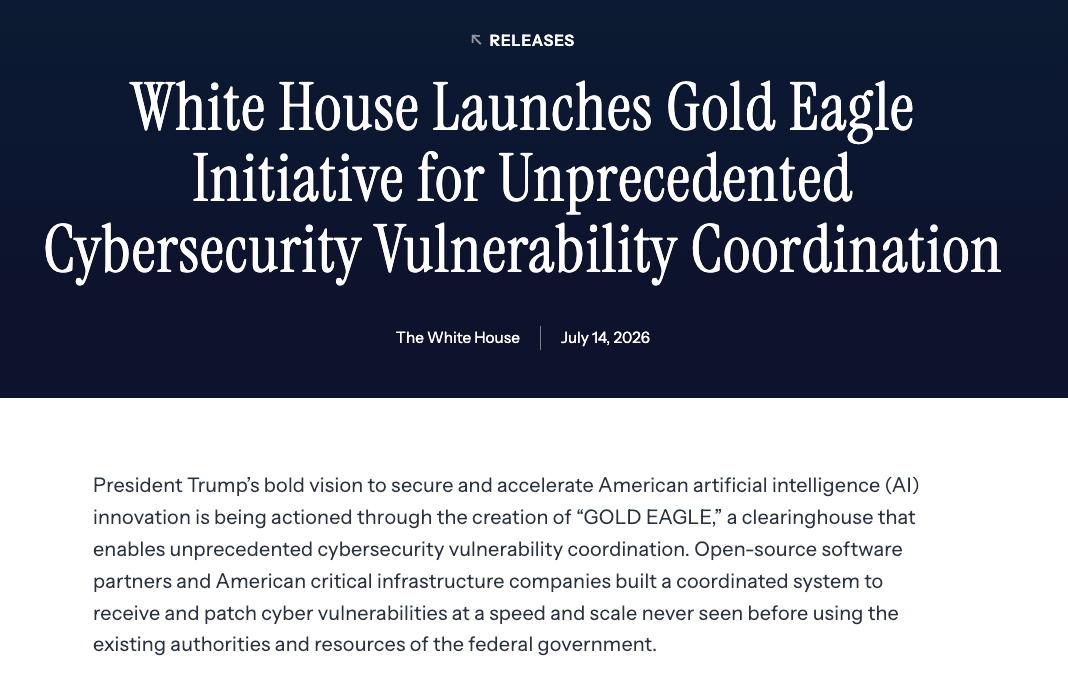
On July 14, the White House launched Gold Eagle, a voluntary vulnerability coordination clearinghouse for critical infrastructure and the AI industry. It runs on VINCE, the Vulnerability Information and Coordination Environment that Carnegie Mellon’s Software Engineering Institute has operated through CERT/CC for years. Its stated function is to intake vulnerabilities, deconflict scanning across sectors, coordinate validation, and route remediation.
The gap it targets is genuine. Take, for example, the most common problem we solve with Phoenix Correlate: which vulnerabilities are in code, in a container, and in a base image, and which container is active. All this has been hindering remediation efforts; without clear data, remediation becomes noisy and token-expensive. The KEV catalog, the NVD, and the ISACs each cover part of the picture, and none of them coordinate across industries.
But look at what the mandate actually promises. Casey Ellis, described Gold Eagle as a coordination process wearing a technical system’s clothes. His sharper point is the one worth sitting with: the initiative is described in verbs, not nouns. Coordinate. Prioritize. Deconflict. Relentlessly patch. By whom, under what authority, funded how?
The security industry has spent a decade solving the wrong constraint. We built scanners that find everything. We added EPSS to score exploit likelihood, KEV to flag active exploitation, SBOMs to inventory dependencies. Now we are bolting AI-speed discovery on top so models can surface vulnerabilities faster than any human can trace them. Gold Eagle accelerates the same layer we have already over-invested in.
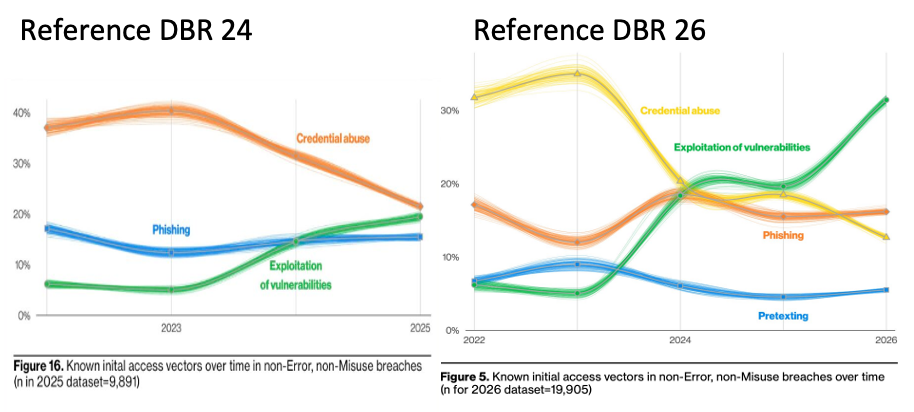
Discovery was never the bottleneck. Verizon’s 2026 DBIR, cited by CISA in the BOD 26-04 rollout, found that 26% of KEV CVEs were fully remediated in 2025, down from 38% the year before. More findings, fewer fixes
2. Technical Analysis: What a Clearinghouse Cannot Do
Finding vulnerabilities proactively has never been the constraint, and finding a fix or patch has not been a significant constraint either. The constraint is deploying the fix everywhere the software runs, then recertifying that everything still works. Sunil Yu has mentioned this clearly here. The key is to demystify remediation; it is not a single step. It is deploy, then validate, then prove nothing broke.
A clearinghouse operates upstream of all of that. It can tell you a vulnerability is exploited in the wild. It can deconflict two agencies scanning the same asset. It can hand you a prioritized queue.
Then it stops.
- Is this vulnerability in your systems?
- How exposed are those systems?
- How many teams have this vulnerability?
- Is this vulnerability a high-impact vulnerability (like Remote Code Execution) or a non-reachable network attack on a container that is not even running
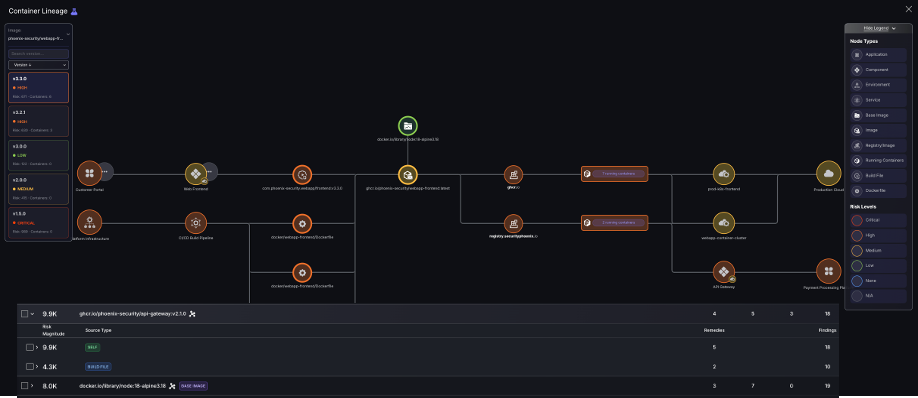
The queue of problems lands somewhere, but teams are not even aware, and everything expensive begins there: figuring out which of your 40 teams owns the affected service, whether the fix is a breaking change, whether you can batch it with eleven other upgrades touching the same library, and whether the container carrying the vulnerable dependency is even running.
None of that is coordination work. It is remediation work, and it happens inside your walls where no clearinghouse has visibility.
The BOD 26-04 model reflects this reality. CISA’s directive, published June 10, revoked the old CVSS-based BOD 19-02 and replaced flat KEV timelines with a four-variable risk model: is the asset publicly exposed, is the CVE in KEV, can the exploit be automated, and what is the post-exploitation technical impact? Sixteen combinations collapse into five remediation deadlines, and on one large federal agency CISA analyzed, only 1% of vulnerability instances landed in the three-day bucket while more than 60% were deferred to the next scheduled upgrade. The model concentrates effort rather than diluting it.
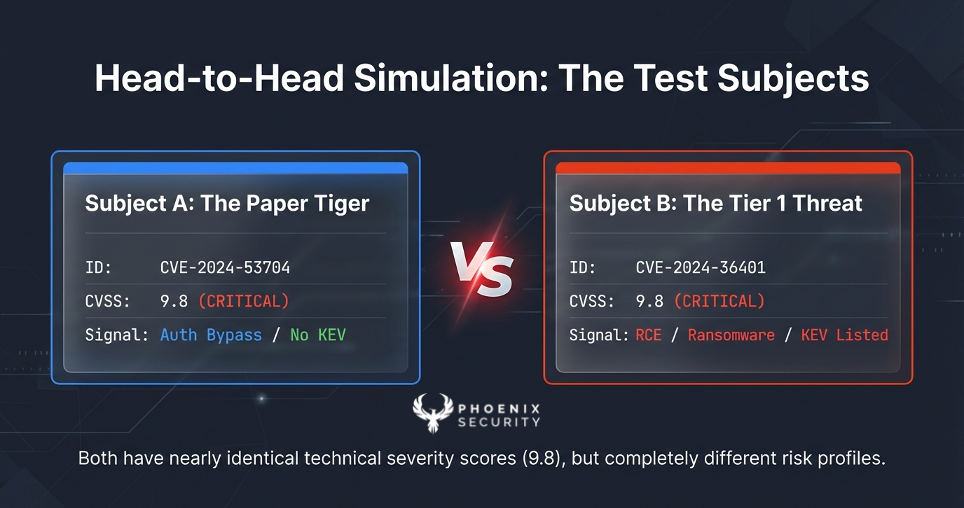
Those four dimensions are the right signals. They are also the four dimensions Phoenix has argued for since before the directive existed:
Risk = Exploitability + Exposure + Reachability + Business Context
KEV status is exploitability with evidence. Public exposure is exposure. Exploit automation is a reachability and blast-radius question. Technical impact is business context. BOD 26-04 is the federal government arriving at the same conclusion: severity alone is noise, and the classes of vulnerability that carry the biggest blast radius are the ones worth measuring. That is exactly what Phoenix Blue scores. Not the CVSS number, but the exploitation reality and the technical impact behind it.
3. The Phoenix Approach: Clear the Houses, Then Close the Tap
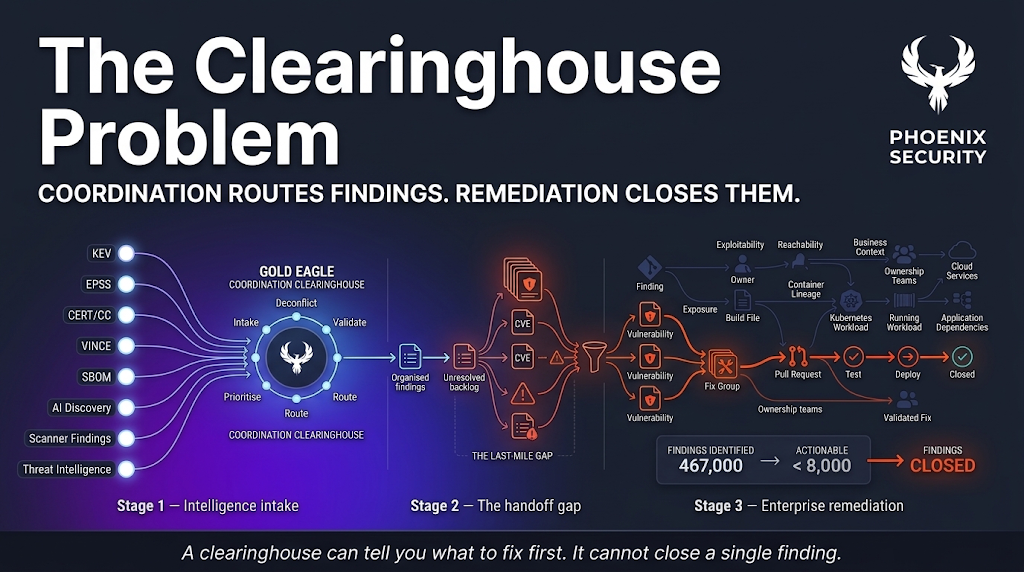
Phoenix Security starts from a position that predates Gold Eagle: security teams do not lack data; they lack context and ownership. A clearinghouse adds more data and a routing layer. It does not add ownership, and it does not remediate. Those are the two things that decide whether a backlog ever shrinks.
Frame the whole problem as two jobs. Burn down the backlog, clearing the existing houses full of vulnerabilities. And close the tap to stop new toxic combinations from flowing in. Gold Eagle helps with neither. Phoenix is built for both.
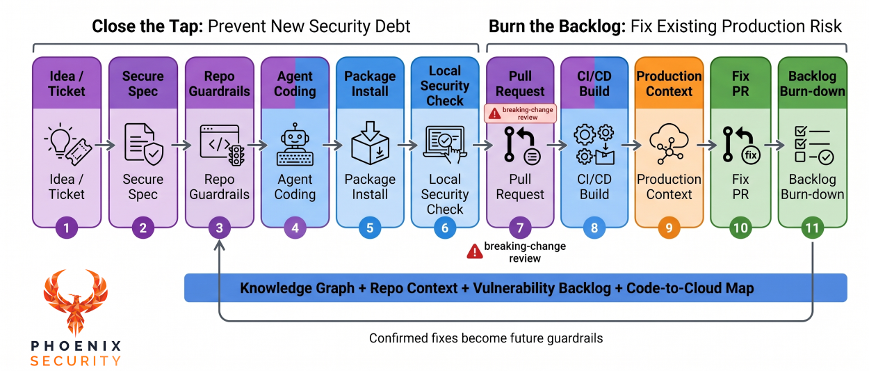
Burning down the backlog is a remediation-velocity problem. It depends on three things the clearinghouse leaves untouched: attributing the right asset to the right team, prioritizing metrics that reflect real exploitation, and bundling fixes so developers stop context switching.
Phoenix Orange handles the prioritization dimension: what is exploited in the wild, what is externally reachable, and where vulnerabilities chain together into an attack path worth more than the sum of its CVEs. Phoenix Green handles the act of remediation itself, which is the core value and the part everyone else skips.
Green does not remediate by generating tickets. Tickets are where fixes go to age. It acts where the code lives:
- SCA remediation happens per build file, directly in the repository, with fixes proposed as pull requests instead of routed into a backlog nobody burns down.
- SCA distinguishes breaking from non-breaking changes, so low-impact upgrades get combined and applied automatically while high-impact changes are surfaced with the priority they deserve.
- Patch campaigns run per set of assets, starting from the externally-facing surface and working back in, the same exposure-first logic BOD 26-04 encodes.
- Container work is scoped to what is actually running. A registry of 400,000 image vulnerabilities is meaningless if 95% of those images are not deployed; container lineage traces the vulnerability from source through build to the running workload and discards the rest.
- Cloud findings are correlated down to the key set of vulnerabilities that share an owner, an exposure path, or a fix.
Closing the tap is a code-analysis problem. New vulnerabilities enter faster than any team can clear old ones, and AI-generated code has widened the pipe. Phoenix Purple works at the source. It finds toxic combinations in code, the individually minor issues that become critical when chained, and it remediates at scale by bundling related fixes into fix groups. One review, one merge, many vulnerabilities closed. That is how you stop refilling the house while you are still trying to empty it.
The sequence matters. Context, then prioritization, then agent assistance. LLMs without context are expensive guessing machines. Phoenix agents (the Researcher for threat correlation, the Analyzer for reachability and exposure, the Remediator for fix bundling and ownership) activate only after findings are correlated, attributed, and prioritized. Gold Eagle’s own plan to triage with AI at intake inverts this: it applies AI before the environmental context that makes triage meaningful exists.
4. Where Phoenix Maps Onto Gold Eagle
Gold Eagle defines a pipeline the industry has needed for years: signal, context, prioritization, remediation, prevention, feedback. It builds the first stage well. Cross-sector signal and coordinated intelligence are exactly what a federal clearinghouse should own. The remaining stages happen inside your environment, and that is the ground Phoenix already covers. Read the two together, and Phoenix helps execute a national signal into a closed finding.
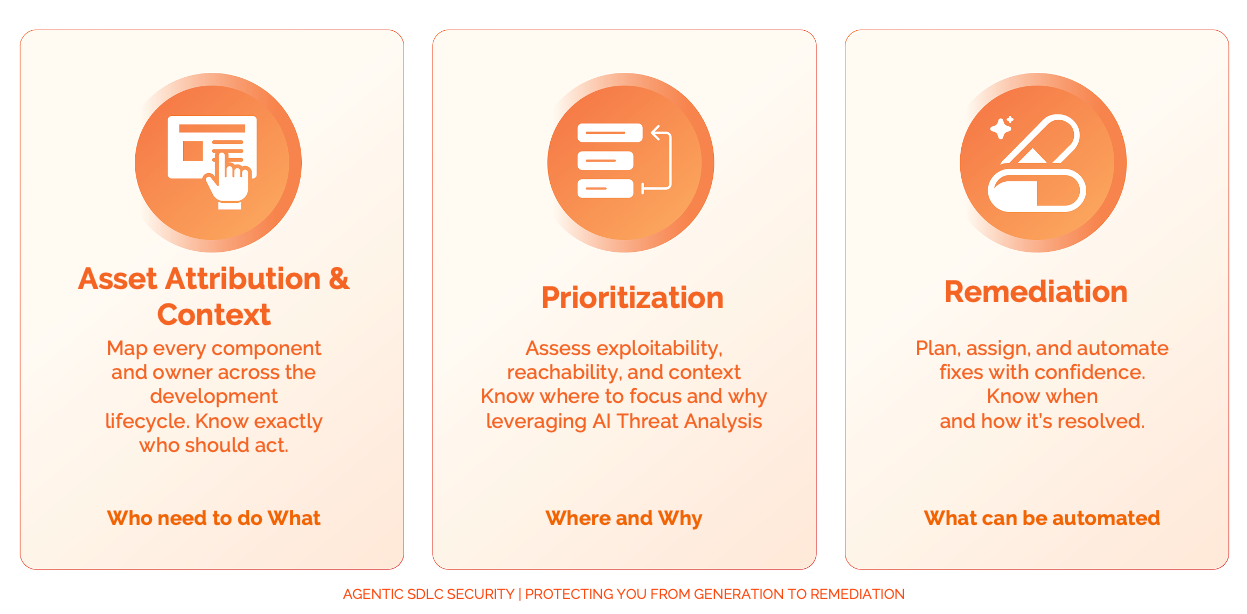
Phoenix Orange owns context and prioritization. It attributes the right vulnerabilities to the right team, correlates and deduplicates findings across scanners, and prioritizes across the four dimensions that matter: business impact, exposure, exploitation probability and exploitation in the wild, and code-to-cloud reachability. Those are the same four dimensions BOD 26-04 encodes, computed against your environment rather than a generic feed. Two of them, business impact and reachability, cannot be supplied by any external clearinghouse because they only exist inside your estate.
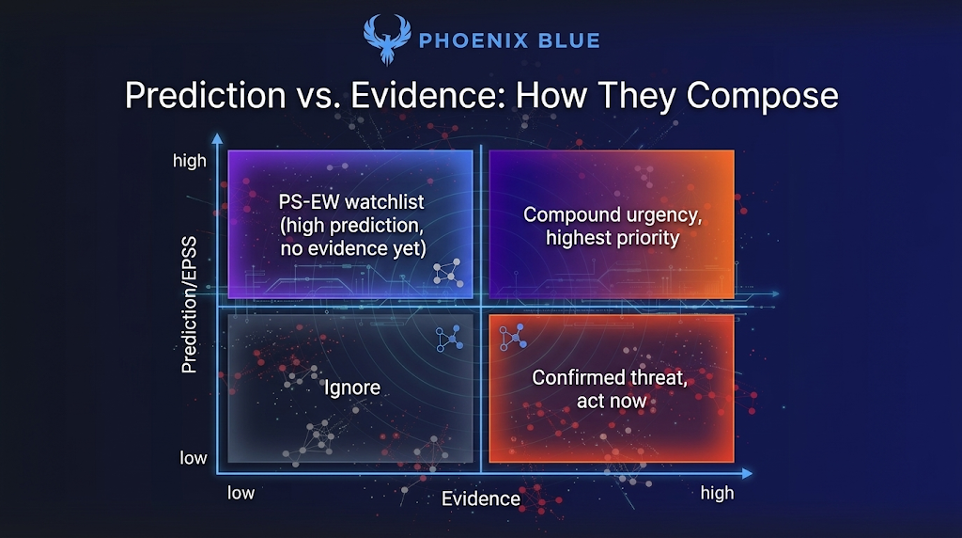
Phoenix Blue Intelligence is the enrichment layer underneath prioritization. Orange carries a basic version; Blue is the full feed. It answers the questions a prioritization decision actually turns on: what is the blast radius of a vulnerability class such as RCE or buffer overflow, which CVEs are exploited in the wild, and what the root cause is, delivered through one API and data feed. This is the layer that scores the classes of vulnerability that carry the biggest impact, which is the signal that Gold Eagle’s own model depends on.
Phoenix Green owns remediation. It groups vulnerabilities into remediation plans built around the largest available fix, then generates the pull request that carries the lowest friction and the biggest impact. Augmented remediation means the plan accounts for what breaks and what does not before it reaches a developer. Green Advanced, arriving in September, extends this to one-click assess-and-remedy from Orange, grounding each fix in threat modeling and research-backed remediation, and returning an execution path rather than a suggestion.
Phoenix Purple owns prevention and closes the tap. It is a full agentic scanner and remediator that finds vulnerabilities across SCA, SAST, secrets, containers, and IaC, tests them with DAST to confirm real exploitability, and proposes remediation grouped by effort: low friction, medium attention, close attention, delivered directly in a pull request. Purple AI Scanners extend the same engine to AI-native risk, mapping which models and prompts you use, how they can be chained, and how to remediate them. This is the AI BOM coverage Gold Eagle anticipates but does not yet address. Purple also finds zero-days and returns remediation guidance for them, not just detections.
Line them up against Gold Eagle’s pipeline, and the division of labor is clean. Gold Eagle provides cross-sector visibility and shared prioritization signals. Phoenix provides contextual prioritization inside the enterprise, automated remediation, exploit validation, and preventive controls at the developer level. Coordination without execution changes nothing. Execution without coordination lacks direction. The two compose into one pipeline, and the half that was always the constraint is the half Phoenix runs.
5. Real-World Example: What Remediation Velocity Looks Like
The difference between a routing layer and a remediation engine shows up in the numbers. In one deployment, contextual deduplication and reachability analysis compressed 467,000 container vulnerabilities to fewer than 8,000 actionable items, a 98% reduction in what teams had to touch. Ownership attribution meant those 8,000 items were assigned to the specific team responsible, not to a shared queue where they aged.
The mechanism was not faster discovery. Every one of those 467,000 findings had already been discovered; that was the problem. The mechanism was reachability filtering to remove what could not be exploited, lineage analysis to remove what was not running, and fix bundling to collapse what remained into a small number of remediation units. A clearinghouse could have handed the same team a beautifully prioritized list of 467,000 items. It would have changed nothing.
Remediation velocity is the only metric that measures progress toward what a clearinghouse claims to deliver. Findings identified is a vanity number. Findings closed, per owner, per unit of engineering time, is the one that moves risk.
6. Practical Guidance
Gold Eagle will send prioritized findings downstream. What you do with them on Monday morning is what determines your outcome.
Adopt the BOD 26-04 four-variable model now, regardless of whether you are a federal agency. Exposure, KEV status, exploit automation, and technical impact are better prioritization inputs than any CVSS score, and two of the four are specific to your environment, which means no external clearinghouse can compute them for you.
Attribute ownership before you scale discovery. A finding without an owner is not a finding; it is a notification. Map every asset to a team before you turn up the intake volume, or faster discovery just deepens the backlog.
Move remediation out of the ticketing system and into the repository. Propose fixes as pull requests against the build file. Separate breaking from non-breaking changes so you can auto-apply the safe upgrades and reserve human review for the ones that carry risk.
Run patch campaigns by asset set, with an external-facing first approach. Match your remediation order to your exposure, not to your scanner’s alphabetical output.
Scope container and cloud work to what is running and reachable. Discard vulnerabilities in images you do not deploy and code paths you do not execute before they ever reach a developer’s queue.
Next Steps
- Measure remediation velocity, meaning findings closed per owner per sprint, and make it the headline metric your board sees, above findings identified.
- Bundle fixes into groups at the code layer so one review closes many vulnerabilities, and catch toxic combinations before they ship rather than after they are cataloged.
- Treat any clearinghouse feed as an input to your remediation engine, never a substitute for one; the last mile is inside your environment, and it is the only mile that was ever the constraint.
Protect yourself with the latest threat intelligence, get access to PHOENIX BLUE Today
The data behind this article is available in full in the Phoenix Security Supply Chain Intelligence Report