Executive Summary
Apache Roller is a Java blog server. It runs as a WAR on Tomcat or a similar servlet container. Its XML-RPC endpoint deserializes attacker-supplied data while it parses the request, before it checks who sent it.
An unauthenticated remote attacker who can reach that endpoint can trigger Java deserialization. If the server has a usable gadget chain on its classpath, the attacker runs code as the Roller service account.
One defect has two identifiers. CVE-2026-82384 came out in September and named only 6.1.5. CVE-2026-129448 came out in November and added 4.0.0 through 6.1.4. The combined affected range is 4.0.0 through 6.1.5. The first fixed release is 6.1.6.
On November 17, 2026, the Apache Roller project stated that the issue lets an unauthenticated remote attacker run arbitrary code, and that it is being actively exploited. For now, Apache is the only source for the exploitation claim. Public proof-of-concept tooling has been out since late September. Internet-facing instances carry the most risk. The attack is one HTTP POST, with no account and no user interaction.
One detail causes missed fixes. Turning XML-RPC off in the Roller admin interface does not protect affected versions. The servlet is mapped unconditionally. It parses the request body, serialized object included, before it checks any setting. Owners who switched XML-RPC off and assumed they were safe are still exposed.
TL;DR for Engineering Teams
What it is: Unauthenticated pre-auth Java deserialization in the Apache Roller XML-RPC endpoint (CVE-2026-129448, also CVE-2026-82384). CWE-502, CVSS 3.1 base 9.8.
Where it bites: The /roller-services/xmlrpc endpoint in Roller 4.0.0 through 6.1.5, on any deployment where that path is reachable over the network. Internet-facing instances come first.
Why it matters: Apache confirms active exploitation. So far no other source confirms it independently. A weaponizable PoC has been public since about September 28, 2026. No credentials, no user interaction, CVSS 9.8. Whether code execution lands depends on the target JDK and the gadget libraries on its classpath. The deserialization itself happens on every affected version.
Patch status: Available. Fixed in 6.1.6. 6.1.7 (released November 11, 2026) is the recommended target and carries further fixes.
Immediate action: Upgrade to 6.1.7. If you cannot patch today, set enabledForExtensions to false in WEB-INF/web.xml or remove the /roller-services/xmlrpc servlet mapping. Then restart Roller. Do not rely on the admin UI toggle. Block the XML-RPC path at your proxy or WAF unless a desktop blogging client really needs it.
Vulnerability Overview
| Field | Value |
|---|---|
| Vendor | Apache Software Foundation |
| Product | Apache Roller |
| Vulnerability Type | Deserialization of untrusted data, pre-authentication |
| CWE | CWE-502 |
| CVSS Score | 9.8 (CVSS 3.1: AV:N/AC:L/PR:N/UI:N/S:U/C:H/I:H/A:H) |
| CVE | CVE-2026-129448 (primary), CVE-2026-82384 (same defect, 6.1.5 scope) |
| Patch Available | Yes (6.1.6, recommended 6.1.7) |
| Active Exploitation | Confirmed by Apache. Single source, no public IOCs yet |
Technical Anatomy
Root Cause
Roller ships the standard Apache ws-xmlrpc library, version 3.1.3, the same across all affected Roller releases. It wires the library’s XmlRpcServlet into WEB-INF/web.xml with the init parameter enabledForExtensions set to true.
That setting turns on the library’s non-standard vendor types. One of them is ex:serializable, which carries a base64-encoded Java serialized object. The servlet mapping to /roller-services/xmlrpc is unconditional.
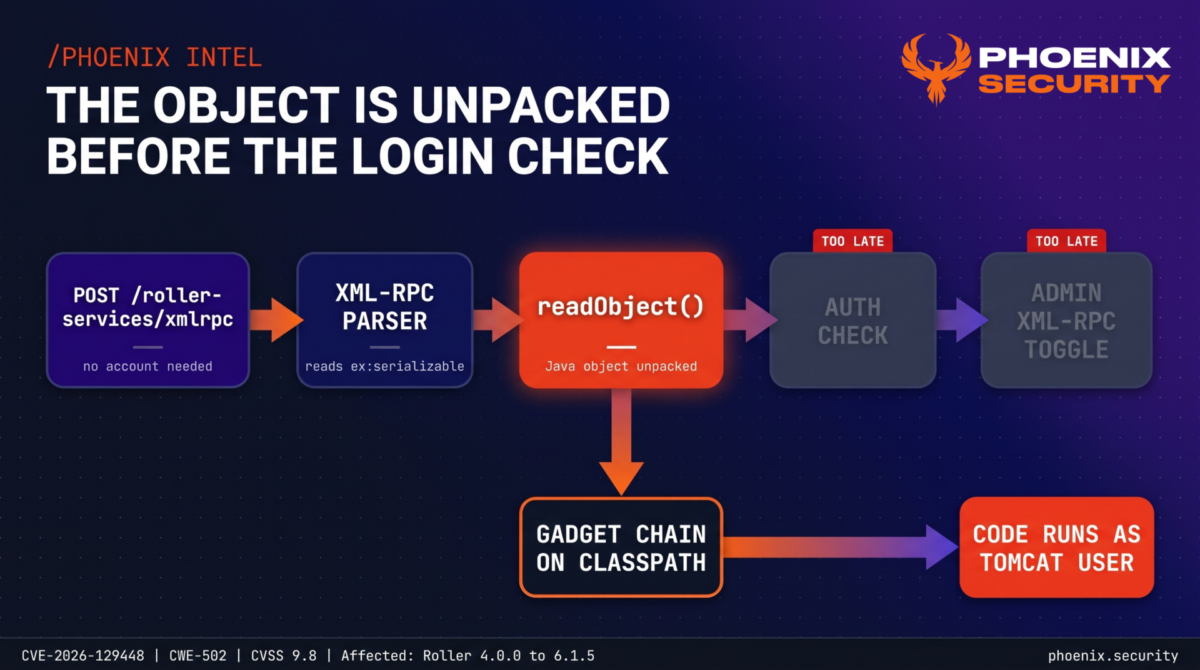
When a request arrives, the library parses the whole methodCall body before any handler runs. An ex:serializable element sends the decoded bytes into org.apache.xmlrpc.parser.SerializableParser, which calls ObjectInputStream.readObject(). That call is the sink.
It runs during parsing. So it runs before Roller authenticates the caller, and before the webservices.enableXmlRpc admin setting is read. Roller blogging credentials are parameters inside each method call. They are checked only after the body is parsed and the object is already deserialized. The method name does not matter.
The same library behavior caused the older CVE-2016-5003 in Apache ws-xmlrpc. This is a Roller configuration defect, not a new library bug. The unsafe path exists because Roller left vendor extensions on for an unauthenticated endpoint.
Exploit Path
- Entry point. The attacker sends an unauthenticated HTTP POST to
/roller-services/xmlrpc, or to/roller/roller-services/xmlrpcwhen Roller is not the root context, withContent-Type: text/xml. The body is a normal XML-RPCmethodCall. Its parameter is anex:serializableelement with a base64 Java object inside. Serialized payloads start withrO0AB, the base64 form of the Java serialization magic bytes. - Trigger. The library parses the extension element and passes the decoded bytes to
ObjectInputStream.readObject(). This happens inside request parsing, before authentication and before the feature toggle. The object graph is rebuilt from whatever classes sit on the server classpath. - Execution impact. If the classpath holds a usable gadget chain, deserialization drives it to arbitrary code execution as the Roller service account. From there, an attacker can read the database credentials in
roller-custom.properties, drop a JSP web shell underwebapps/, or move into the surrounding network. If no working chain is present, the attacker still has an unauthenticated deserialization primitive. That is a strong foothold and a reliable way to fingerprint a vulnerable host.
For triage: reachability is unconditional, but reliable code execution depends on the environment. Independent lab analysis found that a modern stock Roller install blocks the default ysoserial chains. commons-collections 3.2.2 carries the InvokerTransformer guard, and the JDK blocks the default TemplatesImpl sink.
Other gadget sources stay on a typical classpath, for example commons-beanutils and Spring. A working in-the-wild chain either avoids those two guards or targets an older runtime. Older Roller 4.x and 5.x builds on older JDKs are the softest targets. This article does not publish a working chain. Detection and mitigation are covered below.
Disclosure Timeline
| Date (2026) | Event |
|---|---|
| Aug 29 | Fix PR #171 opened on apache/roller |
| Sep 5 | PR #171 merged |
| ~Sep 24-27 | Roller 6.1.6 released, bundling this and 17 other CVE fixes |
| ~Sep 28 | CVE-2026-82384 published (scoped to 6.1.5); public PoC tooling appears |
| Nov 11 | Roller 6.1.7 released with further fixes |
| Nov 17 | CVE-2026-129448 published; Apache states active exploitation and expands range to 4.0.0-6.1.4 |
Dates for the September release and CVE publication vary by a few days across sources. The November 17 advisory date matches the CVE.org record and SecurityWeek.

Affected Versions
| Package | Vulnerable Versions | Fixed Version | Notes |
|---|---|---|---|
Apache Roller (org.apache.roller:roller) | 4.0.0 through 6.1.5 (inclusive) | 6.1.6 | 6.1.7 recommended. The combined range spans both CVE records; neither CVE alone states it in full. |
Apache ws-xmlrpc (org.apache.xmlrpc:xmlrpc) | 3.1.3 as shipped by Roller | Mitigated by Roller fix | The library version does not change across releases. The fix turns off vendor extensions in Roller; it does not upgrade the library. |
Ignore aggregator entries that list 6.1.5 as the fixed version. 6.1.5 is the version named by CVE-2026-82384, not a fix.
Exposure Analysis
| Environment | Risk Level | Reason |
|---|---|---|
| Internet-exposed Roller instances | Critical | Direct unauthenticated access to the sink; single POST, PoC public. |
| CI/CD and build hosts running Roller | High | Deserialization yields code execution and credential theft in a trusted zone. |
| Cloud workloads hosting Roller | High | Service-account code execution enables lateral movement and secret extraction. |
| Internal-only Roller instances | Medium | Exploitable only after the attacker has a network path to the endpoint. |
| Developer or staging Roller | Medium | Often forgotten and unpatched; credentials and tokens readable by the Tomcat user. |
We found no public internet scan count of exposed Roller instances, so any exposure figure here would be a guess. BleepingComputer and SC World describe Roller as a niche product with a small market share next to mainstream content management systems. A small install base does not make each instance safer. The attack is easy to automate, and mass-scan PoC tooling already exists.
One inventory trap matters for scanning teams. Roller ships as a WAR from the Apache project. It is not resolved as a Maven Central dependency. SCA tools that only read pom.xml or lockfiles will usually miss live deployments. Inventory has to run against deployed servlet hosts, not just manifests.
Real-World Impact
Apache’s own statement is the only evidence of exploitation. It is credible: it comes from the vendor, and a weaponizable PoC had been public for about seven weeks before the notice. Treat the claim as reliable for prioritization, but know its limits.
Apache did not share a first-seen date, a victim count, attacker infrastructure, or forensic indicators. News coverage from The Hacker News, BleepingComputer, SecurityWeek, and Security Affairs traces back to that one Apache notice, not to separate incident data. None of it is independent confirmation yet.
There is no credible attribution. As of November 19, 2026, no source we reviewed links this to a ransomware group, state actor, botnet, or named malware family. The researchers credited by Apache (n0mi1k as finder, Matt Raible as reporter) are not attackers.
On a compromised instance, realistic attacker goals include:
- Pulling the Roller database and mail or LDAP credentials
- Deploying a JSP web shell for persistence
- Collecting any cloud or deploy secrets the service account can read
- Using the host to move into nearby network segments
Detection Guidance
Log Indicators
Search proxy, WAF, and application access logs for any POST to /roller-services/xmlrpc or /roller/roller-services/xmlrpc. Pay attention to sources that never run desktop blogging clients, and to unusually large bodies.
Inspect request bodies for these strings: ex:serializable, the extensions namespace http://ws.apache.org/xmlrpc/namespaces/extensions, and the serialized-object prefix rO0AB.
On the response side, the string Failed to load class for result object means a vulnerable server deserialized untrusted input. That is a strong sign of probing or exploitation against an affected host.
On the host, alert on:
- Child processes of the Tomcat JVM such as
sh,bash,curl,wget,python, orpowershell.exe - New or modified
.jspfiles underwebapps/ - Unexpected outbound connections from the Tomcat service account
- New Roller admin accounts
Scanner References
Phoenix Security correlates affected Roller deployments across SCA, SBOM, and attack surface signals and maps them to the owning team. Add to that:
- SBOM analysis for the
org.apache.roller:rollerandorg.apache.xmlrpc:xmlrpccoordinates - External attack surface scanning for exposed
/roller-services/xmlrpcendpoints - A safe, non-destructive endpoint probe. A
system.listMethodscall to a patched 6.1.6+ instance with XML-RPC disabled returns HTTP 404 with the messageXML-RPC service is disabled.
Public detection content is circulating: Sigma-style rules, a ModSecurity rule, and non-RCE reachability scanners. Check that any rule matches ex:serializable, not just the path. Otherwise it will flood on normal MetaWeblog traffic.
Verification Steps for Teams
- Inventory every deployed Roller WAR on Tomcat or servlet hosts. Include old 4.x and 5.x builds. The September advisory named only 6.1.5, so owners may have dismissed them.
- On each host, run the two checks below. Any
truevalue forenabledForExtensionsmeans the instance is exposed. AXmlRpcEnabledFiltercount of0means a pre-6.1.6 build.
bash
grep -A1 'enabledForExtensions' WEB-INF/web.xml
grep -c 'XmlRpcEnabledFilter' WEB-INF/web.xml- Scan your external attack surface for reachable
/roller-services/xmlrpcendpoints. - Review SBOM output for the Roller and ws-xmlrpc coordinates across all applications, transitive inclusion included.
Remediation Guidance
Immediate Actions
- Upgrade to Roller 6.1.7 (minimum 6.1.6). This is the only complete fix. The patch turns off vendor extensions on the servlet. It also adds a filter that returns 404 before the body is read when XML-RPC is disabled.
- Investigate exposed hosts. Treat any internet-reachable instance exposed since at least September 28, 2026 as a compromise investigation. Keep application, proxy, and host logs and a disk snapshot. Hunt the indicators above. Rebuild from a clean image rather than patching in place.
- Rotate secrets the Roller service account can reach. That means database credentials in
roller-custom.properties, mail and LDAP credentials, and any cloud, SSH, or deploy keys the Tomcat user can read.

Temporary Mitigations
If you cannot patch right away, apply Apache’s interim guidance. Set enabledForExtensions to false in WEB-INF/web.xml, or remove the /roller-services/xmlrpc servlet mapping. Then restart Roller.
Apache is clear that turning XML-RPC off in the admin UI is not enough. Affected versions deserialize the request before they read that setting.
At the edge, block POST /roller-services/xmlrpc at your reverse proxy or WAF. If a desktop blogging client needs the path, allowlist only those source addresses.
Low EPSS scores and the missing CISA KEV listing lag behind here. Vendor-confirmed exploitation and a CVSS 9.8 pre-auth RCE outweigh both.
Phoenix Security Recommendations
Phoenix Security turns a scattered Roller exposure into one owned, tracked remediation effort.
Contextual deduplication joins findings for the same Roller instance across SCA, SBOM, and attack surface scanners. You get one prioritized item, not a pile of duplicates.
Reachability and exposure analysis shows which affected deployments actually expose /roller-services/xmlrpc to a network path. Teams fix the internet-facing instances first instead of chasing every match equally.
Attack surface management surfaces the exposed endpoints an external scanner would find.
Vulnerability ownership attribution maps each affected deployment to the responsible team automatically.
A remediation campaign lets you create the effort, assign owners, track the upgrade to 6.1.7, and confirm that runtime exposure is closed.
The signal for this flaw comes from deployment-level detection, not a clean dependency manifest. A low heuristic score on any single feed does not mean low risk. Phoenix puts those signals together in one view.
Phoenix Campaign: APACHE_ROLLER_XMLRPC_RCE
We built a ready campaign for this vulnerability. Load it into Phoenix and matching findings land in one remediation campaign, mapped to the teams that own them.
The campaign filter:
| Filter | Value |
|---|---|
| Campaign name | APACHE_ROLLER_XMLRPC_RCE |
| Scanner category | SCA |
| CWE | CWE-502 (Deserialization of Untrusted Data) |
| Severity | Critical |
| CVSS vector | CVSS:3.1/AV:N/AC:L/PR:N/UI:N/S:U/C:H/I:H/A:H |
| Libraries | org.apache.roller:roller (4.0.0), org.apache.xmlrpc:xmlrpc (3.1.3) |
json
"filters": [{
  "cwes": [502],
  "cvssVector": "CVSS:3.1/AV:N/AC:L/PR:N/UI:N/S:U/C:H/I:H/A:H",
  "severityLevels": ["CRITICAL"],
  "scannerCategory": "SCA",
  "libraries": [
    { "name": "org.apache.roller:roller", "version": "4.0.0" },
    { "name": "org.apache.xmlrpc:xmlrpc", "version": "3.1.3" }
  ]
}]
The config also carries two briefs. The executive threat brief is for CISOs: what is affected, business impact, and actions for the next 24 to 72 hours. The structured report is for threat intel and senior security engineers: attack vector, payload, IOCs, and detections.
The campaign works on SCA and SBOM findings. Roller WAR installs that no manifest lists will not show up there. Run the host inventory steps above alongside it.
External References
- CVE-2026-129448 record on CVE.org
- CVE-2026-82384 record on CVE.org
- Apache Roller security advisory on the ASF mailing list
- Apache Roller 6.1.6 release announcement with 18 security fixes
- Fix PR #171 on apache/roller: disable vendor extension types on the XML-RPC servlet
- GitHub Advisory GHSA-4gqp-296r-j5mq on ws-xmlrpc deserialization
- BleepingComputer: Apache warns of Roller RCE vulnerability exploited in attacks
- SecurityWeek: Critical Apache Roller, Axis vulnerabilities exploited in attacks