Phoenix Security + Google Cloud Platform: ASPM for Smarter Application Security and Cloud Vulnerability Management

Phoenix Security Available on GCP

Phoenix Security is now officially available on the Google Cloud Platform (GCP) Marketplace, giving organizations a faster path to deploy ASPM (Application Security Posture Management) and AI-powered vulnerability management across modern, cloud-native environments.

This launch simplifies how DevSecOps and security teams protect complex application ecosystems. With a few clicks, customers can deploy Phoenix directly within GCP, gaining unified visibility and automated remediation from code to cloud — without disrupting developer velocity.

Unified Context Across Code, Cloud, and Containers

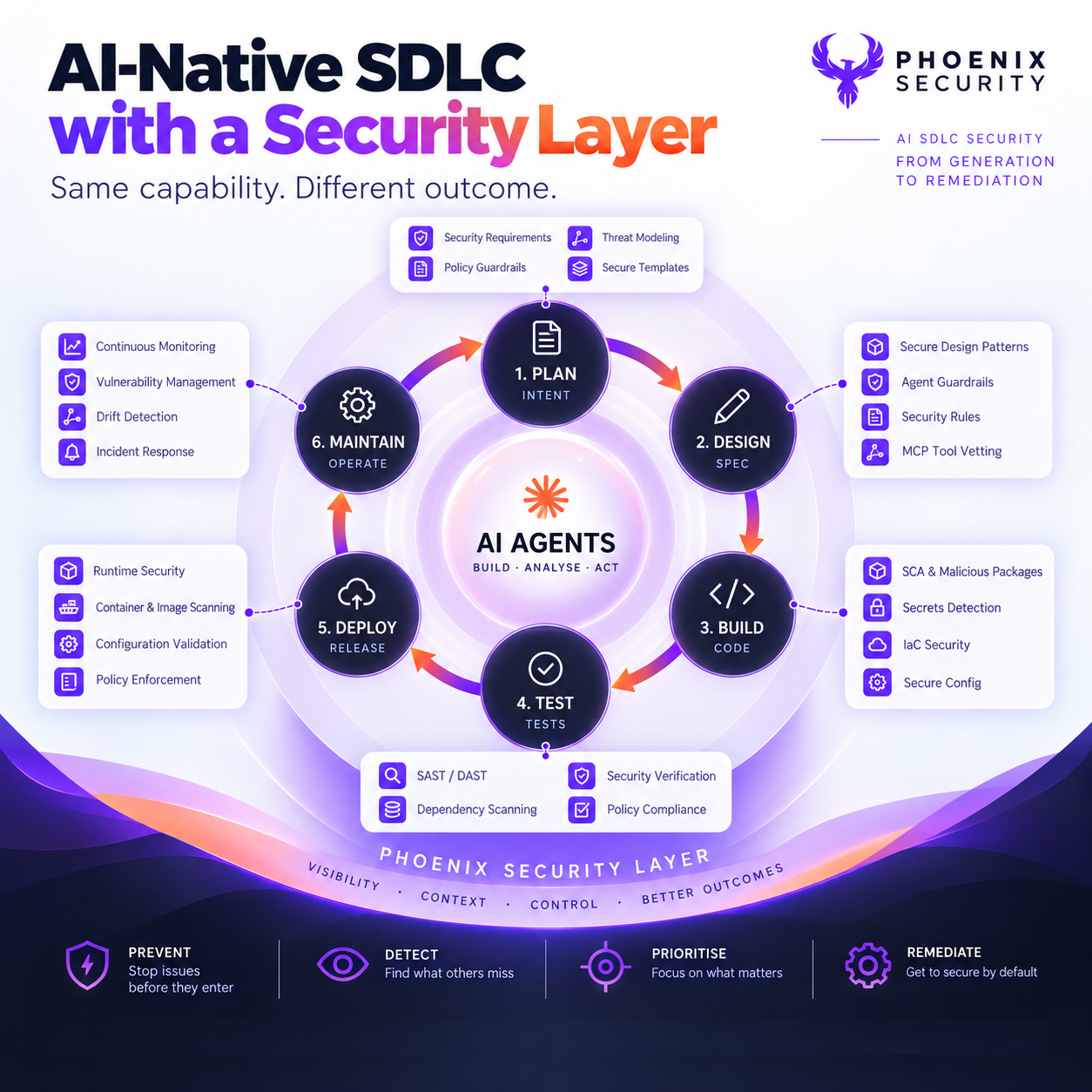
Phoenix Security ingests data from repositories, CI/CD pipelines, containers, and cloud assets to build a live, contextual view of every vulnerability. By mapping ownership automatically through YAML definitions and integrations with tools like ServiceNow, Backstage, and Okta, Phoenix eliminates the guesswork of who owns what.

Every finding is enriched with business impact, exploitability, and exposure data, enabling teams to prioritize the risks that matter most. This is true ASPM application security vulnerability management — adaptive, data-driven, and ready for automation.

Fixing Vulnerabilities Faster with AI-Driven Remediation

Security teams can now move beyond triage. Phoenix Security’s AI Remediation Agent suggests and validates fixes directly in GitHub, merging verified patches securely through existing workflows. Combined with GCP’s scalability, enterprises can transform remediation from a bottleneck into a continuous process that keeps pace with cloud deployments.

With Phoenix Security on Google Cloud, organizations can:

  • Deploy in minutes through the Google Cloud Marketplace
  • Unify visibility across multi-cloud and hybrid environments
  • Detect and remediate cloud misconfigurations before they become incidents
  • Empower developers through DevSecOps automation that aligns with existing pipelines
  • Enhance compliance posture with clear, auditable risk reduction metrics

Security that Moves as Fast as the Cloud

“Security teams want precision, not more noise,” said Francesco Cipollone, CEO of Phoenix Security. “Our collaboration with Google Cloud brings together the scalability of GCP with Phoenix’s ASPM engine — giving organizations a clear path from detection to verified fix, faster than ever.”

Phoenix Security’s availability on GCP Marketplace and feature on the Gemini marketplace reflects its commitment to helping organizations fix what truly matters, enabling secure innovation through automation, collaboration, and risk-based intelligence.

Explore Phoenix Security on the Google Cloud Marketplace or discover how the Phoenix ASPM platform unifies vulnerability management, DevSecOps visibility, and cloud misconfiguration remediation at scale.

Deploy Phoenix Security todayPhoenix Security ASPM-UVM


The information in this article is also available in greater detail in the eBook – A threat-centric approach on vulnerabilities.

AI, LLM, Threat Centric, Phoenix Security, Application Security, ASPM, Cybersecurity, AI for Cybersecurity, LLM

Download the eBook on LLM Application for a Threat-Centric Approach on Vulnerabilities

Alfonso brings experience running international teams for multi-million dollar, technologically advanced projects for Telefónica, IBM and Vodafone. Alfonso joins with two decades of experience working for tech leaders, including at Dell EMC, Yahoo! and Intershop.

Discuss this blog with our community on Slack

Join our AppSec Phoenix community on Slack to discuss this blog and other news with our professional security team

From our Blog

A typosquatted npm dependency called easy-day-js — an exact metadata clone of the legitimate dayjs library — was injected across 144 @mastra packages in an 88-minute automated publishing window, reaching over 1.1 million weekly downloads. The second-stage payload is a cross-platform RAT that installs OS-level persistence on Windows, macOS, and Linux and targets LLM API keys, cloud credentials, and 166 cryptocurrency wallet extensions. No CVE was assigned; every CVE-based scanner was blind during active exploitation.
Sarah Mitchell
Phoenix Security has launched Blue Shield, a behavioural supply chain firewall that blocks malicious packages and AI agent skills at the point of install — across the developer workstation, CI/CD pipeline, and agent session. Built on the Phoenix Blue intelligence backbone, which has tracked 59 campaigns and 657 malicious package versions since June 2024 with zero CVEs assigned during active exploitation, Blue Shield’s free core tier is open today at phxintel.security
Francesco Cipollone
TeamPCP (UNC6780) released Miasma in June 2026: a self-spreading worm that injects itself into the SessionStart hooks of 13 AI coding tools including Claude Code, GitHub Copilot, and Gemini CLI. It forges SLSA provenance signatures to pass npm audit checks, uses GitHub itself as a command-and-control channel, and carries a DEADMAN_SWITCH that wipes developer machines if tokens are revoked before network isolation. Zero CVEs assigned. Every standard scanner returns clean.
Francesco Cipollone
The Miasma worm crossed two new boundaries in 48 hours: GitHub’s automated enforcement disabled 73 Microsoft repositories in 105 seconds after AI coding agent hooks were planted in Azure/durabletask, then 37 malicious PyPI wheels hit 19 packages with .pth startup hooks that steal credentials on every Python invocation. 448 total artifacts tracked. Zero CVEs assigned across the entire campaign.
Marcus Webb
Phoenix Security’s Malware Package Intelligence corpus documents 59 supply chain campaigns and 657 malicious package IOCs across npm, PyPI, VS Code, and AI agent tooling from June 2024 through June 2026. The first half of 2026 alone produced 4.5 times the package volume of all 2025 — driven by self-propagating worms, AI assistant config poisoning, and a compiled Rust implant with an eBPF rootkit. Every single campaign: zero CVEs assigned during active exploitation.
Francesco Cipollone
Contents
Derek

Derek Fisher

Head of product security at a global fintech

Derek Fisher – Head of product security at a global fintech. Speaker, instructor, and author in application security.

Derek is an award winning author of a children’s book series in cybersecurity as well as the author of “The Application Security Handbook.” He is a university instructor at Temple University where he teaches software development security to undergraduate and graduate students. He is a speaker on topics in the cybersecurity space and has led teams, large and small, at organizations in the healthcare and financial industries. He has built and matured information security teams as well as implemented organizational information security strategies to reduce the organizations risk.

Derek got his start in the hardware engineering space where he learned about designing circuits and building assemblies for commercial and military applications. He later pursued a computer science degree in order to advance a career in software development. This is where Derek was introduced to cybersecurity and soon caught the bug. He found a mentor to help him grow in cybersecurity and then pursued a graduate degree in the subject.

Since then Derek has worked in the product security space as an architect and leader. He has led teams to deliver more secure software in organizations from multiple industries. His focus has been to raise the security awareness of the engineering organization while maintaining a practice of secure code development, delivery, and operations.

In his role, Jeevan handles a range of tasks, from architecting security solutions to collaborating with Engineering Leadership to address security vulnerabilities at scale and embed security into the fabric of the organization.

Jeevan Singh

Jeevan Singh

Founder of Manicode Security

Jeevan Singh is the Director of Security Engineering at Rippling, with a background spanning various Engineering and Security leadership roles over the course of his career. He’s dedicated to the integration of security practices into software development, working to create a security-aware culture within organizations and imparting security best practices to the team.
In his role, Jeevan handles a range of tasks, from architecting security solutions to collaborating with Engineering Leadership to address security vulnerabilities at scale and embed security into the fabric of the organization.

James

James Berthoty

Founder of Latio Tech

James Berthoty has over ten years of experience across product and security domains. He founded Latio Tech to help companies find the right security tools for their needs without vendor bias.

christophe

Christophe Parisel

Senior Cloud Security Architect

Senior Cloud Security Architect

Chris

Chris Romeo

Co-Founder
Security Journey

Chris Romeo is a leading voice and thinker in application security, threat modeling, and security champions and the CEO of Devici and General Partner at Kerr Ventures. Chris hosts the award-winning “Application Security Podcast,” “The Security Table,” and “The Threat Modeling Podcast” and is a highly rated industry speaker and trainer, featured at the RSA Conference, the AppSec Village @ DefCon, OWASP Global AppSec, ISC2 Security Congress, InfoSec World and All Day DevOps. Chris founded Security Journey, a security education company, leading to an exit in 2022. Chris was the Chief Security Advocate at Cisco, spreading security knowledge through education and champion programs. Chris has twenty-six years of security experience, holding positions across the gamut, including application security, security engineering, incident response, and various Executive roles. Chris holds the CISSP and CSSLP certifications.

jim

Jim Manico

Founder of Manicode Security

Jim Manico is the founder of Manicode Security, where he trains software developers on secure coding and security engineering. Jim is also the founder of Brakeman Security, Inc. and an investor/advisor for Signal Sciences. He is the author of Iron-Clad Java: Building Secure Web Applications (McGraw-Hill), a frequent speaker on secure software practices, and a member of the JavaOne Rockstar speaker community. Jim is also a volunteer for and former board member of the OWASP foundation.

Join our Mailing list!

Get all the latest news, exclusive deals, and feature updates.

The IKIGAI concept
Protected By
Shield Security PRO