
AI-Driven Vulnerability Intelligence | Phoenix Security
VISION
REAL-TIME
PRECISE
Phoenix Blue

Predictive Vulnerability Intelligence Grounded in Reality

Phoenix Research · Intelligent Crawlers · Threat-Centric Scoring

300K CVEs. 800K vulnerabilities linked to active malware. Speed of attack: under 1 hour. One question that matters: which ones are actually coming for you? Phoenix tracks exploitation velocity, blast radius, and attacker behaviour — so your team and agents work the right list, not the longest one.

Watch Demo ↓
+THREAT-CENTRIC
+REAL-TIME INTEL
+VULNCHECK DATA
+VALERIAN AI SCORING
+CISA KEV
+EXPLOIT CONTEXT
+AGENTIC RESEARCH
+ZERO-DAY COVERAGE
+GITHUB POCS
+RANSOMWARE TRACKING
+THREAT-CENTRIC
+REAL-TIME INTEL
+VULNCHECK DATA
+VALERIAN AI SCORING
+CISA KEV
+EXPLOIT CONTEXT
+AGENTIC RESEARCH
+ZERO-DAY COVERAGE
+GITHUB POCS
+RANSOMWARE TRACKING

The Patch Window
Is Gone

In 2018 you had a year to respond after a CVE dropped. Today the median is under a week — and 67.2% of exploited vulnerabilities get weaponized before a patch even exists. By the time CISA adds something to KEV, attackers have usually been running it for days.

2018
>1 year

Disclosure to exploitation, on average.
Zero-days: 16.1% of all exploited CVEs.

2026
<1 week

Median time to exploitation now.
Zero-days: 67.2% of all exploited CVEs.

False Urgency

Paper Tigers

CVSS 9.8. Niche library. No external exposure. No exploit code anywhere. But it's “critical” — so the team drops everything to patch it. This is how backlogs pile up and engineers burn out. The score is high. The risk is not.

False Calm

Silent Killers

VPN gateway. Low EPSS score at disclosure. Nobody panics. Six weeks later it's in every ransomware playbook. High blast radius, no public exploit yet — exactly the gap attackers count on. Most tools miss this entirely.

Fast Reaction on Real Intelligence

Phoenix scores every CVE on a 0–100 composite: exploitation evidence (CISA/VulnCheck KEV, mass-scan telemetry, ransomware links, bug bounty data), blast radius in your specific environment, attacker behaviour, and speed of exploitation. A CVSS 10.0 with no attacker interest scores low. A VPN vulnerability with confirmed exploitation and high blast radius goes straight to Critical — Tier 1, patch in 24–48 hours.

For the 37% of high-blast-radius CVEs without exploitation evidence yet, Phoenix builds a watchlist with predicted exploitation timing. You get ahead of the attack, not behind it.

Filtering the Noise
1,000 CVEs → ~50 that actually matter
Subject A - The Ghost
CVSS 9.8, score 25/100 — Tier 4: Monitor
Subject B - The Killer
CVSS 9.8, score 95/100 — Tier 1: Act now

Four Risk Surfaces.
One Platform.

Each area has its own scoring model. Product CVEs behave differently from open-source dependencies. Zero-days need different signal than known exploits. Phoenix handles all four without treating them the same.

Product Vulnerability & EOL

Product Vulnerabilities & End-of-Life

CVEs in your product inventory, scored against active exploitation data. EOL flags surface before the software becomes a permanently unpatched entry point.

Result: A short, prioritized list — not a dump of everything tagged “critical” in NVD.
Libraries & EOL

Open-Source Libraries & Dependencies

Open-source vulnerabilities spread through dependency trees, not single products. Phoenix uses OpenSSF Criticality Score and tracks packages that keep getting compromised.

Result: Dependency risk ranked by ecosystem impact, not raw CVSS. License flags included.
Zero-Day Detection

Zero-Day & In-the-Wild Threats

67.2% of exploited CVEs get used before a patch drops. The Exploit Acceleration Index measures how fast exploitation is spreading across internet telemetry — and escalates automatically.

Result: Zero-days hitting the 0–24h window go to Tier 1 immediately. No manual triage required.
Agentic AI Analysis

AI-Driven Scoring & Enrichment

Phoenix advisory analysis surfaces vulnerability details normally hidden in standard feeds — CVE context, attacker patterns, and exploitation chains. Combined with a scoring system that weights high-quality intel over noise, every CVE gets a composite score built on evidence, not guesswork.

Result: A live composite score per CVE. Evidence, blast radius, likelihood, and speed pressure in one number.
Library Firewall

Library Firewall & Malware Scanner

Phoenix scans every library your code pulls in — catching malicious packages like compromised axios versions or sha1-hulud before they enter your environment. Customizable firewall rules block by package, version, or behaviour pattern. Malware intelligence ingestion to detection: under 15 minutes.

Result: Your supply chain stays clean. Threats blocked before they reach your codebase.

The Database,
Live

Open access for security practitioners before you commit to Phoenix. Explore the data, run your CVEs, see how the scoring works.
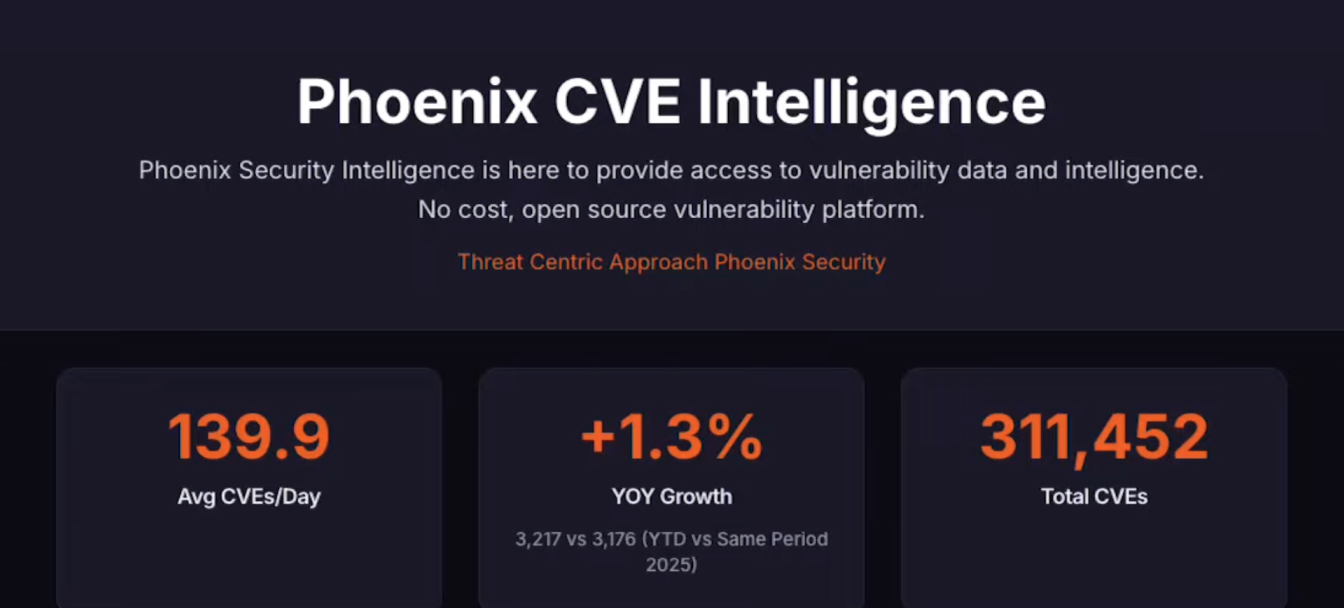
Phoenix CVE Intelligence Dashboard
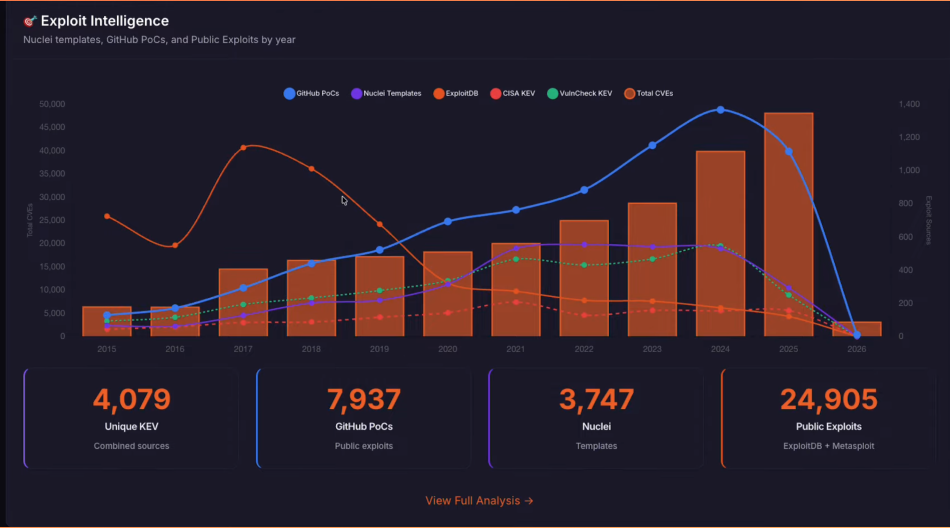
Exploits by Year
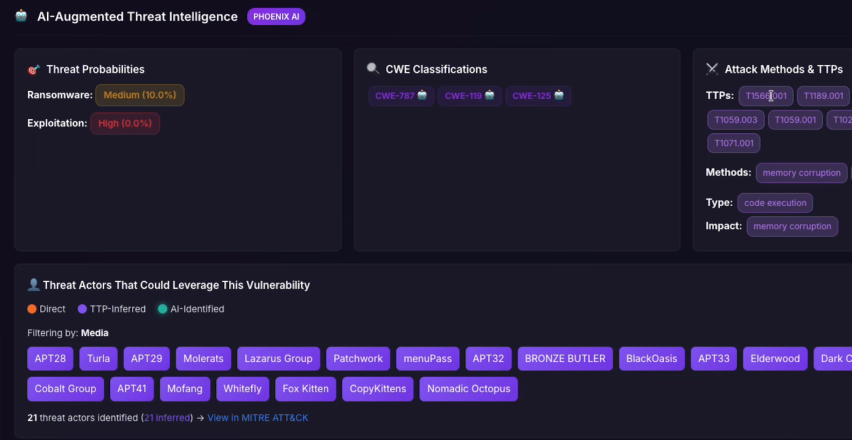
AI Threat Intelligence
311,452Total CVEs Tracked
210Ransomware CVEs
67.2%Zero-Day Rate 2026
<1 weekMedian TTE Today

Watch Before
You Decide

See how Phoenix Blue scores CVEs in real time, catches zero-days before they hit KEV, and cuts 1,000 vulnerabilities down to the 50 that actually matter.

The Scoring Model,
Explained

Whitepaper cover
Whitepaper

A Threat-Centric Approach on Vulnerabilities Leveraging AI & LLMs

The full breakdown of how Phoenix applies LLMs to vulnerability scoring — moving past EPSS and scaling to CVE volumes that human analysts can't cover.

Download Whitepaper →

CVSS tells you how bad a vulnerability could be in the worst-case scenario. It says nothing about whether anyone is actually exploiting it, whether your infrastructure is in the blast radius, or how fast the situation is moving.

This paper walks through what Phoenix measures instead — and why the difference matters when your team has to decide what to fix this week.

Our
Data Partners

Proprietary Threat Intelligence
Malware Analysis Engine
Exploit & KEV Intelligence
AI Re-scoring Engine
Known Exploited Vulnerabilities
Community Vulnerability Reports
Zero-Day Research

Try It Before
You Buy Anything

Early access is open to security practitioners, researchers, and engineering leaders. No sales call required. Explore the database, run your CVEs, see if the scoring makes sense for your environment.

Security Practitioners
Researchers
Engineering Leaders

Access granted on a rolling basis.

Request Access

Leave your details. We'll send credentials when your spot is ready.

Rolling access · Limited spots

Derek

Derek Fisher

Head of product security at a global fintech

Derek Fisher – Head of product security at a global fintech. Speaker, instructor, and author in application security.

Derek is an award winning author of a children’s book series in cybersecurity as well as the author of “The Application Security Handbook.” He is a university instructor at Temple University where he teaches software development security to undergraduate and graduate students. He is a speaker on topics in the cybersecurity space and has led teams, large and small, at organizations in the healthcare and financial industries. He has built and matured information security teams as well as implemented organizational information security strategies to reduce the organizations risk.

Derek got his start in the hardware engineering space where he learned about designing circuits and building assemblies for commercial and military applications. He later pursued a computer science degree in order to advance a career in software development. This is where Derek was introduced to cybersecurity and soon caught the bug. He found a mentor to help him grow in cybersecurity and then pursued a graduate degree in the subject.

Since then Derek has worked in the product security space as an architect and leader. He has led teams to deliver more secure software in organizations from multiple industries. His focus has been to raise the security awareness of the engineering organization while maintaining a practice of secure code development, delivery, and operations.

In his role, Jeevan handles a range of tasks, from architecting security solutions to collaborating with Engineering Leadership to address security vulnerabilities at scale and embed security into the fabric of the organization.

Jeevan Singh

Jeevan Singh

Founder of Manicode Security

Jeevan Singh is the Director of Security Engineering at Rippling, with a background spanning various Engineering and Security leadership roles over the course of his career. He’s dedicated to the integration of security practices into software development, working to create a security-aware culture within organizations and imparting security best practices to the team.
In his role, Jeevan handles a range of tasks, from architecting security solutions to collaborating with Engineering Leadership to address security vulnerabilities at scale and embed security into the fabric of the organization.

James

James Berthoty

Founder of Latio Tech

James Berthoty has over ten years of experience across product and security domains. He founded Latio Tech to help companies find the right security tools for their needs without vendor bias.

christophe

Christophe Parisel

Senior Cloud Security Architect

Senior Cloud Security Architect

Chris

Chris Romeo

Co-Founder
Security Journey

Chris Romeo is a leading voice and thinker in application security, threat modeling, and security champions and the CEO of Devici and General Partner at Kerr Ventures. Chris hosts the award-winning “Application Security Podcast,” “The Security Table,” and “The Threat Modeling Podcast” and is a highly rated industry speaker and trainer, featured at the RSA Conference, the AppSec Village @ DefCon, OWASP Global AppSec, ISC2 Security Congress, InfoSec World and All Day DevOps. Chris founded Security Journey, a security education company, leading to an exit in 2022. Chris was the Chief Security Advocate at Cisco, spreading security knowledge through education and champion programs. Chris has twenty-six years of security experience, holding positions across the gamut, including application security, security engineering, incident response, and various Executive roles. Chris holds the CISSP and CSSLP certifications.

jim

Jim Manico

Founder of Manicode Security

Jim Manico is the founder of Manicode Security, where he trains software developers on secure coding and security engineering. Jim is also the founder of Brakeman Security, Inc. and an investor/advisor for Signal Sciences. He is the author of Iron-Clad Java: Building Secure Web Applications (McGraw-Hill), a frequent speaker on secure software practices, and a member of the JavaOne Rockstar speaker community. Jim is also a volunteer for and former board member of the OWASP foundation.

Join our Mailing list!

Get all the latest news, exclusive deals, and feature updates.

The IKIGAI concept
x  Powerful Protection for WordPress, from Shield Security PRO
This Site Is Protected By
Shield Security PRO